FemiCore Ingredients List: All 9 and What Each One Does
Nine names on a label tell you less than you might think. Here is each FemiCore ingredient in plain terms: what it is, why a bladder formula would include it, how strong the research is, and the numbers the label keeps to itself.
- Written by
- HealthCure Guide Editorial Team
- Reviewed by
- HealthCure Guide Editorial Team
- Updated
- Reading time
- 8 min read
This guide contains affiliate links. If you buy through them we earn a commission at no extra cost to you. It does not change the verdict. Disclosure.
The FemiCore ingredients list is short enough to read in ten seconds, and that is part of the problem. Nine names do not tell you which ones carry the formula, which are there for support, or which have barely been studied in people. This guide takes each ingredient in turn and answers four questions: what it is, why a bladder and urinary supplement would include it, what the research actually shows, and the one safety point worth knowing.
We have no link to the manufacturer. Store links on this page are affiliate links, which means we earn a commission if you order, at no extra cost to you.
The FemiCore ingredients list at a glance
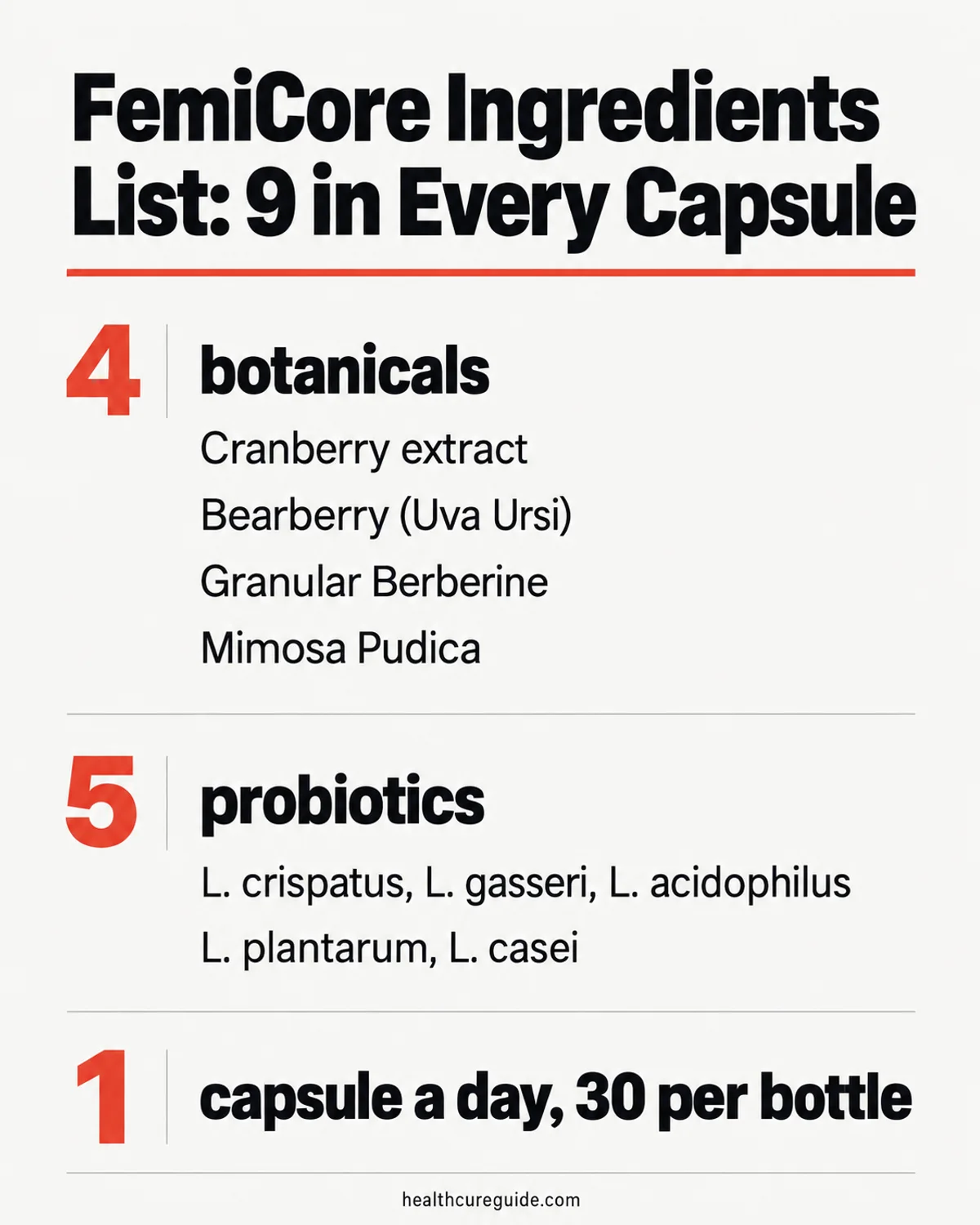
Each capsule contains the same nine ingredients. The bottle holds 30 capsules and the directions are one capsule a day, in the morning with water.
| Ingredient | Type | Main reason it is in the formula | Strength of human evidence |
|---|---|---|---|
| Cranberry extract | Fruit extract | Urinary tract defence | Strongest of the nine (for UTI prevention) |
| Lactobacillus crispatus | Probiotic | Dominant “good” species in the female urogenital tract | One relevant randomised trial |
| Lactobacillus gasseri | Probiotic | Another urogenital species | Indirect |
| Lactobacillus acidophilus | Probiotic | Lactic acid producer, widely used | Indirect |
| Lactobacillus plantarum | Probiotic | Hardy gut species | Indirect |
| Lactobacillus casei | Probiotic | Gut and general probiotic use | Indirect |
| Bearberry (Uva Ursi) | Leaf extract | Traditional urinary herb | Limited |
| Granular Berberine | Plant alkaloid | Gut microbiome and antimicrobial effects | Mechanism studies, not bladder trials |
| Mimosa Pudica | Herb | Traditional use for urinary complaints | Traditional only |
“Indirect” here means the species is well studied as a probiotic in general, but there is no trial of it for bladder symptoms.
What the label tells you, and what it leaves out
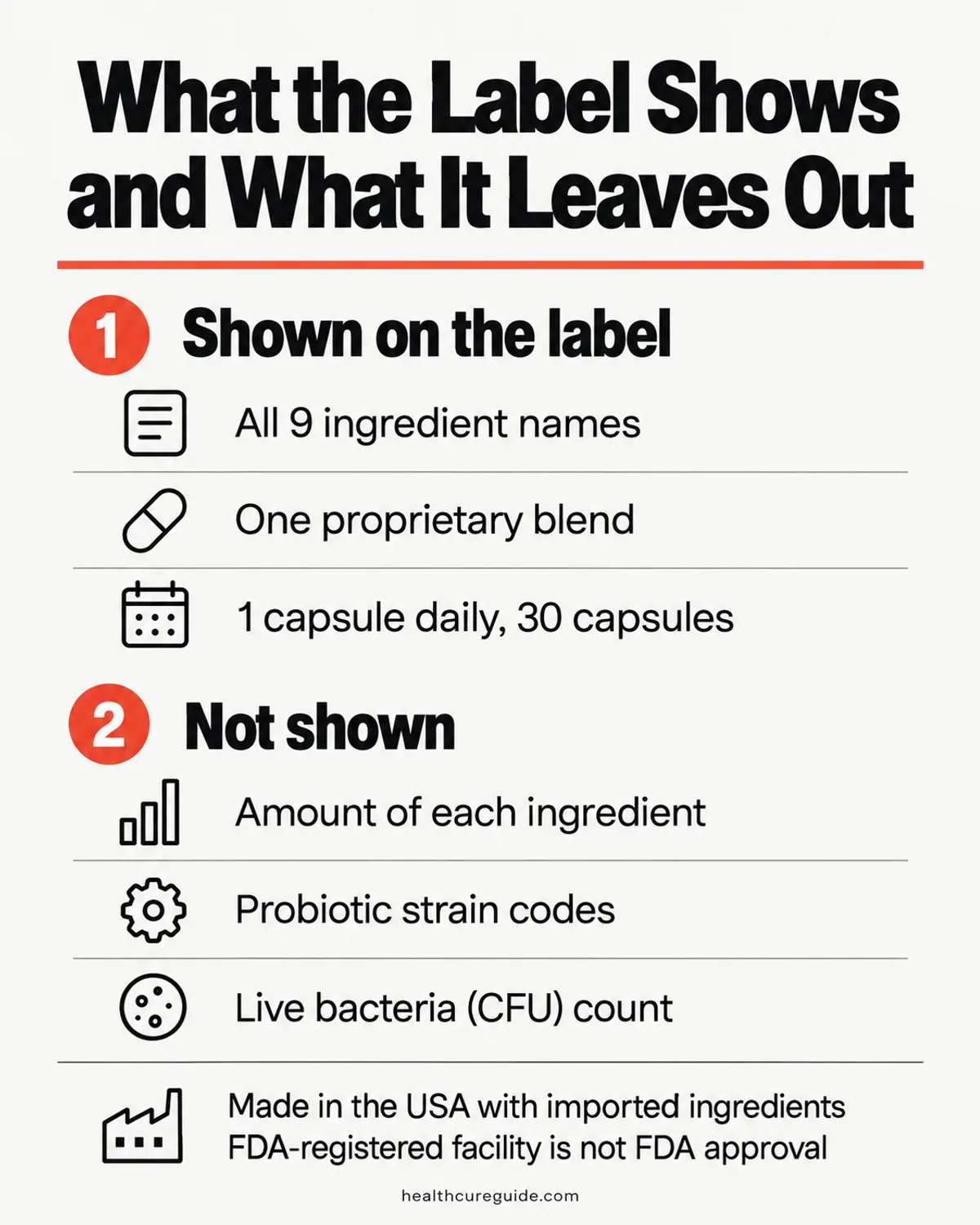
All nine ingredients are grouped into a single proprietary blend. Under US supplement rules a company may list the blend’s total weight and the ingredients in it without giving the amount of each one. It is legal and common, and it stops competitors copying a formula. It also means three gaps for the buyer.
No individual doses. You cannot check whether the cranberry content resembles what was used in research, or whether bearberry is a trace amount or a large share of the capsule.
Species, not strains. Probiotic effects can differ between strains of the same species. The label says Lactobacillus crispatus, not which L. crispatus, so you cannot match it to a specific study.
No live-bacteria count. Most standalone probiotics state colony-forming units (CFU). The FemiCore label lists the five species without a CFU figure.
On the positive side, the manufacturer says the product is manufactured in the USA with imported ingredients, in a GMP-certified, FDA-registered facility, contains no stimulants and is non-GMO. Registration means the facility is on the FDA’s list, not that the FDA has approved the product. No dietary supplement is FDA-approved.
The four botanicals
Cranberry extract
What it is. A concentrated extract of the cranberry fruit, rich in compounds called proanthocyanidins.
Why it is here. Cranberry is the most familiar urinary supplement there is. The proposed action is that its compounds make it harder for bacteria such as E. coli to stick to the lining of the urinary tract.
What research says. The 2023 Cochrane review of cranberry for UTI prevention concluded that cranberry products reduce the risk of repeat urinary tract infections in some groups, including women with recurrent UTIs. That is about infection, not bladder leaks or urgency, and FemiCore does not state its cranberry dose.
One safety line. Cranberry may increase the effect of warfarin.
Bearberry (Uva Ursi)
What it is. The leaf of a low shrub, used in European herbal tradition for urinary complaints.
Why it is here. Bearberry contains arbutin, which the body converts into compounds with antibacterial activity in urine. That makes it a classic “urinary tract cleansing” herb.
What research says. Human evidence is limited. The NCCIH fact sheet on uva ursi notes that it has been used for urinary tract infections but that the evidence is not strong enough to confirm a benefit.
One safety line. It is meant for short-term use and is not advised in pregnancy or kidney disease.
Granular Berberine
What it is. A yellow alkaloid found in plants such as barberry and goldenseal, and one of the most researched botanicals of recent years.
Why it is here. Berberine has broad antimicrobial activity and changes the make-up of gut bacteria. A 2020 review by Habtemariam describes how much of its effect seems to run through the gut microbiota. The thinking in a bladder formula is that a healthier gut supports a healthier urogenital environment.
What research says. The research is mostly about metabolism and the gut. There are no trials of berberine for bladder control.
One safety line. It interacts with diabetes, blood pressure and blood-thinning medication, and is not for use in pregnancy.
Mimosa Pudica
What it is. The “sensitive plant”, whose leaves fold when touched. Its seeds and leaves have a long history in traditional medicine systems.
Why it is here. It has been used traditionally for urinary and digestive complaints, and the manufacturer presents it as a calming ingredient for an over-reactive bladder.
What research says. There are no human trials for bladder symptoms. Of the nine, it rests most heavily on tradition.
One safety line. There is little human safety data, which is itself a reason for caution in pregnancy.
The five Lactobacillus probiotics
The second half of the FemiCore ingredients list is all one genus. Lactobacillus bacteria produce lactic acid, which keeps the local environment slightly acidic and less friendly to many unwanted microbes.
Lactobacillus crispatus
The headline strain. Research on the female urinary and vaginal microbiome points to L. crispatus as a common dominant species in healthy women. In a 2011 randomised trial by Stapleton and colleagues, women with recurrent UTIs who used a vaginal L. crispatus suppository had a recurrence rate of 15%, compared with 27% on placebo. That trial used a vaginal product and a specific strain, not an oral capsule, so it supports the choice of species rather than FemiCore itself.
Lactobacillus gasseri
Another species often found in the female urogenital tract. Its role in the formula is to back up L. crispatus in the same environment. There is no bladder-specific trial for it.
Lactobacillus acidophilus
Probably the best-known probiotic name, used for decades in foods and supplements. It is a reliable lactic acid producer. Its inclusion is about general support for a Lactobacillus-friendly environment.
Lactobacillus plantarum
A tough species that tends to survive the trip through the stomach well. In this formula it mainly targets the gut, the indirect route the manufacturer says links digestive and urinary health.
Lactobacillus casei
A widely used gut probiotic. Like L. plantarum, it is there for the gut side of the formula rather than the bladder directly.
One safety line for all five. Mild bloating or a change in bowel habit is common in the first days of any probiotic, and people with weakened immune systems should ask a doctor before taking live bacteria.
Why these nine ingredients together
The logic of the blend comes from a fairly new area of research. In 2012, Wolfe and colleagues found bacteria in bladder urine from women whose standard urine cultures were negative, which challenged the old idea that the bladder is sterile. In 2014, Pearce and colleagues reported that women with urgency urinary incontinence tended to have less Lactobacillus in their urinary microbiome than women without it. A 2018 paper by Thomas-White and colleagues showed that bladder and vaginal bacteria are closely connected.
Read against that research, the FemiCore ingredients list has a clear shape:
- Add the “good” bacteria: five Lactobacillus species, led by L. crispatus.
- Make life harder for unwanted bacteria: cranberry and bearberry.
- Work on the gut side: berberine, L. plantarum and L. casei.
- Calm the bladder: Mimosa Pudica, on traditional grounds.
The limit is that the microbiome studies show associations. They do not prove that adding Lactobacillus changes bladder symptoms, and FemiCore as a finished product has not been tested in a published trial.
Ranking the ingredients by evidence
If you want one view of where the weight of evidence sits, this is it, from strongest to weakest for urinary health:
- Cranberry extract. A Cochrane systematic review supports it for preventing repeat UTIs in some groups.
- L. crispatus. One randomised trial, vaginal route, specific strain.
- The other four Lactobacillus species. Well-studied probiotics, but not for bladder outcomes.
- Berberine. Solid mechanism research on the gut, no bladder trials.
- Bearberry. Long traditional use, limited and mixed human evidence.
- Mimosa Pudica. Traditional use only.
Notice that the top of the list is about urinary tract infections, not leaks. If your main concern is urgency or leaking, the ingredients point in a plausible direction, but no single one has been shown to fix it. Our FemiCore reviews piece weighs that gap against price and the guarantee.
Questions worth asking about any ingredient list
These apply to FemiCore and to any bladder supplement you are comparing it with.
- Are the doses stated? For FemiCore, no. A product with stated doses lets you compare with research.
- Are probiotic strains named, with a CFU count? For FemiCore, species only, no count.
- Do any ingredients interact with what you already take? For FemiCore, berberine and cranberry are the ones to check. Our FemiCore side effects guide goes through each.
- Is any ingredient meant for short courses only? For FemiCore, bearberry.
- What happens if it does not suit you? FemiCore bought on the official website has a 60-day money-back guarantee covering opened bottles, as long as you return all bottles with the packing slip.
Our take on the FemiCore ingredients
As a set, the nine ingredients are coherent. They follow the bladder microbiome research closely, and two of them, cranberry and L. crispatus, have human evidence relevant to urinary health. Nothing on the list is exotic or a stimulant. The weak points are the proprietary blend, the unnamed strains and the missing CFU count, which together mean you are trusting the manufacturer on dose. That is a fair trade for some buyers and a deal-breaker for others. If you are in the first group, the FemiCore product page sets out every package side by side.
Common questions
What are the 9 ingredients in FemiCore?
FemiCore lists four botanicals and five probiotics. The botanicals are Mimosa Pudica, Bearberry (Uva Ursi), Cranberry extract and Granular Berberine. The probiotics are Lactobacillus crispatus, L. acidophilus, L. plantarum, L. gasseri and L. casei. All nine sit inside one proprietary blend, so the label gives a combined weight rather than the amount of each ingredient.
Does the FemiCore label show how much of each ingredient is in a capsule?
No. The ingredients are grouped as a proprietary blend, which is legal and common in supplements but means the individual amounts are not disclosed. You cannot tell how much cranberry, berberine or bearberry is in one capsule, and the label does not give a colony-forming unit count or named strain codes for the probiotics.
Which FemiCore ingredient has the best research behind it?
Cranberry. A 2023 Cochrane review concluded that cranberry products reduce the risk of repeat urinary tract infections in some groups, including women with recurrent infections. Lactobacillus crispatus comes second, based on a randomised trial in which a vaginal suppository lowered UTI recurrence to 15% against 27% on placebo. The weakest evidence is for Mimosa Pudica.
Are the probiotics in FemiCore the same as in yogurt?
Some of the species overlap. L. acidophilus and L. casei are widely used in fermented foods and general probiotic products. L. crispatus and L. gasseri are less common in food and are more closely associated with the female urogenital tract. The label lists species only, so the specific strains in FemiCore cannot be compared with any particular food or product.
Does FemiCore contain caffeine, hormones or stimulants?
The manufacturer says FemiCore contains no stimulants and is non-GMO. None of the nine listed ingredients is a hormone or a caffeine source. As with any manufacturer claim, this is the company's own statement; the product is made in a GMP-certified, FDA-registered facility in the USA, which is a manufacturing standard rather than an FDA approval.
Is any FemiCore ingredient unsafe?
None is unusual, but three deserve care. Berberine interacts with diabetes, blood pressure and blood-thinning medication. Bearberry is traditionally a short-term herb and is not advised in pregnancy or kidney disease. Cranberry may interact with warfarin. Our separate FemiCore side effects guide covers each one in detail.
Can I buy the FemiCore ingredients separately instead?
You could buy cranberry, a women's probiotic and berberine as separate products, and you would then know the dose of each. You would also be taking three or more products instead of one capsule, and you would lose the 60-day money-back guarantee that covers FemiCore bought on its official website. Which matters more depends on whether you value dose transparency or convenience.
Sources
- Williams G et al. Cranberries for preventing urinary tract infections. Cochrane Database Syst Rev. 2023.
- Stapleton AE et al. Randomized, placebo-controlled phase 2 trial of a Lactobacillus crispatus probiotic given intravaginally for prevention of recurrent urinary tract infection. Clin Infect Dis. 2011.
- Wolfe AJ et al. Evidence of uncultivated bacteria in the adult female bladder. J Clin Microbiol. 2012.
- Pearce MM et al. The female urinary microbiome: a comparison of women with and without urgency urinary incontinence. mBio. 2014.
- Thomas-White K et al. Culturing of female bladder bacteria reveals an interconnected urogenital microbiota. Nat Commun. 2018.
- National Center for Complementary and Integrative Health. Uva Ursi.
- Habtemariam S. Berberine pharmacology and the gut microbiota: a hidden therapeutic link. Pharmacol Res. 2020.