FemiCore Reviews: Does This Probiotic Bladder Formula Work?
FemiCore is a once-a-day capsule that treats bladder leaks and urgency as a microbiome problem rather than a muscle problem. We went through the research behind each ingredient, the fine print on pricing and the guarantee, and the gaps the label does not fill.
- Written by
- HealthCure Guide Editorial Team
- Reviewed by
- HealthCure Guide Editorial Team
- Updated
- Reading time
- 19 min read
This guide contains affiliate links. If you buy through them we earn a commission at no extra cost to you. It does not change the verdict. Disclosure.
If you are reading FemiCore reviews, you probably already know the problem it is sold for. The urge that arrives with no warning. Crossing your legs when you sneeze. Mapping the bathrooms on a road trip. Urinary incontinence affects roughly one in three women over 40 and more than half of women after menopause, and most of them never mention it to a doctor. The standard medical options, pelvic floor training, anticholinergic drugs and newer beta-3 agonists, work for many but come with a drop-out rate that tells its own story: the drugs cause dry mouth, constipation and, with long-term use, concerns about cognition.
FemiCore steps into that gap with a different premise. Instead of blocking the nerve signals that tell the bladder to contract, it tries to change the environment inside the bladder itself, using four botanicals and five strains of Lactobacillus bacteria. This FemiCore review looks at whether that premise holds up, ingredient by ingredient, and then at the parts most reviews skip: the proprietary blend problem, the real pricing including shipping, what the guarantee actually requires, and who should not take it.
We have no relationship with the manufacturer. We earn a commission if you buy through the links on this page, which does not change the verdict.
What FemiCore is
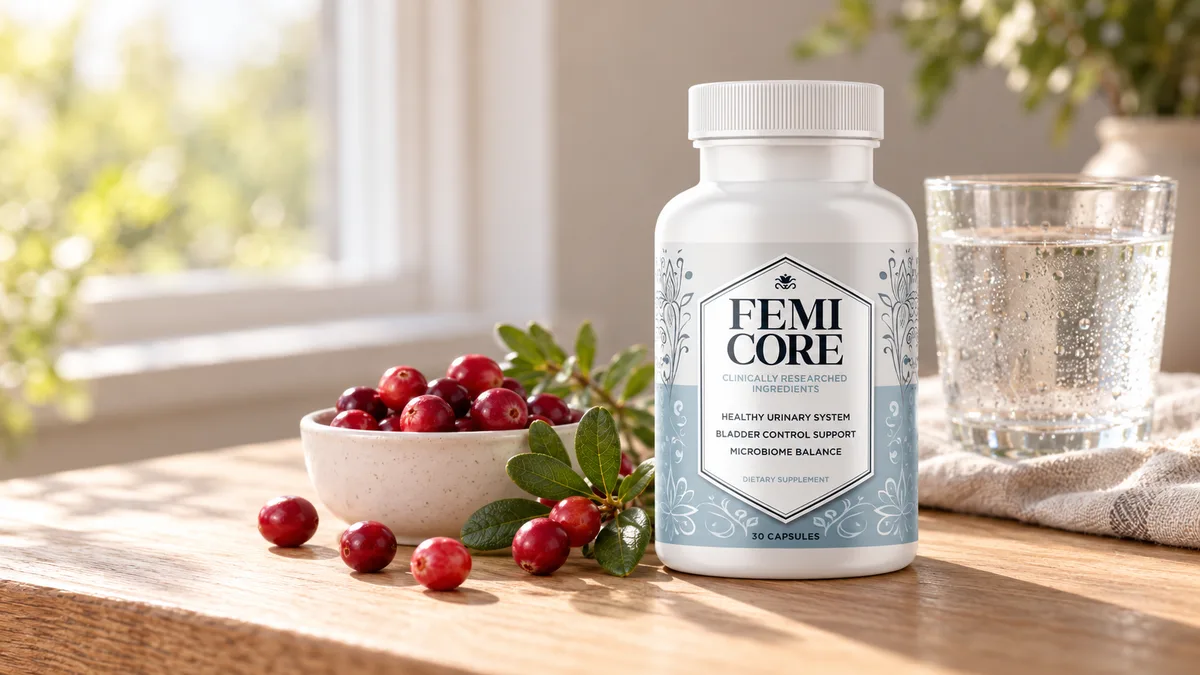
FemiCore is a dietary supplement in capsule form, sold only through its official website with checkout handled by BuyGoods. Each bottle contains 30 capsules and the directions are one capsule each morning with water. It is marketed to women with bladder urgency, frequency and stress leaks, and the manufacturer positions it as a non-drug, non-stimulant daily routine rather than a quick fix.
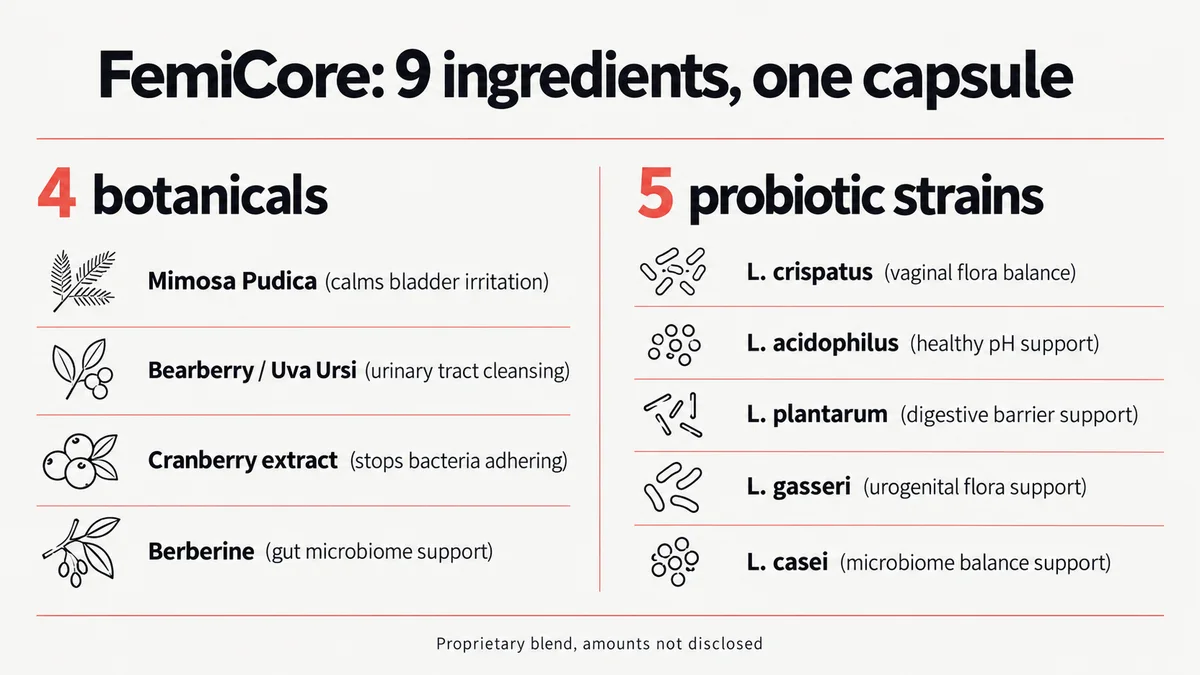
The formula has nine named ingredients:
| Ingredient | Type | Role claimed by the manufacturer |
|---|---|---|
| Mimosa Pudica | Botanical | Calms bladder irritation and over-reactivity |
| Bearberry (Uva Ursi) | Botanical | Urinary tract cleansing |
| Cranberry Extract | Botanical | Prevents bacteria adhering to the bladder wall |
| Granular Berberine | Botanical | Antimicrobial, gut and inflammation support |
| Lactobacillus crispatus | Probiotic | Dominant protective species in the female urogenital tract |
| Lactobacillus acidophilus | Probiotic | Lactic acid production, pH balance |
| Lactobacillus plantarum | Probiotic | Gut barrier support |
| Lactobacillus gasseri | Probiotic | Urogenital colonisation |
| Lactobacillus casei | Probiotic | Gut and immune support |
The ingredients are listed as a proprietary blend, which means the total weight is on the label but the amount of each component is not. We come back to why that matters below.
Quick facts
| Form | Capsule, 30 per bottle |
| Dose | 1 capsule each morning with water |
| Made in | USA, GMP-certified and FDA-registered facility |
| Free from | Stimulants, GMO ingredients, gluten (per manufacturer) |
| Sold by | Official website only, checkout via BuyGoods |
| Price | $49 to $79 per bottle depending on package |
| Guarantee | 60 days, all bottles returned with packing slip |
| Best for | Urgency, frequency, mild stress leaks in adult women |
| Not for | Pregnancy, breastfeeding, under-18s, unassessed new symptoms |
Note that “FDA-registered facility” means the factory is on the FDA’s register of food facilities, which is a legal requirement, not an endorsement. No dietary supplement is FDA-approved, FemiCore included, and any page that tells you otherwise is wrong.
Who makes it
FemiCore is sold through its own official website, with payment and order support handled by BuyGoods, a retail platform used by many direct-to-consumer supplement brands. The manufacturer does not publish a company address or executive names on the sales page, which is common in this market but not reassuring. What we could confirm: the retailer is an established platform with a published refund process, the formula sheet matches what is on the bottle images, and the guarantee terms are stated in writing. What we could not confirm: who formulated the product or whether any third-party laboratory has tested a finished batch.
The idea behind it: the bladder is not sterile
For most of the twentieth century medical textbooks said urine was sterile and the bladder had no resident bacteria. That changed in 2012, when a team at Loyola University Chicago used DNA sequencing on urine collected directly from the bladder by catheter and found bacterial communities in women whose standard cultures had come back negative. They called it the female urinary microbiome.
Two years later the same group published the study that supplement makers have been citing ever since. Comparing women with urgency urinary incontinence to women without it, they found the incontinent group had a different bacterial profile: less Lactobacillus overall, and more of species such as Gardnerella and Aerococcus. A 2018 follow-up in Nature Communications showed the bladder and vaginal microbiomes are closely connected, sharing strains, which is why vaginal probiotics are thought to influence the bladder at all.
Two things are worth being precise about. First, these are associations. Nobody has yet shown that adding Lactobacillus to a bladder with urgency incontinence makes the urgency go away; the microbiome difference could be a consequence of the condition rather than a cause. Second, the connection is strongest for urgency incontinence, the sudden-need-to-go type. For pure stress incontinence, leaking when you cough or lift, the mechanism is mostly mechanical and a probiotic has less obvious reason to help.
FemiCore’s design makes sense in the light of that research. Whether it works is a separate question, and the ingredient evidence is the closest we can get to answering it.
The ingredients, one by one
Cranberry extract
The best-supported ingredient on the list. Cranberry’s proanthocyanidins (PACs) stop E. coli from attaching to the cells lining the urinary tract, so the bacteria are flushed out instead of colonising. The 2023 Cochrane review, which pooled 50 trials with nearly 9,000 participants, concluded that cranberry products reduce the risk of recurrent urinary tract infections in women with recurrent UTIs, in children, and in people susceptible after medical procedures. That was a reversal of the 2012 Cochrane conclusion and reflects better-designed trials since.
The caveat is dose. Trials that worked used products standardised to around 36 mg of PACs a day. FemiCore does not disclose its cranberry content, so there is no way to know whether it reaches that threshold. Also note that the Cochrane evidence is about infection, not incontinence. The link to leaks runs through the idea that a cleaner bladder is a less irritable one, which is plausible but not directly tested.
Lactobacillus crispatus
The flagship probiotic, and the one with the most relevant trial. In 2011, Stapleton and colleagues ran a randomised, placebo-controlled study in 100 women with recurrent UTIs, giving them a vaginal L. crispatus suppository after antibiotic treatment. Recurrence over ten weeks was 15 percent in the probiotic group against 27 percent in the placebo group, and the benefit tracked with how well the strain colonised.
Two gaps between that trial and FemiCore: the trial used a vaginal product, not an oral capsule, and a specific strain (CTV-05) at a known dose. Oral Lactobacillus can reach the vagina and bladder via the gut, which is how most oral women’s probiotics are thought to work, but the evidence for the oral route is thinner. FemiCore does not name its strains beyond the species level or state colony-forming units.
The other four Lactobacillus strains
L. acidophilus, L. plantarum, L. gasseri and L. casei are all well-characterised, widely used probiotic species with good safety records. L. gasseri and L. crispatus are the species most often found dominating a healthy vaginal and urinary microbiome; L. plantarum and L. casei are hardier gut strains that survive stomach acid reliably. Together they cover the two routes FemiCore is trying to influence: direct urogenital colonisation and the gut-based immune and inflammation signalling that reaches the bladder indirectly. None has a trial specifically for incontinence.
Bearberry (Uva Ursi)
A traditional European remedy for urinary discomfort, approved by Germany’s Commission E for uncomplicated lower urinary tract inflammation. Its active compound, arbutin, is converted in the body to hydroquinone, which has antibacterial activity in alkaline urine. The clinical evidence is modest: one randomised trial found a combination of uva ursi and dandelion reduced UTI recurrence over a year, and a 2019 trial found it did not reduce antibiotic use in women with acute UTI symptoms.
The important thing about bearberry is that it is a short-course herb. Standard guidance from NCCIH and European regulators is to use it for no more than a week or two at a time, because hydroquinone is a liver concern with prolonged use. FemiCore is sold as a daily supplement for 60 to 180 days. We could not find any statement from the manufacturer addressing this. The dose is likely small, given the capsule size and eight other ingredients, but it is a question we would want answered.
Mimosa Pudica
The “sensitive plant”, whose leaves fold when touched, has a long record in Ayurvedic and Caribbean folk medicine for urinary complaints, wound healing and digestive parasites. Laboratory and animal studies show anti-inflammatory and smooth-muscle-relaxing effects, which is the rationale for including it in a bladder formula: a less reactive bladder muscle sends fewer urge signals. There are no human trials of mimosa pudica for bladder symptoms. It is the least evidence-backed ingredient on the list.
Berberine
An alkaloid from barberry and goldenseal, berberine is one of the most studied botanicals of the last decade, mostly for blood sugar and cholesterol. Its relevance here is its effect on the gut microbiome: it has broad antimicrobial activity, reduces inflammatory signalling and shifts gut bacterial composition in ways that may favour beneficial species. A 2020 review in Pharmacological Research lays out the gut-microbiota mechanism in detail.
Berberine is also the ingredient with the most drug interactions. It lowers blood sugar, inhibits several liver enzymes that process common medications, and can add to the effect of blood-pressure drugs. If you take any prescription medication, this is the ingredient to ask your pharmacist about.
What to expect, and when
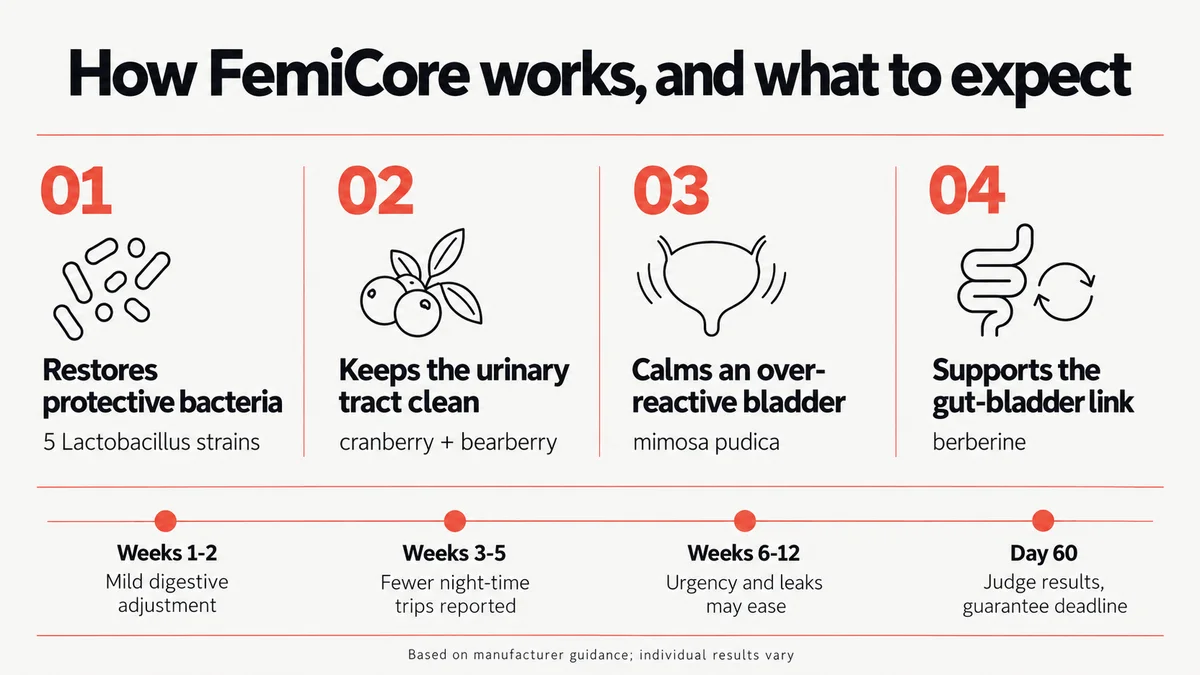
Because the proposed mechanism is microbiome change, FemiCore is slow by design. Based on the manufacturer’s guidance and how probiotic colonisation studies run, a realistic expectation looks like this:
Weeks 1 to 2. Mild digestive adjustment is common when starting any multi-strain probiotic: some bloating, a change in bowel habit. Bladder symptoms are unlikely to shift yet. If you get significant stomach upset, taking the capsule with breakfast rather than on an empty stomach usually settles it.
Weeks 3 to 5. This is when the first reports of change tend to come in, usually night-time frequency. If you are tracking, a simple diary (trips per day, trips per night, leaks per week) started before you begin is the only way to tell real change from wishful thinking.
Weeks 6 to 12. The window the manufacturer points to for urgency and leak changes. By the end of the second bottle you should know whether it is doing anything for you. If your diary shows no change at 60 days, that is the time to use the guarantee.
Beyond 12 weeks. Probiotic effects generally fade within weeks of stopping, so if it works, the manufacturer’s framing of it as an ongoing routine is probably accurate rather than just a sales line.
Side effects and who should not take it
FemiCore contains no stimulants, no hormones and nothing that acts on the nervous system, which is its main safety advantage over anticholinergic medication. Within that, four cautions apply:
- Berberine and medication. As above: diabetes drugs, blood-pressure drugs, blood thinners, statins and anything metabolised by CYP enzymes. Check with a pharmacist.
- Bearberry duration. Not recommended in pregnancy, breastfeeding, kidney disease or for children, and intended for short courses. Discuss long-term use with a clinician.
- Probiotics and immune suppression. Women on immunosuppressants, chemotherapy or with a central venous catheter should not take probiotic supplements without medical advice.
- New or worrying symptoms. Blood in the urine, pain, fever, sudden onset of incontinence or leaking that follows a fall or surgery all need a medical assessment first. A supplement is not the place to start.
For a healthy adult woman not on medication, the realistic side effect is a week of mild bloating.
What customers actually report
Reading through the FemiCore reviews that customers have posted, on the retailer’s own pages and in forum threads, a few patterns repeat often enough to be worth noting. None of this is a clinical result, and positive reviews are over-represented wherever a company controls the page, but the shape of the feedback is informative.
The night-time change comes first. The most common specific claim is fewer bathroom trips at night, often reported between weeks three and six. This fits the mechanism: if bladder irritation is part of the problem, reduced irritation shows up most clearly when there is no daytime distraction.
Urgency improves before leaks do. Women describe getting more warning before the need to go, and later, fewer leaks. Stress leaks on coughing or exercise are the least often reported to improve, which again fits: those are mechanical, and a capsule cannot strengthen a pelvic floor.
The first week is the drop-off point. Negative reviews cluster around bloating in the first days and around people who stopped before the one-month mark. A smaller group used it for the full 60 days and saw nothing, and several of those mention using the guarantee successfully, which is at least evidence that the refund process works.
Price is the main complaint from people it helped. $49 to $79 a month is a real cost for a product with undisclosed doses, and several reviewers who liked it said they would prefer a transparent label at the same price.
We did not find reports of serious adverse effects, which is consistent with the ingredient profile.
How to give it a fair trial
If you decide to try FemiCore, the way you run the trial matters more than most reviews admit. Supplements with gradual, modest effects are easy to misjudge in both directions.
- Start a bladder diary before the first capsule. Three numbers a day for one week: daytime trips, night-time trips, leaks. Keep it in a notes app. Without a baseline, you will be guessing at week eight.
- Take it with breakfast, not on an empty stomach. This reduces the early bloating that makes people quit.
- Do pelvic floor work alongside it. Ten minutes a day of correctly performed Kegels, ideally after one session with a pelvic health physiotherapist to check your technique. This has stronger evidence than any supplement and addresses the stress-leak component FemiCore cannot.
- Watch the obvious bladder irritants. Caffeine, alcohol, carbonated drinks and artificial sweeteners all increase urgency in sensitive bladders. Cutting them for the trial period removes a confounder.
- Do not restrict fluids. Concentrated urine irritates the bladder more, not less. Aim for pale yellow.
- Judge at day 55. Compare the diary to your baseline. A meaningful change is a reduction of a third or more in night trips or leaks. If it is not there, claim the refund before day 60 and keep the packing slip handy from the start.
Is FemiCore a scam?
Several FemiCore reviews online ask this directly, so it deserves a direct answer. A scam, in the sense that matters, is a product that does not exist, does not ship, or cannot be refunded. On those tests FemiCore passes: it ships through an established retailer, the product matches its description, and the refund process is documented and, by customer accounts, honoured.
What it is not is a proven treatment. The marketing is heavier than the evidence, the “regular price” is inflated to make the discount look larger, and the review count is a manufacturer figure. Those are standard practices in the direct-to-consumer supplement market and they should make you read carefully, but they are not fraud. The practical protection is the guarantee, which is why we keep coming back to running the trial properly.
Two things to watch for that are outside the manufacturer’s control: counterfeit listings on third-party marketplaces, which is why buying only from the official site matters, and fake review sites that copy the official page wholesale. If a review has no criticism at all, it is an advert.
Where it falls short
Most FemiCore reviews are either sales pages or drive-by dismissals. Neither tells you the actual weaknesses, which are these:
The proprietary blend. This is the one that matters most. The label lists nine ingredients and a total blend weight but not the amount of each. That makes it impossible to compare FemiCore’s cranberry content to the 36 mg PAC dose that worked in trials, or its probiotic count to the billions of CFU typical of standalone products. Proprietary blends are legal and common, and they protect formulas from copying, but they shift the burden of trust entirely onto the brand.
No product trial. The ingredient evidence is real but FemiCore itself has not been tested in a published study. “19,263 reviews” on the sales page is a manufacturer figure that cannot be verified.
Unnamed probiotic strains. Probiotic effects are strain-specific. “Lactobacillus crispatus” covers many strains with different behaviours; the trial evidence is for one of them. Without the strain designation, you are trusting that the one used is comparable.
Aggressive marketing. The official page uses countdown-style urgency and a “regular price” of $129 that nobody appears to pay. The product does not need that, and it makes sceptical readers more sceptical.
Single sales channel. Only available from the official site. That protects the guarantee but means no independent retailer reviews to cross-check.
How it compares
Against the alternatives a woman with mild to moderate urgency might consider:
| Option | Evidence for incontinence | Main drawback |
|---|---|---|
| Pelvic floor training (Kegels, ideally with a physiotherapist) | Strong, first-line in every guideline | Takes 3 months of consistent effort |
| Bladder training (timed voiding) | Strong for urgency | Requires discipline |
| Anticholinergic drugs (oxybutynin, solifenacin) | Strong | Dry mouth, constipation, cognitive concerns long-term |
| Beta-3 agonists (mirabegron) | Strong | Prescription, cost, blood pressure monitoring |
| Pumpkin seed and soy extract supplements | Modest, a few small trials | Mixed results |
| Cranberry PAC supplements (standalone) | Good for UTI prevention, indirect for leaks | Does not address microbiome directly |
| Women’s probiotic (standalone, named strains) | Moderate for UTI and vaginal health | Not formulated for bladder control |
| FemiCore | Ingredient-level only; no product trial | Proprietary blend, undisclosed doses |
FemiCore’s position is as an add-on, or as a first experiment for women who want to try something before medication. It does not replace pelvic floor work, which has the best evidence of anything on that list and costs nothing.
Pricing, exactly
From the official website at the time of writing. The manufacturer sets these and they can change.
| Package | Per bottle | Shipping | Total | Extras |
|---|---|---|---|---|
| 2 bottles (60 days) | $79 | $9.99 (US) | $167.99 | None |
| 3 bottles (90 days) | $69 | Free (US) | $207 | None |
| 6 bottles (180 days) | $49 | Free (US) | $294 | 3 digital bonus guides |
All three carry the same 60-day money-back guarantee. The three bonus guides with the 6-bottle package (a bladder-control habit guide, a night-time routine guide and a women’s microbiome diet guide) are listed at a combined $793 value; treat that figure as marketing. Payment is through BuyGoods, which accepts major cards and handles order support.
Our reading of the numbers: 2 bottles is the minimum that gives a fair 60-day trial and the guarantee covers it. If you intend to continue after a successful trial, 6 bottles is $30 a bottle cheaper and the guarantee still applies to the whole order.
The bonus guides
The 6-bottle package includes three PDF downloads. From the manufacturer’s descriptions:
- A bladder-control habit guide (listed at $199): pelvic floor routines, timed voiding schedules and the daily habits that reinforce what the capsules are meant to do. The useful content here overlaps with what a pelvic health physiotherapist or the NHS bladder-training leaflet will give you for free.
- A night-time routine guide (listed at $397): evening fluid timing, wind-down steps and sleep hygiene aimed at reducing wake-ups.
- A women’s microbiome diet guide (listed at $197): foods and fibres that feed Lactobacillus species.
They are a pleasant extra, not a reason to buy six bottles. Decide on the package based on how long you expect to use the product, and treat the guides as free.
Where not to buy it
FemiCore is not sold on Amazon, eBay, Walmart or in pharmacies. Listings that appear on those platforms are either resellers (no guarantee, unknown storage conditions for a probiotic product) or counterfeits. The only purchase route that carries the 60-day guarantee is the official website.
The guarantee, in practice
The 60-day guarantee is better than most in this category because it covers opened bottles. The conditions, from the manufacturer’s terms:
- Contact support within 60 days of the purchase date.
- Return all bottles from the order, used or not, together with the packing slip.
- Refund of the purchase price to the original payment method. Return postage is generally at your cost, and the original shipping fee on the 2-bottle package may not be refunded.
Keep the box and the packing slip. The return requirement is the step people miss.
Our verdict
FemiCore is a reasonable product with a real scientific rationale and a transparency problem. The bladder microbiome research it rests on is sound, cranberry and L. crispatus have human trial support for urinary health, and the formula avoids the side effects that make bladder drugs hard to stay on. Against that, the proprietary blend means you cannot check whether the doses match the studies, there is no trial of the product itself, and bearberry’s long-term use is a question the brand has not addressed.
Who it suits: a woman with mild to moderate urgency or occasional leaks, not on interacting medication, who is already doing pelvic floor work and wants to try a non-drug daily routine with a refund if it does nothing.
Who it does not suit: anyone with new, painful or severe symptoms, anyone pregnant or breastfeeding, anyone on diabetes or blood-pressure medication without pharmacist advice, and anyone looking for a quick result. Give it 60 days with a symptom diary, and use the guarantee honestly if the diary does not move.
If you prefer the short version with pricing and FAQs in one place, our FemiCore product page has it.
Common questions
Does FemiCore actually work for bladder leaks?
There is no clinical trial of FemiCore as a finished product, so the honest answer is that it has not been proven. What exists is evidence for several of its ingredients: cranberry proanthocyanidins reduce recurrent urinary tract infections in a 2023 Cochrane review, Lactobacillus crispatus reduced UTI recurrence in a randomised trial, and the bladder microbiome research it is built on is real. Whether that translates into fewer leaks for a given woman is unknown; the 60-day guarantee is the practical way to find out.
How long does FemiCore take to work?
The manufacturer's guidance is to allow 8 to 12 weeks. That matches how long probiotic colonisation studies typically run. Some women report fewer night-time trips within two to three weeks, but changes in urgency and leaks, if they happen, are gradual. Judge it on a full 60-day course, not the first bottle.
What are the side effects of FemiCore?
The common one is mild bloating or looser stools in the first week, which is normal when starting any probiotic. Berberine can lower blood sugar and interacts with several medications, so women taking diabetes, blood pressure or blood-thinning drugs should check with a pharmacist first. Bearberry is not recommended in pregnancy, breastfeeding or kidney disease. FemiCore contains no stimulants.
What does FemiCore cost?
On the official website: 2 bottles at $79 each plus $9.99 shipping ($167.99 total), 3 bottles at $69 each with free US shipping ($207), or 6 bottles at $49 each with free US shipping and three bonus guides ($294). All packages carry the 60-day money-back guarantee.
What is the FemiCore refund policy?
A 60-day, 100% money-back guarantee from the purchase date. Contact support within 60 days, return all bottles (opened or not) with the packing slip, and the purchase price is refunded to the original payment method. Return postage is normally your cost.
Where can I buy FemiCore?
Only from the official website, with checkout through BuyGoods. It is not listed on Amazon, Walmart or in pharmacies. Buying elsewhere means no guarantee and no way to verify the product is genuine.
What is in FemiCore?
Nine ingredients in a proprietary blend: Mimosa Pudica, Bearberry (Uva Ursi), Cranberry Extract, Granular Berberine, and five probiotics: Lactobacillus crispatus, L. acidophilus, L. plantarum, L. gasseri and L. casei. The amounts of each are not disclosed, which is our main criticism.
Should I buy 2, 3 or 6 bottles of FemiCore?
Since the realistic trial period is 8 to 12 weeks, 2 bottles is the minimum that gives a fair test and 3 covers it fully with free shipping. The 6-bottle package is the cheapest per bottle at $49 and adds the bonus guides. The guarantee is the same on all three, so the choice comes down to how long you intend to use it if it helps.
Sources
- Wolfe AJ et al. Evidence of uncultivated bacteria in the adult female bladder. J Clin Microbiol. 2012.
- Pearce MM et al. The female urinary microbiome: a comparison of women with and without urgency urinary incontinence. mBio. 2014.
- Stapleton AE et al. Randomized, placebo-controlled phase 2 trial of a Lactobacillus crispatus probiotic given intravaginally for prevention of recurrent urinary tract infection. Clin Infect Dis. 2011.
- Williams G et al. Cranberries for preventing urinary tract infections. Cochrane Database Syst Rev. 2023.
- Habtemariam S. Berberine pharmacology and the gut microbiota: a hidden therapeutic link. Pharmacol Res. 2020.
- National Center for Complementary and Integrative Health. Uva Ursi.
- Thomas-White K et al. Culturing of female bladder bacteria reveals an interconnected urogenital microbiota. Nat Commun. 2018.