FemiCore Review 2026 Women: A Guide by Life Stage
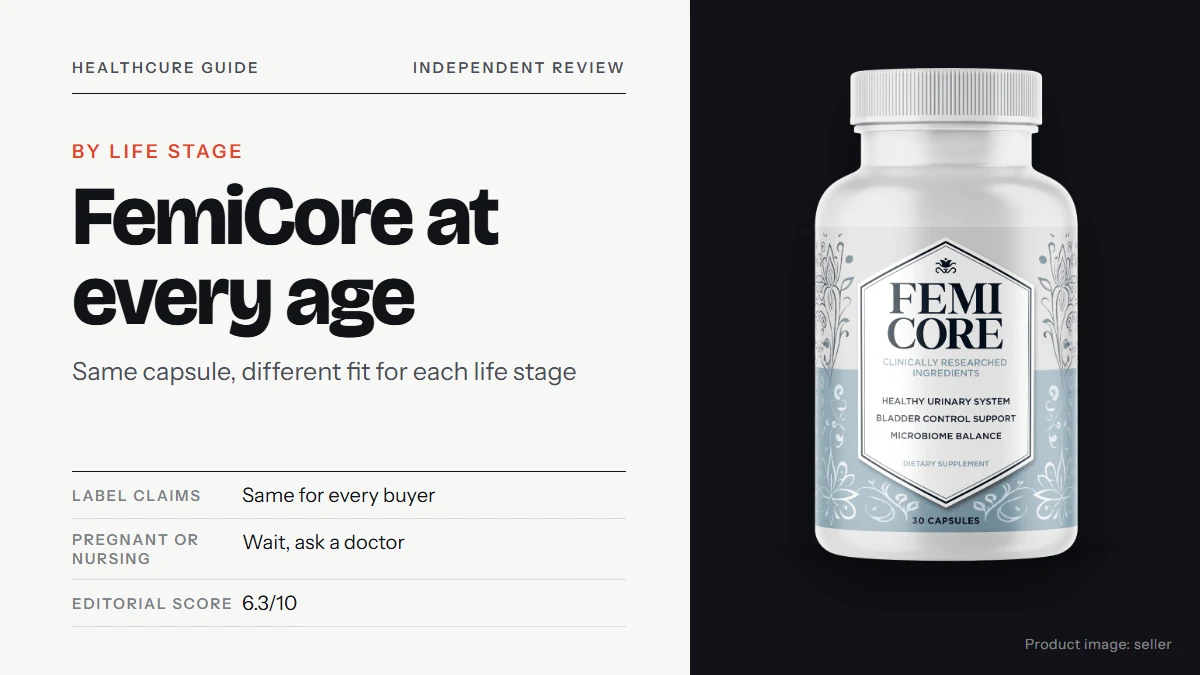
The same capsule is sold to a 28-year-old with repeat infections and a 75-year-old with night trips. Their situations, risks and realistic hopes are not the same. This review takes each life stage separately and says who should see a doctor first.
- Written by
- HealthCure Guide Editorial Team
- Reviewed by
- HealthCure Guide Editorial Team
- Updated
- Reading time
- 10 min read
This guide contains affiliate links. If you buy through them we earn a commission at no extra cost to you. It does not change the verdict. Disclosure.
This FemiCore review 2026 women’s guide is built around one observation: a sales page speaks to everyone at once, but a woman of 28 and a woman of 78 do not have the same bladder, the same medicine cabinet or the same risks. So rather than one verdict for all, we take five life stages in turn. For each, we set out what the seller claims, what is realistic given the evidence, and who should see a doctor before buying anything.
We are an independent site, not the seller. Order buttons on this page are affiliate links; a purchase made through them can pay HealthCure Guide a commission, and the total at checkout does not change because of it. Nothing here is medical advice, and no life-stage section replaces a conversation with your own clinician.
FemiCore review 2026 women: how this guide is organized
Each life stage below has the same three parts, so you can compare them quickly:
- What the seller says. In our sources, the seller does not tailor its claims by age. Every buyer reads the same three promises on the label: urinary system health, help with bladder control, and a balanced microbiome.
- What is realistic. What the research on the ingredients can and cannot support for that stage. Remember throughout that there is no trial of the finished formula in any group of women.
- See a doctor first if. The situations where a supplement should wait.
The facts behind every section are the same. A single capsule taken every morning alongside a large glass of water, 30 capsules a bottle, nine ingredients in a proprietary blend with no individual doses, and a 60-day refund counted from delivery. Our overall editorial score is 6.3/10, set out in our 2026 review.
The three claims the seller makes for every woman
It helps to know what the claims rest on before matching them to an age.
| Label claim | Ingredient behind it | Strength of the support |
|---|---|---|
| Healthy urinary system | Cranberry, bearberry | Cranberry: review-level evidence for repeat UTIs. Bearberry: limited, mixed |
| Bladder control support | Mimosa pudica, the probiotics | Thin: lab and animal reports, early microbiome studies |
| Microbiome balance | Five Lactobacillus species | Plausible idea, species named without strain codes or CFU |
Berberine sits in the blend too. Its strong human data are for blood sugar and cholesterol, not the bladder, and it carries the most interaction cautions of the nine. That matters more at some life stages than others, as you will see.
In your twenties and thirties: repeat UTIs
What the seller says. The same label claims, with “healthy urinary system” the one most relevant here.
What is realistic. This is the stage where the evidence is most on point. The 2023 Cochrane review, for instance, concluded that among women who get infections again and again, cranberry products may reduce how many come back, and a small placebo-controlled trial of a vaginally given L. crispatus product also reduced repeat UTIs. Two cautions keep expectations modest. Cranberry’s benefit tracks its PAC content, a figure missing from the FemiCore label. And the probiotic trial used a vaginal product, while FemiCore is a capsule that lists species only.
See a doctor first if you have burning, fever or chills, flank pain or blood in your urine, which can mean an active infection. A supplement is not a treatment for one. Also check first if you have had kidney stones, since cranberry carries an oxalate concern, or if you might be pregnant.
Pregnancy, breastfeeding and the first year after birth
What the seller says. The official site advises women who are pregnant or nursing to consult a physician before use.
What is realistic. For this stage the honest answer is to wait. Berberine is considered unsafe in pregnancy and while breastfeeding, and bearberry should be avoided in both. Those are two of the four plant ingredients, and with no doses printed there is no way to judge how much of either a capsule holds.
Leaks after a birth are common, and they are usually a physical matter rather than a microbiome one. None of the ingredients is designed to rebuild pelvic floor strength. A doctor or a pelvic health physiotherapist can check what is going on and set up exercises, and that is the first step.
See a doctor first if you are pregnant, trying to conceive, breastfeeding, or have any new urinary symptom during pregnancy. Once breastfeeding has finished and a clinician has looked at any leaks, the later stages below apply.
Perimenopause and menopause
What the seller says. The general label claims. Our sources show no menopause-specific claim, but women in midlife are an obvious audience for a bladder control product.
What is realistic. The microbiome idea is most relevant here. Since around 2012, sequencing work has shown the female bladder is not sterile, and some studies found less Lactobacillus in women with urgency incontinence. That makes a probiotic blend a plausible thing to try for urgency and frequent trips. It does not prove that an oral probiotic changes bladder symptoms, and nobody has tested FemiCore itself in women of this age.
Midlife is also when other medicines tend to appear. Berberine can lower blood sugar and blood pressure, so a woman newly started on either kind of medicine should ask before adding it. Some wind or a bloated feeling during the opening fortnight is a familiar probiotic effect.
See a doctor first if your bladder control changes suddenly, you see blood in your urine, you have pain or fever, or you take diabetes, blood pressure or blood-thinning medicines. Women with kidney disease should not take bearberry without medical advice.
Seventy and older, or caring for an older relative
What the seller says. The same claims. Nothing in our sources addresses older users specifically.
What is realistic. Bladder urgency and night trips are a common reason older women look at products like this, and the same plausible but unproven idea applies. The bigger question at this stage is safety rather than effect. Berberine slows the CYP3A4 and CYP2D6 liver enzymes, which can raise blood levels of many drugs; cyclosporine is one example. Cranberry appears in warfarin case reports, which is why INR checks matter for anyone on that drug. Bearberry interacts with lithium and is meant for short courses only, about a week in European herbal guidance, not continuous daily use. Kidney disease, which becomes more common with age, is a reason to avoid bearberry.
See a doctor first if anyone in this group has new urinary symptoms, and urgently if an older relative becomes confused alongside urinary symptoms, which can signal an infection. A pharmacist should review the full medicine list before a trial starts.
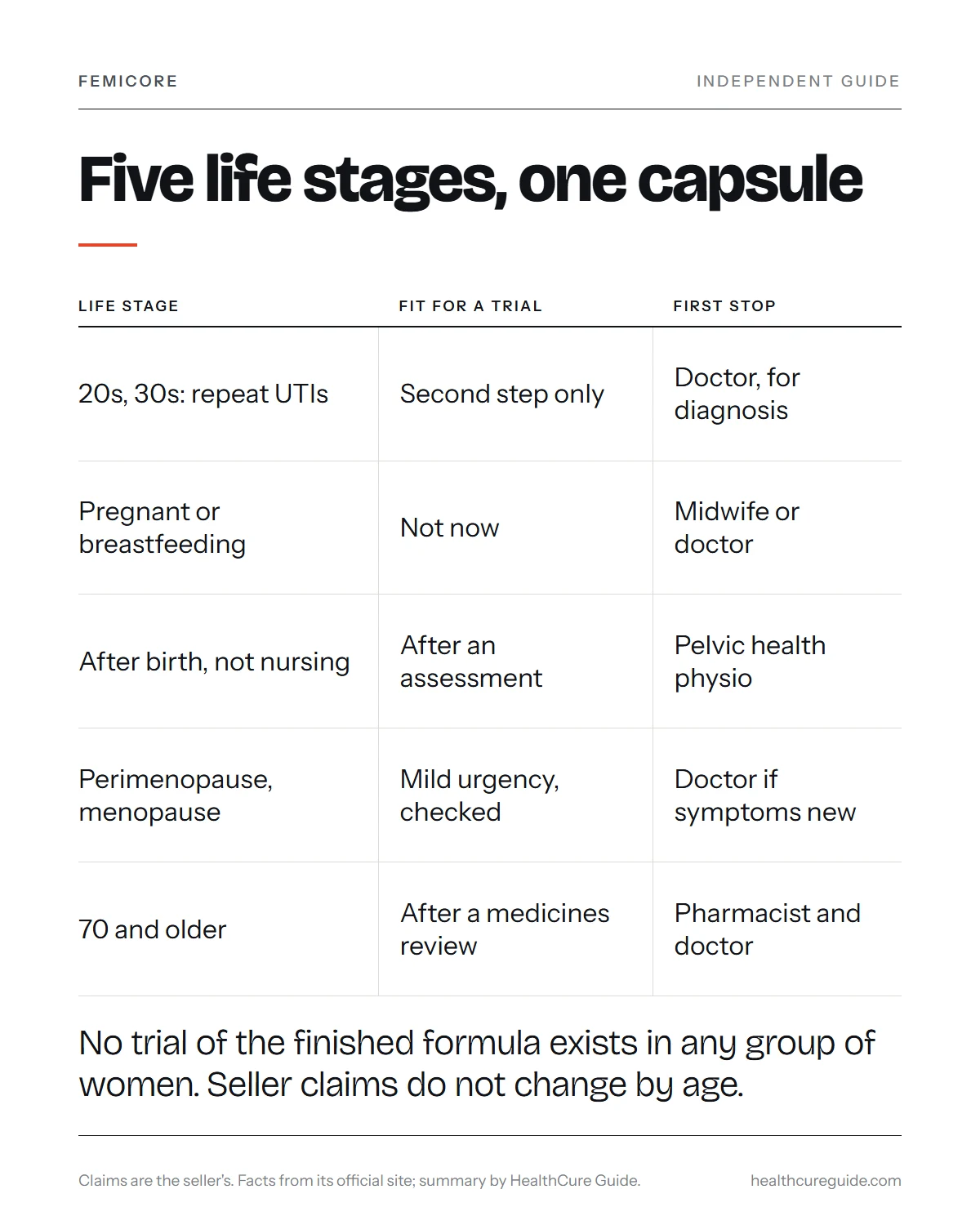
Every life stage on one page
| Life stage | Fit for a trial | Main caution | First stop |
|---|---|---|---|
| 20s and 30s, repeat UTIs | Possible, as a second step | Active infection needs treatment | Doctor, for diagnosis |
| Pregnancy, breastfeeding | Not now | Berberine, bearberry | Midwife or doctor |
| After birth, not breastfeeding | Possible, after an assessment | Leaks are often physical | Pelvic health physio |
| Perimenopause, menopause | Reasonable for mild urgency | New medicines, sudden changes | Doctor if symptoms are new |
| 70 and older | Only after a medicines review | Drug interactions, kidneys | Pharmacist and doctor |
Notice that no row says “ideal”. The best fit across all stages is the same woman described differently: past pregnancy and breastfeeding, mild symptoms already checked, no interacting medicines, and willing to keep a short diary. Our earlier fit guide sorts readers by symptom rather than by age, and our side effects guide goes through each ingredient’s cautions in depth.
Before your appointment: what to bring
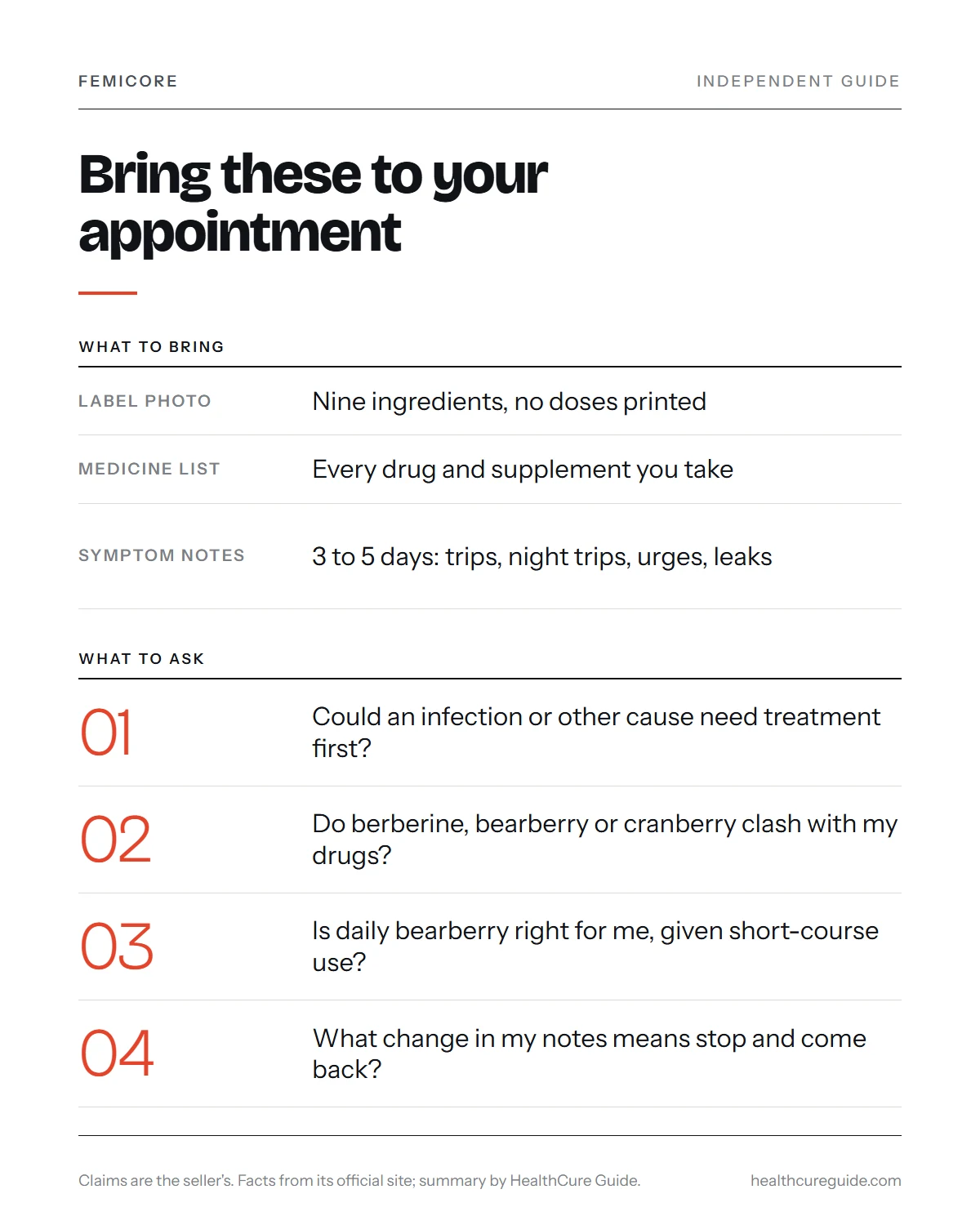
A short visit goes further with the right material. Bring a photo of the FemiCore label, a list of every medicine and supplement you take, and three to five days of notes on daytime trips, night trips, urgent moments and any leaks. Then ask:
- Could my symptoms have a cause that needs treatment first, such as an infection?
- Do berberine, bearberry or cranberry clash with anything I take?
- Is a product with bearberry suitable for me day after day, given it is usually meant for short courses?
- Given my age and history, what change in my notes would make me stop and come back?
- Would pelvic floor exercises or another approach suit my type of symptom better?
Expect your clinician to point out that the label lists no amounts. That is a fair point to raise with them, and it is the main reason our label transparency score is low.
What does not change with age
Some parts of a FemiCore trial are identical at 30 and at 70, and they are worth planning the same way.
The directions. Our sources give one set of directions for every adult buyer: one capsule a day, in the morning, with plenty of water. There is no higher or lower dose by age on the label, and no guidance for children, who should not take it.
The timing problem. The seller suggests about 3 months before you judge the result. The refund, though, closes 60 days after the parcel arrives. Whatever your age, you will be deciding about the refund before you reach the seller’s own suggested mark.
The money. Two bottles cost $79 each plus $9.99 shipping, three cost $69 each, six cost $49 each, with free US shipping on the larger two. If you ask for a refund, you email support with “Refund Request” as the subject, send every bottle back with the packing slip, and pay the postage yourself to the Tallmadge, Ohio return address.
The unknowns. The label leaves all nine amounts blank, so no clinician of any specialty can tell you exactly how much berberine or bearberry you would be taking. That uncertainty is the same for everyone.
Our 2026 take for women at each stage
Life stage changes the advice more than the product does. For a young woman with repeat infections, FemiCore is at most a follow-up to proper care, with cranberry doing the evidence-based work at an unknown dose. For pregnant and breastfeeding women it should wait. For women after birth, pelvic floor assessment comes first. For midlife and older women with mild urgency, it can be a dated experiment once a doctor and pharmacist are satisfied.
The FemiCore catalog page has the packages and refund steps in table form if you want them in one place.
This guide is general information for adult women and is not medical advice. Your own doctor, who knows your history, is the right person to confirm whether any supplement suits you.
Common questions
Can a woman in her twenties take FemiCore for repeat UTIs?
An adult woman can, but the order of steps matters. Repeat infections should be diagnosed and treated by a doctor first, because a supplement does not treat an active infection. Cranberry, one of the nine ingredients, has review-level evidence for cutting repeat UTIs in women prone to them, yet FemiCore does not print its cranberry dose, so the label cannot be matched to that research.
Is FemiCore an option while pregnant or breastfeeding?
Not without a doctor's clear approval, and in practice it is best left until later. Berberine is considered unsafe in pregnancy and while breastfeeding, and bearberry should be avoided in both. The official site itself advises women who are pregnant or nursing to consult a physician. Bladder changes during pregnancy and after birth deserve a proper check in any case.
Can FemiCore replace pelvic floor work after having a baby?
No. None of the nine ingredients is designed to strengthen muscle, and leaks that begin after a birth often need a physical assessment. A doctor or a pelvic health physiotherapist is the right first step. If you later want to try a supplement alongside that work, wait until you have finished breastfeeding, because of the berberine and bearberry in the blend.
Does FemiCore target bladder changes around menopause?
The seller markets it to women for bladder control, urinary health and microbiome balance, without singling out menopause in our sources. Women in midlife are a natural audience, and the microbiome idea behind it is plausible but early. There is no trial of the finished formula in menopausal women or any other group, so treat it as a dated, refundable experiment.
Should an older parent with new bladder symptoms try FemiCore?
Not as a first step. New urinary symptoms in an older person, especially with confusion, fever or pain, need a doctor promptly. Older adults also tend to take more medicines, and berberine slows liver enzymes that clear many drugs, while cranberry has warfarin case reports. A medicines review with a pharmacist should come before any trial.
Does age change how long a FemiCore trial should run?
The plan is the same at any age: the seller suggests about 3 months before judging, while the refund closes 60 days after delivery. What changes with age is the starting point. Older women and anyone on regular medicines should clear the trial with a pharmacist first, and anyone whose symptoms change during the trial should stop and get checked.
Which life stage fits FemiCore best?
On paper, an adult woman past pregnancy and breastfeeding, with mild urgency, frequent trips or night waking that a doctor has already looked at, who takes no interacting medicines. That can be a woman of 35 or 65. Age matters less than the medical checks, the medicine list and a willingness to track symptoms honestly.
Sources
- Pearce MM et al. The female urinary microbiome: a comparison of women with and without urgency urinary incontinence. mBio. 2014.
- Williams G et al. Cranberries for preventing urinary tract infections. Cochrane Database Syst Rev. 2023.
- Stapleton AE et al. Randomized, placebo-controlled phase 2 trial of a Lactobacillus crispatus probiotic given intravaginally for prevention of recurrent urinary tract infection. Clin Infect Dis. 2011.
- National Center for Complementary and Integrative Health. Uva Ursi.