Who Should Use FemiCore? A Fit Guide for Women
FemiCore is designed for a fairly specific group of women. Matching yourself to that group honestly, before you spend anything, saves money and, occasionally, a missed diagnosis. Here is how to tell where you fit.
- Written by
- HealthCure Guide Editorial Team
- Reviewed by
- HealthCure Guide Editorial Team
- Updated
- Reading time
- 8 min read

This guide contains affiliate links. If you buy through them we earn a commission at no extra cost to you. It does not change the verdict. Disclosure.
Who should use FemiCore is a more useful question than whether FemiCore works in general, because the answer changes depending on who is asking. A supplement that is a sensible experiment for one woman can be the wrong choice for another, either because it is unlikely to help her type of symptom or because one of its ingredients does not suit her health or medication.
This guide sorts readers into three groups: women FemiCore is designed for, women who should check with a doctor or pharmacist first, and women for whom something else should come first. If you are unsure about a specific ingredient, our FemiCore side effects guide goes through each one in detail.
Who FemiCore is designed for
The manufacturer describes FemiCore as a daily support formula for women’s bladder control and urinary health. Its nine ingredients (four botanicals and five Lactobacillus strains) are chosen around the idea that the bladder has its own microbiome, and that an imbalance may make it more reactive. Putting that together, the best fit looks like this:
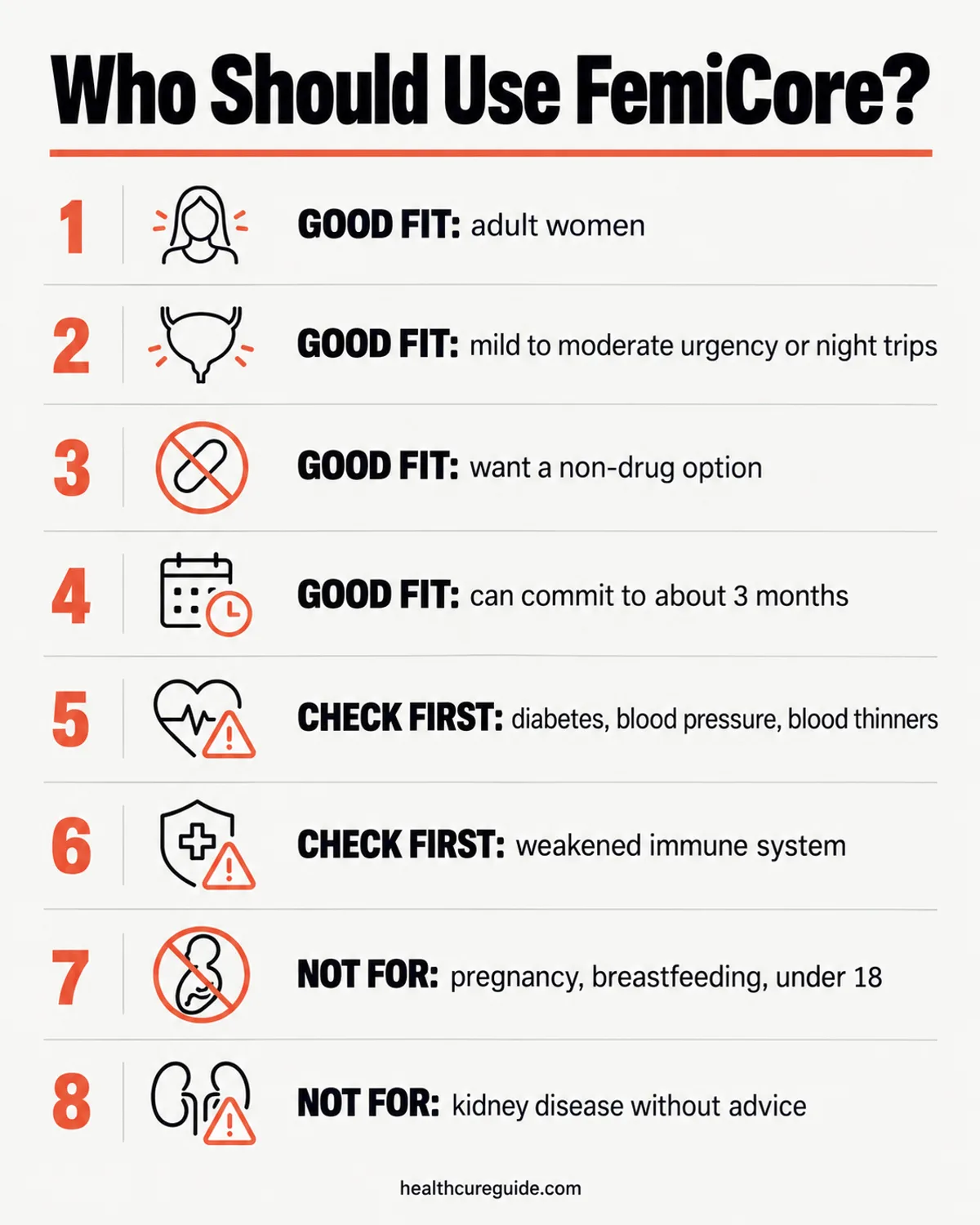
- Adult women with symptoms that have been present for a while and are stable rather than suddenly new.
- Mainly urgency-type symptoms: a sudden strong need to go, frequent daytime trips, or waking at night to urinate.
- Mild to moderate severity: symptoms that are bothersome and limit plans, but are not causing pain or frequent large leaks.
- A preference for a non-drug, stimulant-free option, often after finding prescription bladder medicines hard to tolerate, or before trying them.
- Patience: the seller advises using it for at least 3 months before deciding, so the right user is willing to take one capsule every morning and track her symptoms for that long.
- Women prone to repeat urinary tract infections, whose clinician agrees a supplement is reasonable alongside their usual care, since cranberry has the strongest evidence for that use.
If that describes you, FemiCore is a reasonable thing to try under its 60-day guarantee. For what you can realistically expect, see our evidence check on whether FemiCore really works.
Who should use FemiCore only after asking a doctor or pharmacist
This group may still be able to use FemiCore, but a short conversation first is the safe route.
Women taking regular medication
Berberine is the ingredient to watch. It can lower blood sugar, may add to the effect of blood-pressure medicines, and changes how the liver processes a number of drugs. Cranberry may interact with warfarin. Ask a pharmacist before starting if you take:
- Diabetes medication, including insulin or tablets that lower blood sugar.
- Blood-pressure medication.
- Warfarin or another blood thinner.
- Several regular prescriptions, especially ones where the dose has to be precise.
Women with a weakened immune system
FemiCore contains live bacteria. People on chemotherapy, taking immunosuppressant drugs or with a central line are usually advised not to take live probiotic supplements without medical approval.
Women with gallbladder, liver or digestive conditions
Berberine commonly causes stomach upset in some people. If you have an ongoing digestive or liver condition, check first.
Women over 65 or with several health conditions
Age itself is not a barrier, and bladder urgency is common later in life. But more medicines and more health conditions mean more potential for interactions, so a medication review first is sensible.
Who should not use FemiCore
- Pregnant or breastfeeding women. Berberine and bearberry are not considered safe in pregnancy, and there is not enough safety data for the formula during breastfeeding.
- Anyone under 18. FemiCore is formulated for adult women.
- People with kidney disease, unless their kidney specialist agrees. Bearberry in particular is not recommended.
- People with a known allergy to any of the nine ingredients.
- Men. FemiCore is formulated for the female urogenital microbiome. Men with urinary symptoms should see a clinician, as prostate issues are a common cause.
Symptoms that need a doctor, not a supplement
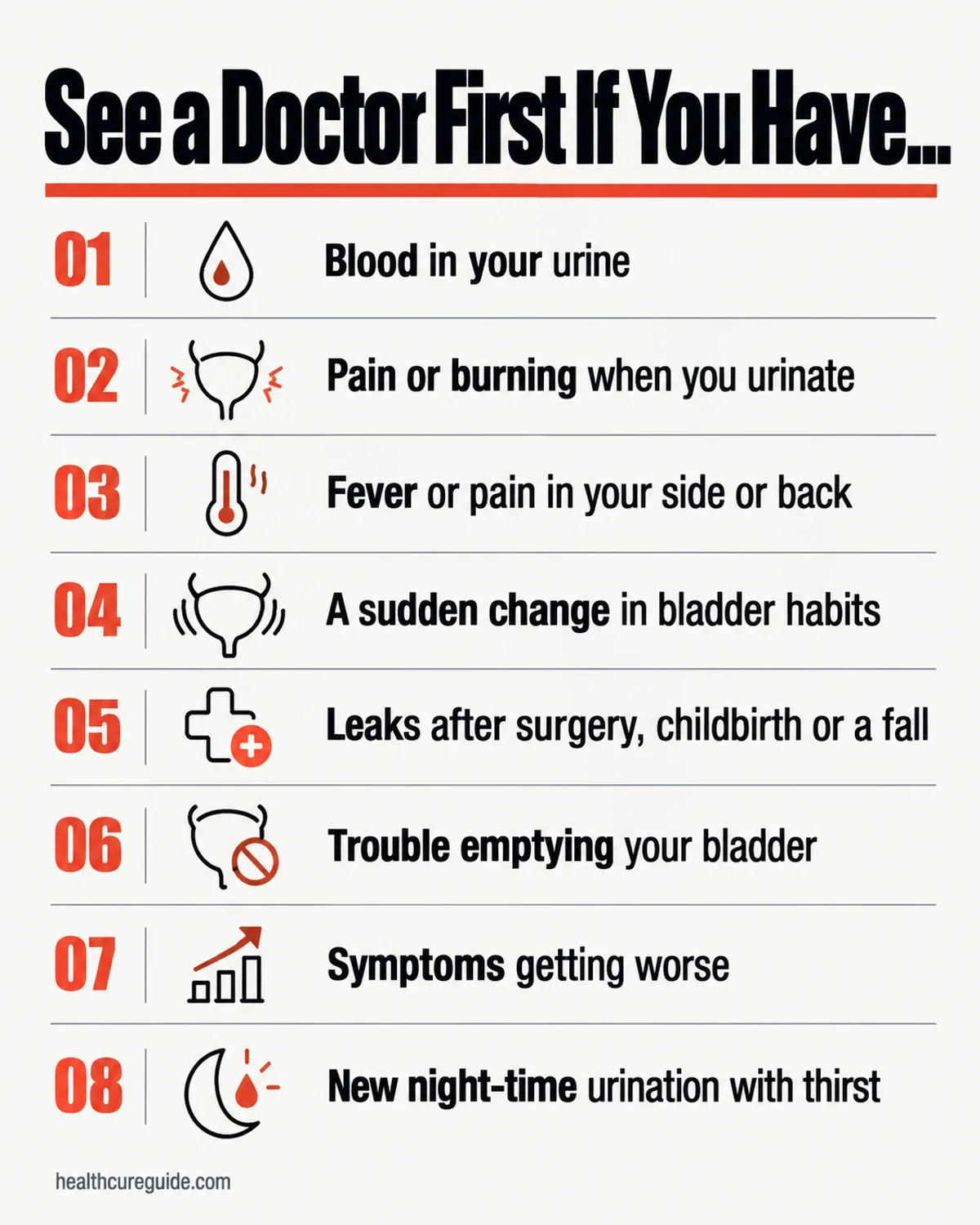
This is the most important section of this guide. Some urinary symptoms are signs of something that needs assessment and treatment. Trying a supplement first can delay that. See a clinician before taking FemiCore, or any bladder supplement, if you have:
- Blood in your urine, even once.
- Pain or burning when you urinate.
- Fever, chills or pain in your side or lower back, which can suggest a kidney infection.
- A sudden change in how often or how urgently you need to go.
- Leaking that started after surgery, childbirth or a fall.
- Difficulty starting or emptying your bladder, or a weak stream.
- Symptoms that are getting worse week by week.
- Night-time urination that is new, particularly with increased thirst, which can be a sign of diabetes.
Once these have been checked and anything treatable has been dealt with, a supplement can be a reasonable addition if your clinician agrees.
Questions to take to your pharmacist
If you are in the “check first” group, a pharmacist can usually answer this in a few minutes. Bring the bottle or a photo of the label, plus a list of everything you take, including other supplements. Useful questions:
- “Does berberine interact with any of my medicines, especially for blood sugar or blood pressure?”
- “Is cranberry a concern with my blood thinner?”
- “Is a daily bearberry-containing product suitable for me for two or three months?”
- “Is a live probiotic safe with my current treatment?”
- “If I start, what should make me stop and call you or my doctor?”
Because FemiCore uses a proprietary blend, the pharmacist will not be able to see exact doses. That is worth knowing in advance, and it is one more reason to start only when the answers are clearly reassuring.
Who should use FemiCore, by symptom type
Even within the target group, some symptoms fit the formula’s design better than others.
| Main symptom | Fit with FemiCore’s design | What else has strong evidence |
|---|---|---|
| Sudden urges, frequent trips | Good fit for a trial | Bladder training, urgency suppression techniques |
| Waking at night to urinate | Reasonable, but many causes | Evening fluid and caffeine timing; medical check if new |
| Repeat urinary tract infections | Cranberry is the best-evidenced ingredient | Clinician-led prevention plan |
| Leaks when coughing, laughing, lifting | Weak fit | Pelvic floor training with a physiotherapist |
| Mixed urgency and stress leaks | Partial fit | Pelvic floor training plus bladder training |
| Pain, burning, blood in urine | Not a fit | Medical assessment |
Many women find the best results come from combining approaches: pelvic floor exercises, sensible fluid habits, cutting back on bladder irritants like caffeine and alcohol, and a supplement if they want to try one.
How to use FemiCore if you are a good fit
If you sit in the target group and have checked any medication questions:
- Keep a short baseline diary for three days: daytime trips, night trips, urgent moments, leaks.
- Take one capsule each morning with water. Each bottle holds 30 capsules.
- Give it 8 to 12 weeks. Judging after two or three weeks is too early.
- Stop and seek advice if you get significant stomach upset, unusual symptoms or anything on the red-flag list above.
- Decide by around day 55. If your diary shows no meaningful change, the 60-day guarantee lets you return all bottles, opened or not, with the packing slip.
For help choosing between the 2, 3 and 6-bottle packages, our FemiCore buy guide matches each one to a goal.
Our view on who should use FemiCore
FemiCore makes the most sense for a woman with stable, mild to moderate urgency-type symptoms who wants a non-drug option, is not on interacting medication, and will track her symptoms for two to three months. It makes less sense for stress leaks alone, and no sense as a substitute for assessment when symptoms are new, painful or severe. Matching yourself honestly to that profile is the single best way to avoid wasting money or time.
This guide is general information and is not medical advice. Your own clinician, who knows your history and medications, is the right person to confirm whether FemiCore suits you.
For the full analysis of the formula and its evidence, read our FemiCore reviews.
Common questions
Who should use FemiCore?
FemiCore is designed for adult women with mild to moderate bladder urgency, frequent daytime trips, night-time wake-ups to urinate or occasional small leaks, who want a non-drug, stimulant-free option and are prepared to take it daily for 8 to 12 weeks. It suits women whose symptoms have already been checked or are long-standing and stable.
Who should not take FemiCore?
Women who are pregnant or breastfeeding, anyone under 18, and people with kidney disease should not take it without medical advice, mainly because of berberine and bearberry. People with weakened immune systems should check before taking any live probiotic. Anyone with new, painful or severe urinary symptoms should see a clinician before trying a supplement.
Can I take FemiCore if I am on medication?
Check with a pharmacist or doctor first if you take diabetes medication, blood-pressure medication, warfarin or another blood thinner, or several regular prescriptions. Berberine can lower blood sugar and affects how the liver processes some drugs, and cranberry may interact with warfarin.
Is FemiCore suitable after menopause?
Post-menopausal women are within the group FemiCore is marketed to, and bladder urgency becomes more common after menopause. The same cautions apply: check medications first, and remember that new or changing symptoms after menopause deserve a medical check, because they can have causes a supplement will not address.
Which urinary symptoms need a doctor instead of FemiCore?
Blood in the urine, pain or burning when urinating, fever, pain in the side or back, a sudden change in bladder habits, leaking after surgery, childbirth injury or a fall, difficulty emptying the bladder, or symptoms that are getting worse. These need assessment, not a supplement trial.
Does FemiCore help stress leaks from coughing or exercise?
It is not specifically designed for them. Stress leaks are largely a pelvic floor issue, and no ingredient in FemiCore strengthens muscle. Pelvic floor training has much stronger evidence for stress leaks. Women with mostly urgency symptoms are a better fit for what FemiCore is designed to do.
Can men use FemiCore?
FemiCore is formulated and marketed for women, and its probiotic strains are chosen for the female urogenital microbiome. Men with urinary symptoms should see a clinician, since prostate problems are a common cause and need a different approach.