FemiCore Reviews 2026: How to Read What You Find Online
Search for opinions on FemiCore this year and you land in four very different places. Each one is useful for some questions and useless for others. This guide sorts them, gives you an eight-point check for any single review, and lists the signs that mean you should stop reading.
- Written by
- HealthCure Guide Editorial Team
- Reviewed by
- HealthCure Guide Editorial Team
- Updated
- Reading time
- 10 min read
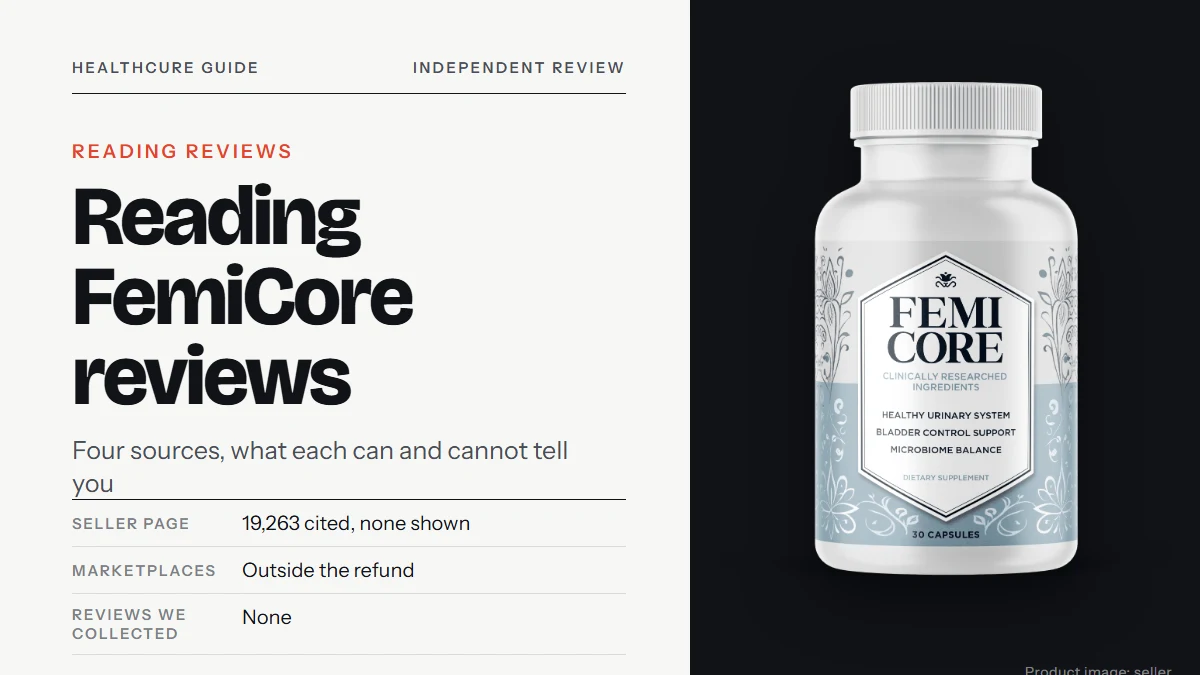
If you are reading FemiCore reviews 2026 results, you have probably noticed they do not agree, and that many of them look oddly alike. That is not surprising. The opinions come from sources with very different incentives and very different access to the facts. This guide works through each source in turn, then hands you a short checklist for any single review and a list of warning signs.
A word on us first. HealthCure Guide is independent of the company behind FemiCore; we are not its seller and we never take orders.
FemiCore reviews 2026: four places they turn up
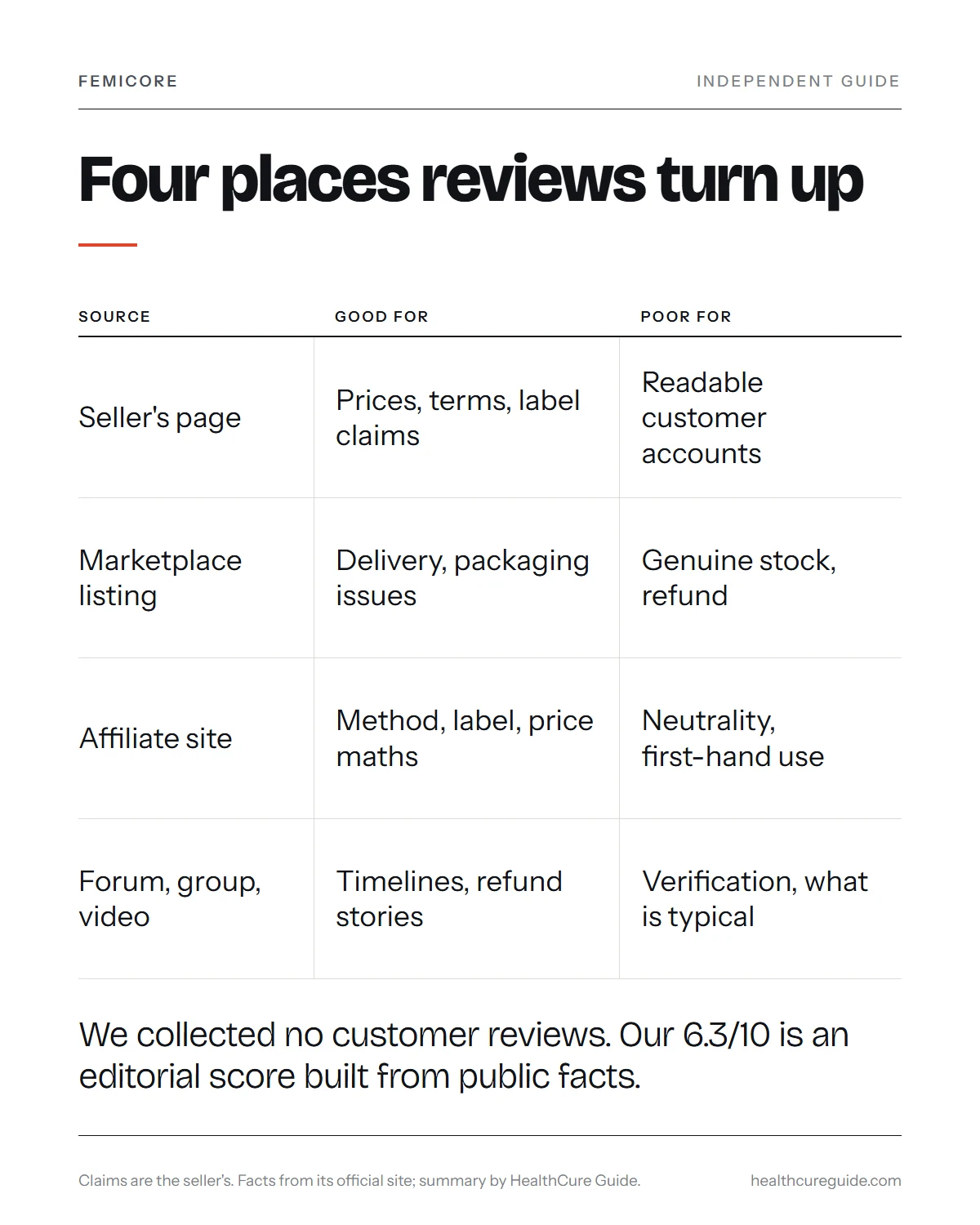
Each source is good for some questions and poor for others. Here is the short map.
| Source | Good for | Poor for |
|---|---|---|
| Seller’s page | Official prices, terms, label claims | Any readable customer account |
| Marketplace listing | Delivery and packaging problems | Genuine stock, refund protection |
| Affiliate review site | Method, label analysis, price maths | Neutrality, first-hand use |
| Forum, group, video | Personal detail, timelines, refund stories | Verification, what is typical |
No source does everything. The useful habit is to ask each one only the questions it can answer.
The seller’s own page
On our October 2026 check, the official home page and order page carried no individual testimonials. There were no names, quotes or photos of buyers. Instead there was a rating image and a line citing 19,263 reviews. Those reviews are not displayed, linked or filterable, so nobody outside the company can read them.
The fine print, for its part, says testimonials “may not reflect the typical purchaser’s experience”. Treat the official page as the place to check facts, such as the three packages, the 60-day refund counted from delivery, and the nine ingredients, not as a place to learn what buyers think. Our guide to the numbers looks at that review figure, and other scores, in more depth.
Marketplace listings
Per the seller, no Amazon, Walmart or eBay store is an authorized FemiCore outlet, and listings there may be fakes or old stock. Bottles from them also lose the 60-day refund. So comments on a marketplace page describe what one reseller shipped, not what the official store ships.
They are not worthless. Read them as a warning system. Comments that mention a bottle with a different capsule count from the official 30, a missing seal, a strange smell or a broken safety seal suggest stock you should not swallow. Comments praising a low price are, if anything, a red flag, because the official packages run from $79 down to $49 a bottle. Our scam warning guide explains how fake sellers work around products like this one.
Affiliate review sites
Much of what ranks for FemiCore in search is written by affiliate sites: pages that earn a commission when a reader buys. The commission does not make a page dishonest, but it does create a pull toward praise, so the useful question is how a site handles that pull.
Signs an affiliate review is trying to be fair:
- It says plainly that it may earn a commission.
- It states how it reached its verdict, and whether anyone actually took the product.
- It mentions the parts that cost buyers money: hidden doses in the proprietary blend, return postage, and the need to return every bottle.
- It says that there is no trial of the finished formula, and treats ingredient research as ingredient research.
- It carries a date, because prices and terms can change.
Our own long-form analysis is in our FemiCore reviews guide. Our editorial score is 6.3/10, and it is not built from customer opinion of any kind.
Forums, groups and video
Health forums, community threads, social media groups and video channels are where first-hand detail lives. A good post there can tell you things no sales page will: how long someone kept going, whether the early bloating settled, whether night trips changed, and how a refund request went.
The limits are just as real. You cannot confirm that the writer bought official stock, has the symptoms they describe, or is not being paid. Some video creators and group posters use affiliate links without saying so clearly, so check descriptions and pinned comments. And people with strong results, good or bad, post more often than people with middling ones, which skews any thread.
Use forums for patterns, not verdicts. If several unrelated posts describe the same refund delay, or the same timing for early stomach upset, that is worth knowing. One dramatic post is not.
When in the trial was it written?
The date a review was written, relative to when the person started, changes what it can tell you. Many accounts never say, so look for clues such as “two weeks in” or “finished my second bottle”.
| Written at | What it can tell you | What it cannot |
|---|---|---|
| First 1 to 2 weeks | Whether the capsule upset the stomach, and how the order arrived | Anything about bladder results |
| Weeks 3 to 8 | Early impressions, and whether the person kept a record | Whether a change will last |
| Around day 60 after delivery | The refund decision and how the process went | What happens after 3 months |
| After 3 months or more | The fullest picture of one person’s result | Whether you will get the same |
Gas or bloating in the first week or two is common with probiotics, so very early posts often read as complaints about the stomach. That is real information, but it is not information about bladder control. At the other end, the seller itself suggests about 3 months before judging, so a long-term account is the closest thing to a complete one.
The middle of that table matters most for your money. A review written near the refund deadline shows how one buyer weighed the two clocks: the 60 days from delivery and the 3 months the seller suggests. If that account explains how the person made the call, it can help you plan yours.
An eight-point usefulness check
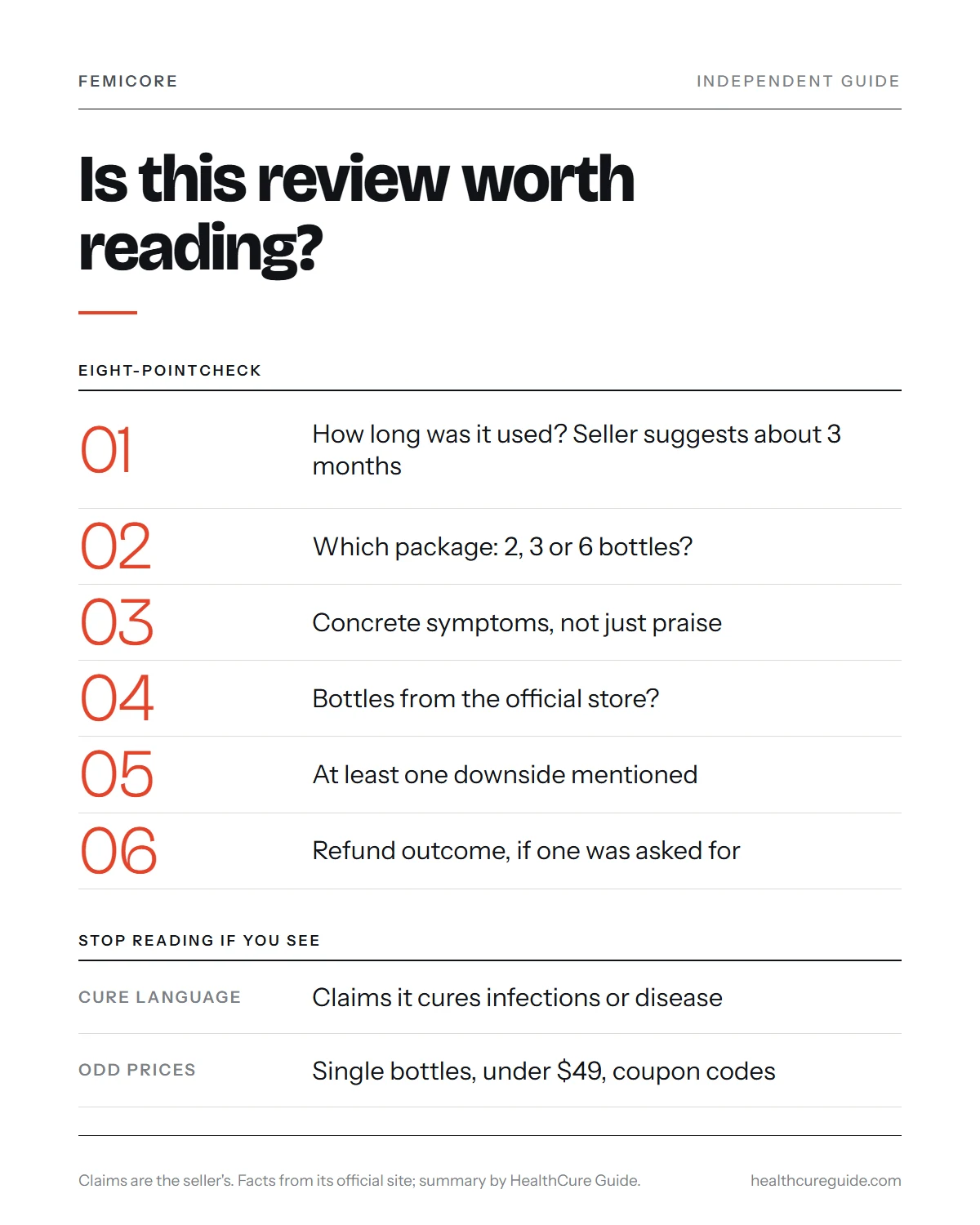
Run any single review through these questions. A review that passes five or more is worth your time.
| Question | Why it matters |
|---|---|
| Does it say how long the person used FemiCore? | The seller suggests about 3 months before judging |
| Does it name the package bought? | 2, 3 and 6 bottles change cost and timing |
| Does it describe symptoms in concrete terms? | “Fewer night trips” beats “life-changing” |
| Does it say where the bottles came from? | Only the official store carries the refund |
| Does it mention any downside at all? | No product has none |
| Does it mention other changes made at the same time? | Fluids, caffeine or exercise can shift symptoms |
| If a refund was asked for, does it say how it went? | The terms ask for every bottle and the packing slip |
| Does it avoid medical promises? | No supplement can be sold as a cure |
Warning signs that mean you should stop reading
Some features tell you a review is marketing, or worse, a route to a fake seller.
- Cure language. Any promise that the capsule will cure an infection, an overactive bladder or another disease. Its label makes support claims only.
- Approval claims. Any line saying the FDA has approved the capsule. All supplements follow the FDA’s supplement rules, and the “FDA registered facility” seal describes the factory, not the product.
- Odd prices. Single bottles, prices below $49, or coupon codes. Official orders come only as 2, 3 or 6 bottles.
- Rushed timelines. Dramatic results in days. Probiotic-based products are slow by the seller’s own advice.
- Copied text. The same paragraphs on several sites, or buyer photos that look like stock images.
- No method, no date, no disclosure. If a page will not say how it reached its view, when, or how it earns, give it little weight.
What we collected, and what we did not
To be plain about our own limits: we collected no customer reviews. We did not survey buyers, we did not quote anyone, and we did not take FemiCore ourselves. We have no customer score and we will not invent one.
What we did was read the official pages, most recently on October 9, 2026, compare the label with published research on its ingredients, and score what anyone can check. That gives you a clear picture of the product and the terms. It does not tell you how FemiCore will work for you, and no review, including ours, can.
Turning other people’s accounts into your own decision
Reviews are best used to sharpen questions, not to answer them. If several accounts mention early bloating, you know to expect it. If they mention refunds handled smoothly, or not, you know how carefully to keep your packing slip. If they mention night trips changing after a month or two, you know what to track.
Then build your own record. Note daytime trips, night trips, urgent moments and leaks for a few days before your first capsule, and again in the weeks before your refund deadline, 60 days after delivery. Pregnancy, breastfeeding, kidney disease, and medicines for diabetes, blood pressure, blood thinning or lithium all mean a talk with a doctor or pharmacist comes first. Seek medical care rather than a supplement for blood in the urine, fever, flank pain or burning.
The FemiCore catalog page brings the label, prices and terms together as a quick reference while you weigh what you have read.
This guide is general information, not medical advice.
Common questions
Why are there no customer comments on the official FemiCore site?
When we checked in October 2026, the home page and order page showed no individual testimonials: no names, quotes or buyer photos. They showed a rating image with a figure of 19,263 reviews, which is the seller's own and cannot be inspected. We do not know why the seller shows no comments. It simply means the official site gives you a claim, not readable accounts.
Did HealthCure Guide gather any customer accounts of FemiCore?
No. We did not collect, survey, quote or count customer reviews, and we did not take the capsules ourselves. Everything we publish about FemiCore is a desk assessment of the label, prices, terms and ingredient research. We would rather say that plainly than fill a page with accounts we cannot verify.
Can I trust what affiliate sites say about FemiCore?
Partly, if you check how they work. A page that names hidden doses, return postage and the lack of a finished-formula trial is more useful than one that only repeats the seller's claims.
How can I tell if a forum post about FemiCore is an advert?
Look at the account and the wording. New accounts with one post, links to a store in the first reply, coupon codes, prices that differ from the official $79, $69 and $49 a bottle, and no downside at all are typical signs. A genuine post usually answers follow-up questions and mentions how long the person used it.
Do marketplace comments about FemiCore describe the real product?
Not necessarily. The seller says Amazon, Walmart and eBay are not authorized outlets, and listings there may be fakes or old stock. Comments describe what that buyer received from that listing. They can still be useful as a warning, for example if buyers describe a bottle that does not match the official 30-capsule bottle.
How long should someone have used FemiCore before their opinion helps?
Longer than a week or two. The seller suggests about 3 months before judging, and early gas or bloating is common with probiotics, so very early accounts mostly describe the start. Accounts written after one to three months, that also say whether the person used the 60-day refund, carry the most information.
What does the FemiCore disclaimer about typical results mean?
The official site says its testimonials may not reflect the typical purchaser's experience. In plain words, any glowing account the seller uses is not a promise of what an average buyer gets. It is a standard caution, and it applies just as well to praise you read anywhere else.