Does FemiCore Really Work? An Honest Evidence Check
There is no clinical trial of FemiCore itself, so the only honest answer comes from weighing the research behind its ingredients against what women actually want from it: fewer urges, fewer night trips, fewer leaks. Here is where that evidence is solid, where it runs out, and how to test it on yourself without losing money.
- Written by
- HealthCure Guide Editorial Team
- Reviewed by
- HealthCure Guide Editorial Team
- Updated
- Reading time
- 8 min read
This guide contains affiliate links. If you buy through them we earn a commission at no extra cost to you. It does not change the verdict. Disclosure.
Does FemiCore really work? It is the question behind every other search about it, and it deserves a straighter answer than most pages give. The sales page says yes. Sceptics say no supplement can touch a bladder problem. Both skip the useful middle ground, which is working out what the ingredients can plausibly do, for which kind of symptom, over what time, and how you would know.
That is what this page does. It is not a full review and it does not repeat the price list. We earn a commission if you order through our links, which has no bearing on the verdict.
What “working” would actually mean
Before asking whether something works, it helps to define the target. Women usually buy FemiCore hoping for one or more of these:
- fewer sudden, hard-to-hold urges
- fewer trips to the toilet during the day
- fewer wake-ups at night to pass urine
- fewer or smaller leaks
- fewer urinary tract infections
The manufacturer describes FemiCore as designed to support bladder control and urinary health. It does not claim to cure incontinence or treat infection, and as a dietary supplement it cannot legally make those claims. So “working” realistically means a noticeable reduction in some of the list above, not their disappearance.
The theory is real
FemiCore is not built on a made-up premise. For decades, urine was assumed to be sterile. In 2012, Wolfe and colleagues used DNA-based methods to find bacteria living in the bladders of women whose standard urine cultures were negative. In 2014, Pearce and colleagues found that women with urgency urinary incontinence tended to have less Lactobacillus in their urinary microbiome than women without it. A 2018 study by Thomas-White and colleagues showed that bladder and vaginal bacteria are closely linked.
FemiCore takes that research and turns it into a hypothesis: if women with urgency have fewer Lactobacillus bacteria, adding Lactobacillus and making the environment less friendly to other bacteria might help.
The weak link is the step from association to cause. Those studies show a difference between groups. They do not show that the difference causes urgency, or that a supplement can reverse it. That experiment has not been published, for FemiCore or for any similar product we can cite.
What the ingredients can and cannot do
Here is the evidence condensed to one table. The FemiCore ingredients list has the background on each.
| Ingredient | What the evidence supports | What it does not show |
|---|---|---|
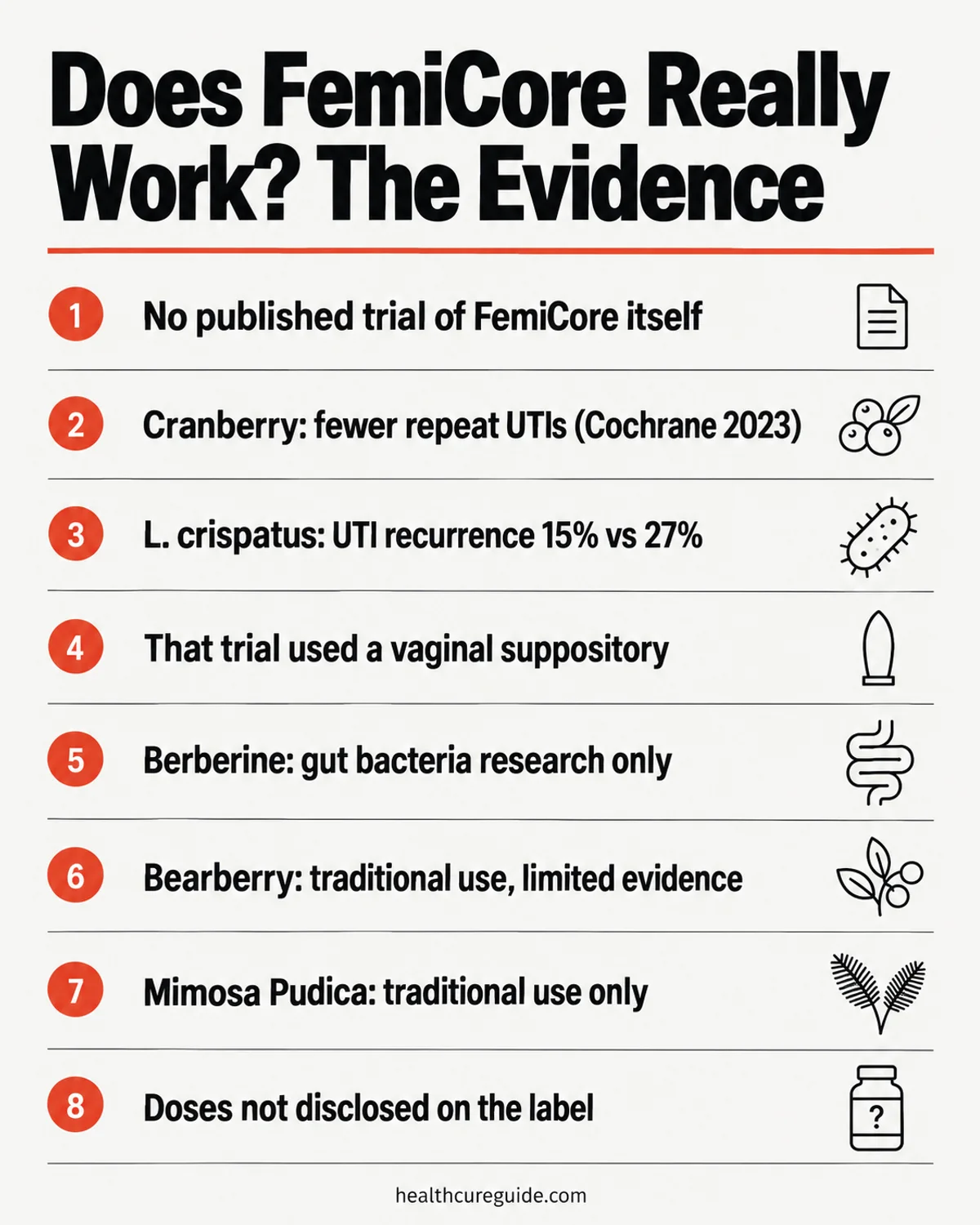
| Cranberry extract | Fewer repeat UTIs in some groups (Cochrane 2023) | Any effect on urgency or leaks |
| L. crispatus | Lower UTI recurrence, 15% vs 27%, with a vaginal suppository (Stapleton 2011) | That an oral capsule works the same way |
| Other four Lactobacillus species | General probiotic use | Any bladder outcome |
| Granular Berberine | Effects on gut bacteria (Habtemariam 2020 review) | Any bladder outcome |
| Bearberry | Traditional urinary use; evidence limited (NCCIH) | Benefit from long-term daily use |
| Mimosa Pudica | Traditional use | Any human trial |
Two patterns stand out. First, the best evidence is about infection, not urgency. Second, even the best evidence comes from products used at known doses, sometimes by a different route, while FemiCore’s doses are undisclosed. That does not mean the formula fails. It means the evidence does not let anyone promise it works.
Does FemiCore really work for your kind of symptoms?
The answer changes a lot depending on what is behind your symptoms.
More likely to be worth a try
- Mild to moderate urgency and frequency with no obvious other cause. This is where the microbiome research is focused.
- Night-time trips that have crept up over time, alongside daytime urgency.
- A history of repeat UTIs that a doctor has investigated, where you want extra support between episodes. Cranberry and L. crispatus point most directly here.
- Women who want a non-drug option to try first, or alongside pelvic floor work.
Less likely to help
- Pure stress leaks when coughing, sneezing, laughing or lifting. That is mostly about pelvic floor support, which no capsule strengthens.
- Symptoms caused by another condition, such as a prolapse, a neurological condition or a medication side effect.
- Anyone hoping for a result in days. The mechanism is slow by design.
Should not use it as a first step
New, painful or worsening symptoms, blood in the urine, fever, or side and back pain need a doctor before any supplement. The same goes for pregnancy and kidney disease. Our FemiCore side effects guide lists the medication cautions.
A realistic timeline: 8 to 12 weeks
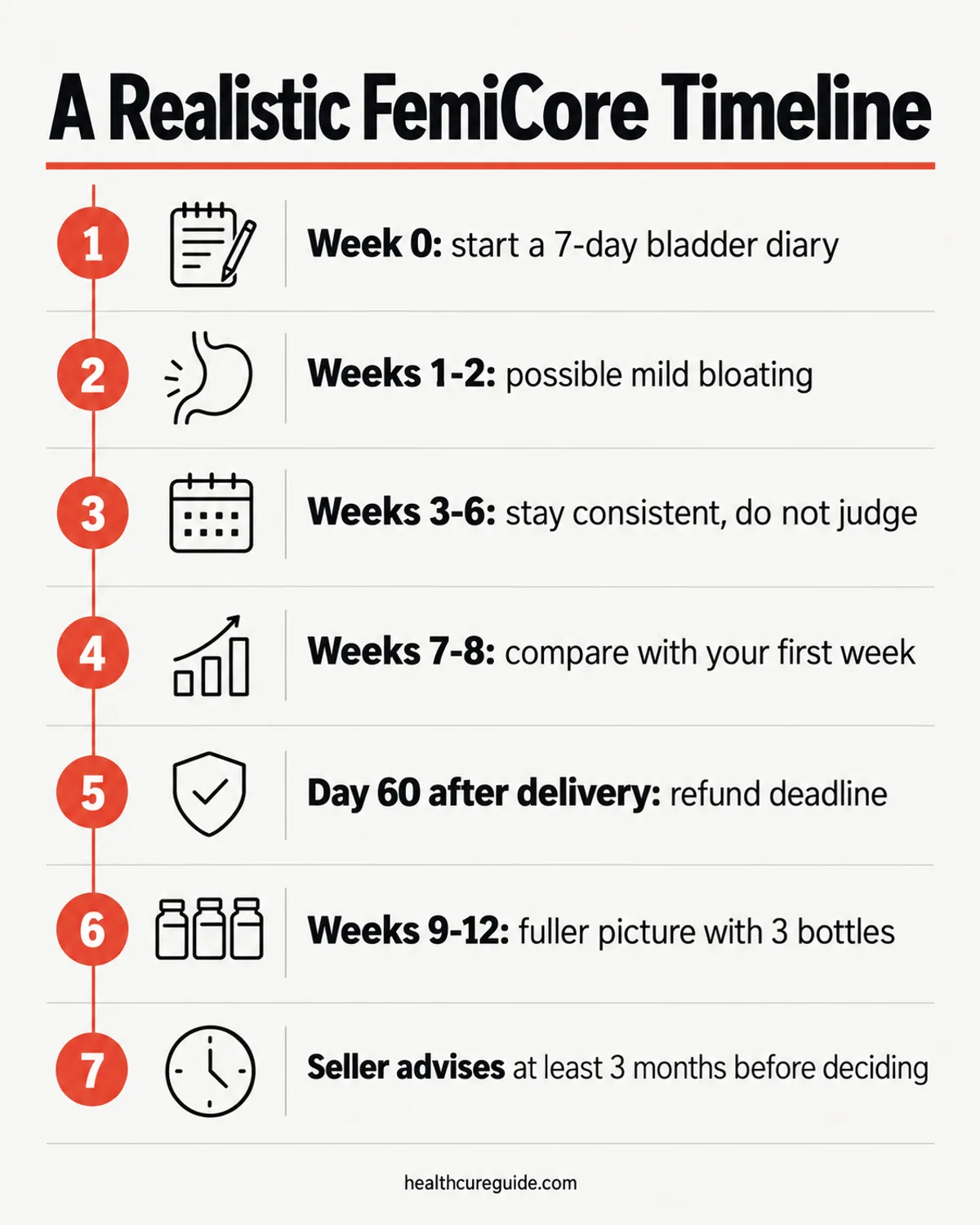
The seller advises using it for at least 3 months before deciding. Based on how probiotic studies run, we treat 8 to 12 weeks as a realistic window, which matches the gradual way probiotic changes are thought to build. Here is what that window might look like in practice. It is a planning guide, not a prediction of anyone’s result.
| Period | What to expect | What to do |
|---|---|---|
| Weeks 1 to 2 | Possible mild bloating; bladder symptoms unlikely to change | Take it daily with breakfast, keep your diary going |
| Weeks 3 to 6 | Any early change, if it comes, is likely to be small | Do not judge yet; stay consistent |
| Weeks 7 to 8 | The point to compare against your starting numbers | Decide before the 60-day guarantee ends |
| Weeks 9 to 12 | Fuller picture if you kept going | Only possible with a 3-bottle order or a reorder |
There is an awkward fact in that table. The guarantee runs for 60 days from delivery, a little over eight weeks, while the suggested window runs to twelve. So the decision about a refund has to be made at the start of the window, not the end. If you see no change at all by week eight, that is meaningful. If you see a small change, you may want the extra month to be sure, which is the case for a 3-bottle order.
How to find out if it works for you
Without a baseline, every supplement either “sort of worked” or “did nothing”, and neither verdict is reliable. A simple record solves that.
| What to record | How | Why |
|---|---|---|
| Daytime toilet trips | Tally on your phone | Shows frequency changes |
| Night-time wake-ups to urinate | Note each morning | Often the easiest change to spot |
| Strong urges you struggled to hold | Tally | Tracks urgency directly |
| Leaks, and what triggered them | Note with a word: cough, urge, lift | Separates urge leaks from stress leaks |
| Caffeine and alcohol that day | Rough count | Removes the biggest confounders |
Keep the record for a week before the first capsule, then carry on. At around day 50, compare your last week with your first. Change things one at a time: if you start pelvic floor exercises in the same month, that is excellent for you but makes it harder to credit either one.
The 60-day guarantee is your control
Because there is no product trial, the guarantee is effectively the trial. The terms are:
- Email support within 60 days of the day your order is delivered, with “Refund Request” in the subject line.
- Return every bottle from the order, opened or unopened, with the packing slip and a note giving your name, email and order ID.
- The purchase price is refunded to the original payment method. Return shipping is at your own cost.
The guarantee only covers orders from the official website, through its BuyGoods checkout. The cheapest way to test FemiCore across the full guarantee window is the 2-bottle package at $79 a bottle plus $9.99 US shipping, about $2.80 a day. The 3-bottle package, $207 with free US shipping, buys you the extra month the 8 to 12 week timeline suggests. Keep the box and slip from day one.
What would change our answer
Our verdict rests on the gap between ingredient research and product proof. Three things would narrow that gap, and they are worth looking for if the manufacturer ever publishes more.
A trial of the finished capsule. Ideally randomised and placebo-controlled, in women with urgency or frequency, measuring diary outcomes over at least eight weeks. That is the only evidence that would answer the question directly.
Disclosed amounts. If the label listed the cranberry, berberine and bearberry content per capsule, it would be possible to compare FemiCore with the doses used in research, and to judge safety more precisely.
Named strains and a live count. Probiotic results can differ between strains of one species. A strain code for the L. crispatus and a colony-forming unit figure would show whether the most promising ingredient resembles what was tested.
Until any of those appear, the honest position is “plausible, not proven”, and your own diary is the best evidence you will get.
So, does FemiCore really work?
It might, for some women, for some symptoms. The formula follows credible research, its two best-supported ingredients are relevant to urinary health, and its safety profile suits most healthy adults. What it lacks is direct proof, and the evidence it does have is stronger for infection prevention than for urgency and leaks. If your symptoms are mild urge-type problems, you have seen a doctor about anything new, and you are willing to keep a simple record for eight weeks, it is a fair experiment with a refund behind it. If your leaks are mainly stress leaks, put your effort into pelvic floor training first. Our long FemiCore reviews piece covers the wider picture, including how it compares with other options.
Common questions
Has FemiCore been tested in a clinical trial?
Not as a finished product, as far as we can find. There is no published trial of the FemiCore formula. The evidence available is for some of its individual ingredients, mainly cranberry and Lactobacillus crispatus, and for the bladder microbiome research the formula is built around. That is useful context, but it is not proof that the capsule itself works.
How long does FemiCore take to work?
The seller advises using it for at least 3 months before deciding. In our view 8 to 12 weeks is a realistic window, which fits the slow way probiotic changes are thought to happen. Very little is likely to change in the first two weeks. If you are going to notice a difference, it should be visible by week eight. Note that the 60-day guarantee ends before week nine, so judge your results before then.
Does FemiCore work for stress incontinence?
It is a weaker fit. Stress incontinence, leaking when you cough, sneeze or lift, is mostly a mechanical problem with pelvic floor support. FemiCore's ingredients act on bacteria and the urinary tract environment, not on muscle strength. Pelvic floor training has much better evidence for stress leaks, and a capsule is no substitute for it.
Does FemiCore work for urinary tract infections?
FemiCore is not a treatment for a UTI, and a suspected infection needs a doctor. For prevention, two of its ingredients have relevant evidence: cranberry, supported by a 2023 Cochrane review, and Lactobacillus crispatus, which lowered recurrence in a trial using a vaginal suppository. The FemiCore doses are not disclosed, so how closely it matches that research is unknown.
What if FemiCore does not work for me?
Use the 60-day money-back guarantee. Contact support within 60 days of delivery, return every bottle from the order, opened or unopened, with the packing slip, and the purchase price is refunded to your original payment method. Return shipping is at your own cost. Set a reminder for around day 50 so you have time to post the parcel.
Why do some women say FemiCore works and others say it does not?
Bladder symptoms have many causes, and FemiCore targets only one of them, the bacterial environment of the urinary tract. A woman whose urgency is linked to that may respond; a woman whose leaks are mechanical or caused by another condition probably will not. Expectations and how long people take it also vary a lot.
Sources
- Wolfe AJ et al. Evidence of uncultivated bacteria in the adult female bladder. J Clin Microbiol. 2012.
- Pearce MM et al. The female urinary microbiome: a comparison of women with and without urgency urinary incontinence. mBio. 2014.
- Thomas-White K et al. Culturing of female bladder bacteria reveals an interconnected urogenital microbiota. Nat Commun. 2018.
- Stapleton AE et al. Randomized, placebo-controlled phase 2 trial of a Lactobacillus crispatus probiotic given intravaginally for prevention of recurrent urinary tract infection. Clin Infect Dis. 2011.
- Williams G et al. Cranberries for preventing urinary tract infections. Cochrane Database Syst Rev. 2023.
- Habtemariam S. Berberine pharmacology and the gut microbiota: a hidden therapeutic link. Pharmacol Res. 2020.
- National Center for Complementary and Integrative Health. Uva Ursi.