Does FemiCore Work? A Goal-by-Goal Answer and Test Plan
Women buy FemiCore for different reasons, and the honest answer changes with the reason. We take each goal in turn, say what the research behind the formula can and cannot support, then lay out a simple way to find out for yourself before the refund window closes.
- Written by
- HealthCure Guide Editorial Team
- Reviewed by
- HealthCure Guide Editorial Team
- Updated
- Reading time
- 9 min read
This guide contains affiliate links. If you buy through them we earn a commission at no extra cost to you. It does not change the verdict. Disclosure.
Does FemiCore work? The question sounds like it should have one answer, but buyers mean very different things by it. One woman wants to stop leaking at the gym. Another wants to sleep through the night. A third has had three infections this year and wants fewer. The formula was not built equally for all of them, and the evidence behind it is uneven from goal to goal.
So this page goes goal by goal. For each one we say what the seller suggests, what the research can support, and what you can realistically hope to notice. The second half is a practical plan for judging the capsule on your own body inside the refund window. For the full evidence review, our earlier piece asking does FemiCore really work goes deeper, and the mechanism is traced step by step in how FemiCore is meant to work.
We are an independent site, not the seller, and we may earn a commission if you buy through our links.
Does FemiCore work? Start by naming your goal
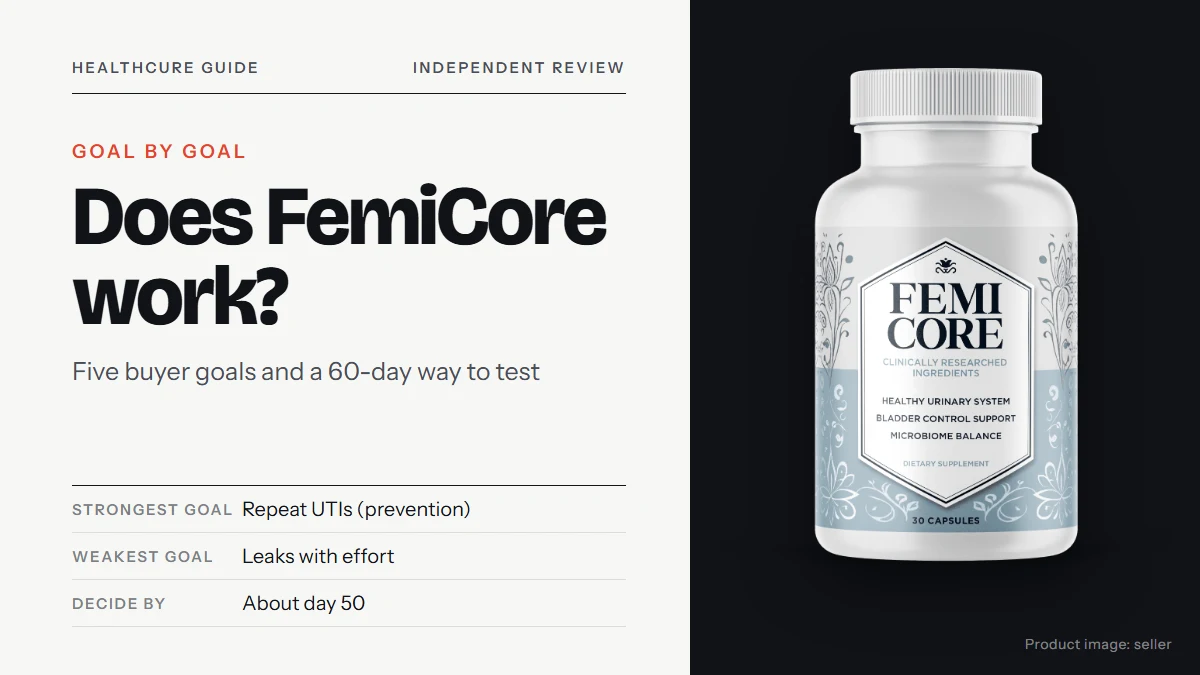
The label makes three promises: “Healthy urinary system”, “Bladder control support” and “Microbiome balance”. Behind those promises sit four plants (cranberry extract, bearberry, granular berberine, Mimosa pudica) and five Lactobacillus species (crispatus, acidophilus, plantarum, gasseri, casei), all inside one proprietary blend with no amount printed for any of them.
Before you read on, pick the one goal that matters most to you. A test that tries to judge everything at once usually ends with “maybe”. A test aimed at one goal can give you a yes or a no.
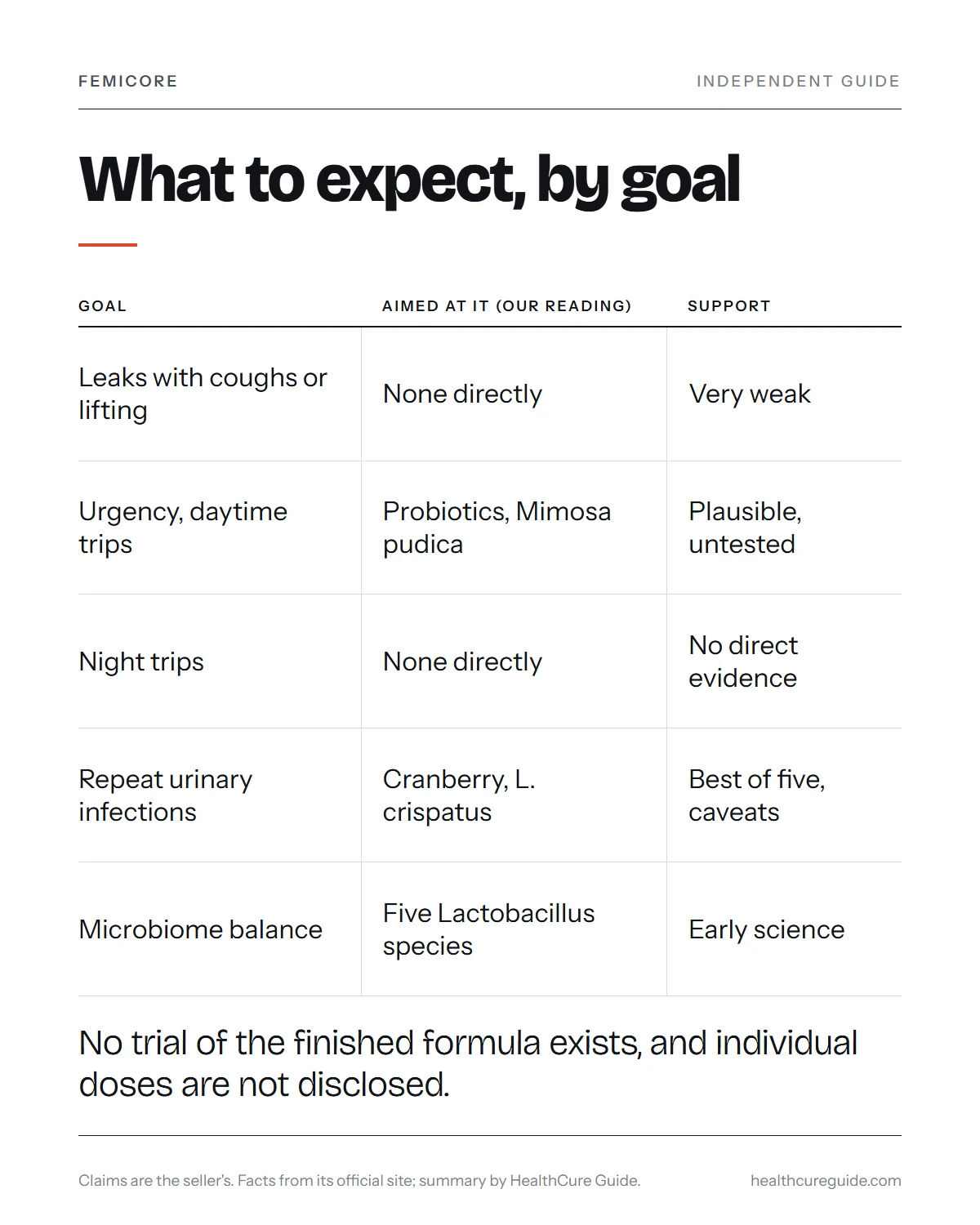
| Your main goal | Ingredients aimed at it (our reading) | Strength of support | Realistic hope |
|---|---|---|---|
| Fewer leaks with coughs or lifting | None directly | Very weak | Little change expected |
| Fewer sudden urges, fewer daytime trips | Probiotics, Mimosa pudica | Plausible, untested | A modest change at best, if any |
| Fewer trips at night | None directly | No direct evidence in our sources | Unknown; other causes are common |
| Fewer repeat urinary infections | Cranberry, L. crispatus | Best of the five, with caveats | The most plausible goal |
| “Microbiome balance” | Five Lactobacillus species | Early science | Cannot be measured at home |
Goal one: fewer leaks
Leaks come in two broad kinds, and the difference matters a great deal here.
Leaks with effort. If you leak when you cough, sneeze, laugh, jump or lift, the usual cause is that the pelvic floor is not supporting the bladder and urethra well enough under pressure. None of the nine ingredients is aimed at muscle strength or tissue support. We would not expect a capsule to change this kind of leak, and pelvic floor training or a visit to a specialist is the more sensible place to put your effort.
Leaks after a sudden urge. If you leak because the urge arrives too fast to reach the toilet, you are closer to the target the formula seems built for. When Pearce and colleagues compared women in 2014, those with urgency incontinence tended to carry less Lactobacillus in the bladder. That is an association between groups, not proof that adding bacteria by mouth reduces leaks.
What to expect. For effort leaks, very little. For urge leaks, possibly a small change over weeks, possibly none. Your diary should record what triggered each leak so you can tell the two kinds apart.
Goal two: less urgency and fewer daytime trips
This is the goal the “Bladder control support” claim seems to point at. Two parts of the formula are relevant. The probiotics are the main bet, resting on the bladder microbiome research. Mimosa pudica has lab and animal reports of antispasmodic effects, which is the property you would point to for a calmer bladder, but no human trial has tested it for bladder symptoms.
What can be supported. The female bladder has its own bacteria, and urgency has been linked with fewer Lactobacillus. The idea is grounded.
What cannot. Nobody has shown that a swallowed probiotic reaches the bladder and settles there, the strains are not named, and the live count is not given. FemiCore itself has not been tested for urgency.
What to expect. If anything changes, think in terms of slightly fewer trips or slightly fewer “I have to go now” moments over several weeks, not a sudden shift. Count both every day. Frequency is easy to tally and hard to fool yourself about.
Goal three: fewer trips at night
Many buyers care most about sleep. Waking two or three times a night to pass urine wears people down. The honest position is that our sources contain no research on night-time urination for any of the nine ingredients. Any benefit would have to come indirectly, through the same urgency effect described above.
Night trips also have many causes that a capsule cannot touch: how much you drink in the evening, caffeine or alcohol late in the day, sleep that is light for other reasons, and some medical conditions and medicines. If night trips are new or have increased quickly, mention them to a doctor before trying any supplement.
What to expect. Unknown. Night trips are, however, the easiest number to record, because you only have to write one figure each morning. If they fall and stay down while your evening drinks stay the same, that is a result worth noting.
Goal four: fewer repeat urinary infections
Here the formula has its firmest footing, with two caveats that matter.
Cranberry. A-type proanthocyanidins (PACs) in cranberry make it harder for E. coli to cling to the urinary tract. A 2023 Cochrane review concluded that cranberry products can reduce repeat infections in women who are prone to them, after earlier reviews had been mixed. The effect depends on the PAC dose, and FemiCore does not print its PAC content.
L. crispatus. In a small placebo-controlled trial, an L. crispatus product lowered repeat infections. That product was used vaginally. FemiCore is a capsule you swallow, and it names species, not the strain used in that trial.
What to expect. This is the most plausible of the five goals, but only for prevention, and only as a possible reduction in how often infections return. Repeat infections are also slow to judge. If you usually have one every few months, 60 days may simply be too short to tell. In that case your diary will show more about tolerability than about effect, and you should say so to yourself honestly at day 50.
FemiCore is not a treatment for an infection you have now. Burning, fever, chills, side pain or blood in the urine need a doctor.
Goal five: “microbiome balance”
The third label claim is the hardest to judge, because you cannot see it. The science behind it is real: from about 2012, sequencing studies, with Loyola University Chicago among the early groups, showed that the female bladder is not sterile. The idea that its bacterial mix can be out of balance is a reasonable hypothesis. Still, the research is young, and no one has yet shown that swallowing a probiotic shifts bladder symptoms.
For a buyer, “balance” only becomes meaningful through the other four goals. There is no practical home test, so a claim about balance can only be judged by whether your symptoms change. The one thing you may feel directly is your gut. Many people get some wind or a swollen feeling during the opening fortnight on any new probiotic.
A 60-day bladder diary plan
Because there is no trial of the finished capsule, your own record is the closest thing to evidence you will get. The plan below fits inside the refund, which runs 60 days from the delivery date. The seller advises at least three months before judging, which is longer than the window, so the plan puts your decision at day 50.
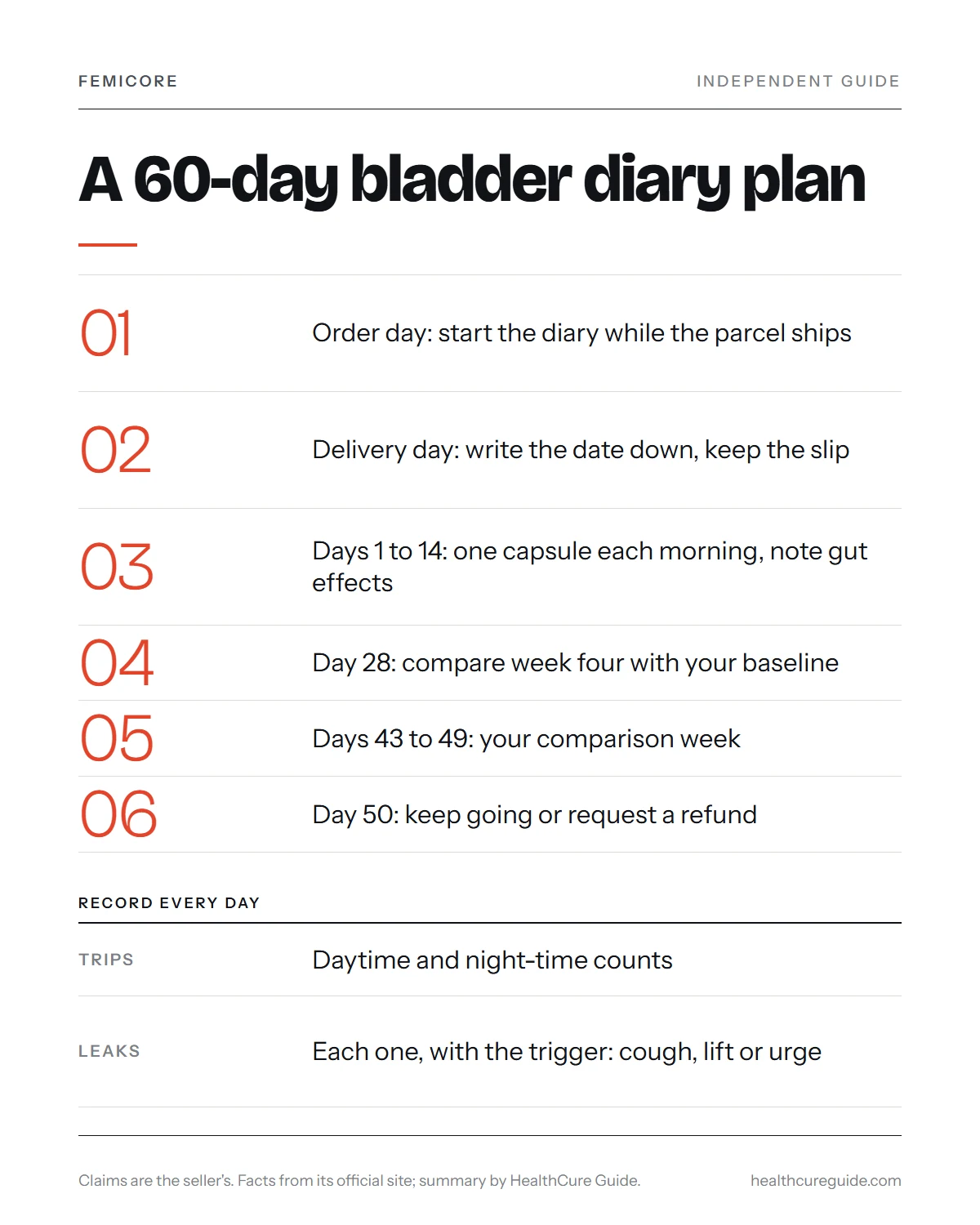
| When | What to do | Why it matters |
|---|---|---|
| Day you order | Start the diary while the parcel is on its way | Your baseline costs no refund days |
| Delivery day (day 0) | Write the date on the box; keep the packing slip | The refund deadline is day 60 |
| Days 1 to 14 | A capsule at breakfast time, washed down with a large glass of water; note gut effects | Probiotic bloating usually shows early |
| Day 28 | Compare week four with your baseline | An early look, not a verdict |
| Days 43 to 49 | Your comparison week; keep drinks and habits steady | The week you will judge on |
| Day 50 | Decide: keep going or request a refund | Leaves time to post the return |
Each day, write down the same few things: daytime trips, night trips, strong urges, leaks with the trigger (cough, lift or urge), any infection symptoms, and anything else that changed, such as a new medicine, more coffee or a cold. One line a day is enough.
If you plan to use the refund, email support with “Refund Request” in the subject, then send back all the bottles from that order, used or not. Put the packing slip in the parcel along with a short note listing your order id, name and email. Return postage is yours to pay. The return address on the seller’s refund page is in Tallmadge, Ohio.
What counts as a change worth keeping
The hardest part of any self-test is being fair to the result. A few rules help.
- Set your bar before you start. Write down what change would justify paying $49 to $84 a month. “Fewer night trips most weeks” is a bar. “Feeling a bit better” is not.
- Compare weeks, not days. Bladder symptoms vary from day to day. Average your baseline days, average your comparison week, and compare the two.
- Look for a change you would notice without the diary. If you need a calculator to find it, it may not be worth the money.
- Rule out the obvious alternatives. Less coffee, cooler weather, a new exercise habit or a medicine change can all move the numbers. If one of those happened, the result is less clear.
- Judge your main goal first. A small improvement in a side goal does not rescue a test where the main goal did not move.
These are our suggestions for a fair personal test, not medical thresholds. If your doctor has set targets with you, use those.
When to stop before day 60
A test is not worth finishing if something is going wrong. Stop and get advice if:
- your stomach is still unsettled, bloated or gassy after roughly two weeks
- a rash or any other reaction appears that concerns you
- you find you are pregnant, or you begin breastfeeding
- a doctor starts you on a new medicine, especially for diabetes, blood pressure or blood thinning, because berberine and cranberry can interact with some drugs
Some signs need a doctor quickly whether or not you take anything: urine with blood in it, a fever or shivering, pain in the flank, stinging as you pass urine, a sudden loss of the control you had, or an older relative with urinary symptoms who becomes newly confused. The seller’s own site tells women who are pregnant or nursing, take medication or have a medical condition to check with a physician first. Each ingredient’s cautions are set out in our guide to possible side effects.
So, our answer
FemiCore has a sensible case for one goal, fewer repeat infections, a plausible but untested case for urgency and daytime trips, no direct evidence for night trips, and almost no case for leaks with effort. Behind all of it sits one gap: no trial of the finished formula, and no published doses to compare with the research.
That makes the right question not “does it work” in general, but “does it work for my goal, on my numbers, by day 50”. If your goal is one of the plausible ones and a doctor has checked anything new, a written 60-day test with the refund behind it is a fair way to find out. Our FemiCore buyer guide has the full picture, including who should skip it.
Common questions
Which goal is FemiCore least likely to help with?
Leaks that happen when you cough, sneeze, laugh or lift. Those are mostly about how well the pelvic floor supports the bladder, and nothing in the formula is aimed at muscle or tissue support. The ingredients are aimed at bacteria and the urinary tract environment. If your leaks are of that kind, pelvic floor training or a specialist visit is a better first step than a capsule.
Should I start my bladder diary before the bottles arrive?
Yes, if you can. The 60-day refund is counted from the delivery date, so a baseline week recorded after delivery uses up part of your window. Ordering, then keeping the diary during the 5 to 7 business days of US shipping, gives you a starting record without spending any refund days on it.
Can I measure my bladder microbiome at home to see if FemiCore is working?
No practical home test exists for that, and the research that found bacteria in the female bladder used laboratory sequencing. For an ordinary buyer, the only things you can track are symptoms: daytime trips, night trips, urgent moments, leaks and infections. That is why a written record matters more than any claim about balance.
What result should make me keep buying FemiCore?
Decide that before your first capsule. Write down what change would be worth $49 to $84 a month to you, such as fewer night trips most weeks. Then compare your first and last diary weeks. If the change is clear in the numbers and nothing else in your routine explains it, continuing is a reasonable choice. A vague feeling is not enough.
Is a bad first two weeks a sign that FemiCore is not right for me?
Not necessarily. Gas or bloating in the first one to two weeks is a common reaction to probiotics, and FemiCore contains five Lactobacillus species. If it settles, carry on with your test. If it does not settle after about two weeks, or you get anything more than mild discomfort, stop and talk to a pharmacist or doctor.
Does FemiCore treat a urinary infection I have right now?
No. It is a dietary supplement, not a treatment, and a suspected infection needs a doctor. Burning when you pass urine, fever or chills, pain in your side or blood in the urine are reasons for a medical appointment, not for starting or continuing a supplement. The cranberry research behind the formula is about preventing repeat infections.
Why might two women get different results from the same bottle?
Because bladder symptoms come from many causes and the formula targets only one idea, the bacterial environment of the urinary tract. Someone whose urgency is linked to that may notice a change, while someone with mechanical leaks or another condition probably will not. Consistency, other habits and how long each person keeps going also differ.
Sources
- Wolfe AJ et al. Evidence of uncultivated bacteria in the adult female bladder. J Clin Microbiol. 2012.
- Pearce MM et al. The female urinary microbiome: a comparison of women with and without urgency urinary incontinence. mBio. 2014.
- Stapleton AE et al. Randomized, placebo-controlled phase 2 trial of a Lactobacillus crispatus probiotic given intravaginally for prevention of recurrent urinary tract infection. Clin Infect Dis. 2011.
- Williams G et al. Cranberries for preventing urinary tract infections. Cochrane Database Syst Rev. 2023.