Is FemiCore Trustworthy? A Claim-by-Claim Check
A sales page is a set of promises. Some you can check in two minutes, some only partly, and some rest on nothing but the seller's word. We sorted every FemiCore statement into those three piles.
- Written by
- HealthCure Guide Editorial Team
- Reviewed by
- HealthCure Guide Editorial Team
- Updated
- Reading time
- 9 min read
This guide contains affiliate links. If you buy through them we earn a commission at no extra cost to you. It does not change the verdict. Disclosure.
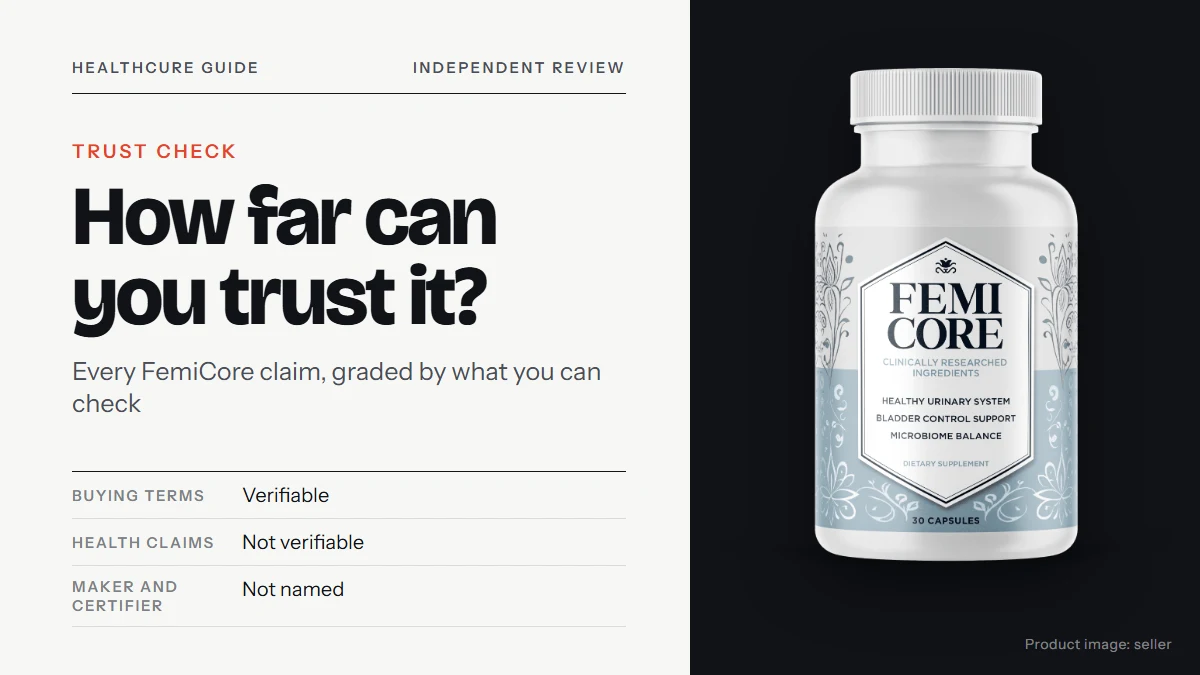
Is FemiCore trustworthy? The question is too broad to answer in one word, because a sales page makes many different kinds of statement. Some are commitments you can hold the seller to. Some are claims about health that nobody has tested on this product. Some are numbers only the seller can see. So instead of one verdict, we took each statement on the official site and label, and asked a simple question of it: can a buyer check this?
We are an independent site, not the seller. The buttons on this page are affiliate links, and a purchase through one may earn us a commission without changing your price.
How we graded each FemiCore claim
Every statement gets one of three grades. The grade is about checkability, not about whether we think the statement is true.
| Grade | What it means | Example |
|---|---|---|
| Verifiable | You can confirm it yourself, before or right after paying | The price at checkout |
| Partly verifiable | Some of it can be confirmed, the rest rests on the seller | “Natural ingredients” |
| Not verifiable | Only the seller holds the evidence, or none is shown | A review count with no reviews |
A statement graded “not verifiable” may still be true. It simply asks you to take the seller’s word, and the more of those a product has, the more carefully you should buy. For the business-side checks (who sells it, how payment and refunds work), our legitimacy audit goes through each one. This page stays with the claims.
Is FemiCore trustworthy on its health claims?
The label promises three things: “Healthy urinary system, Bladder control support, Microbiome balance”. It also says “Clinically researched ingredients”. Here is how each one grades.
| Statement | Grade | Why |
|---|---|---|
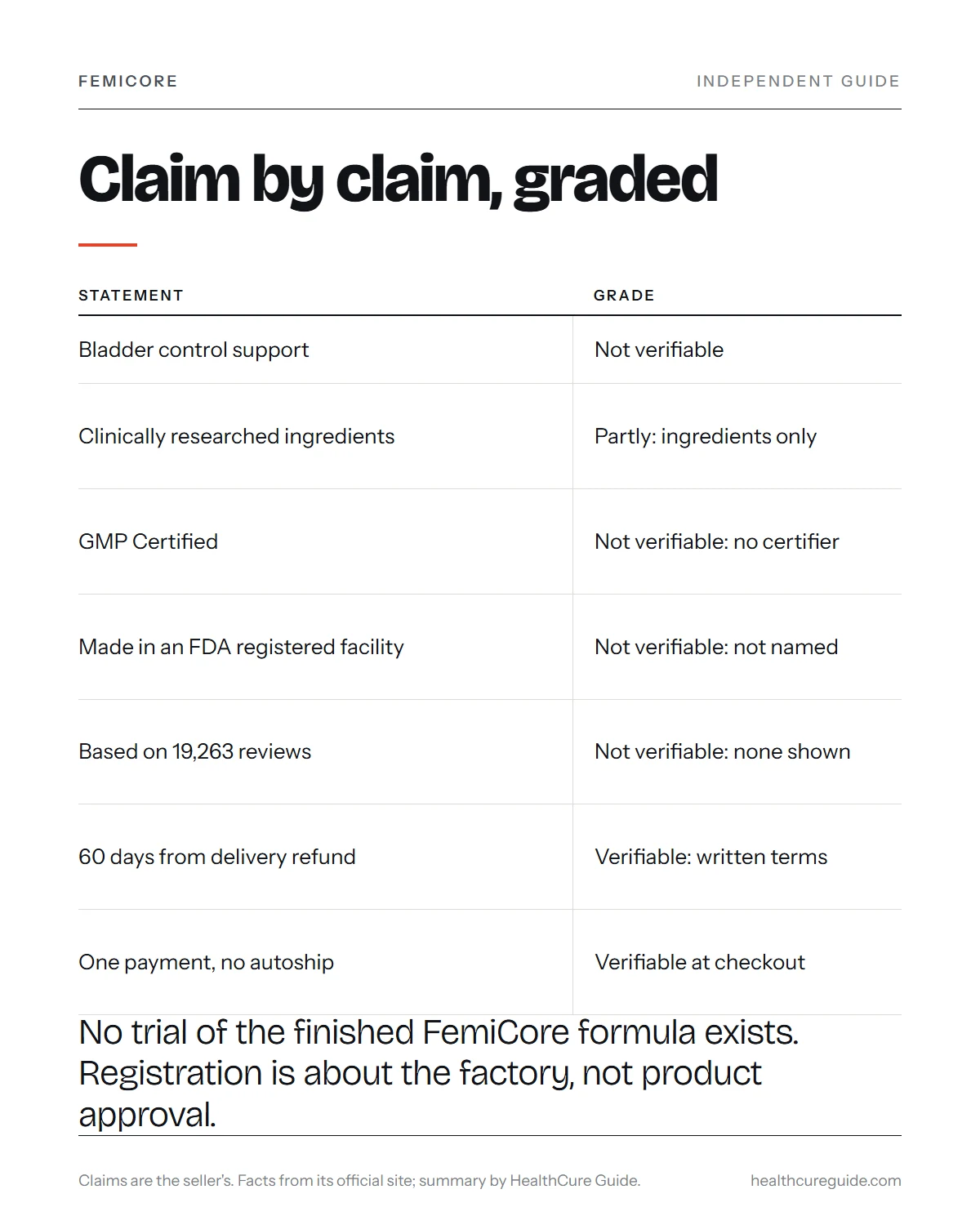
| Healthy urinary system | Not verifiable | No trial of the finished formula; ingredient studies only |
| Bladder control support | Not verifiable | Main ingredient research concerns infections, not leaks or urgency |
| Microbiome balance | Not verifiable | Early science on the bladder microbiome; no test of this capsule |
| Clinically researched ingredients | Partly verifiable | True of several ingredients alone, not of FemiCore |
The research picture behind those grades, in brief:
- The microbiome idea. Since about 2012, DNA sequencing has shown that the female bladder holds bacteria, and some studies found fewer Lactobacillus in women with urgency incontinence. That makes the idea plausible. It does not show that a probiotic swallowed as a capsule changes bladder symptoms.
- Cranberry. A 2023 Cochrane review found cranberry products can cut repeat urinary tract infections in women prone to them. The effect depends on PAC dose, which FemiCore does not disclose.
- L. crispatus. One small trial against placebo found fewer repeat infections, yet that product went in vaginally rather than by mouth, and probiotic effects belong to the exact strain. FemiCore lists species only.
- Bearberry, berberine, Mimosa pudica. Bearberry has limited, mixed human data and is meant for short courses of about a week. Berberine’s human research is mostly about blood sugar and cholesterol. Mimosa pudica has lab and animal reports only.
So “clinically researched” is accurate as a description of the ingredient list and misleading if read as a description of the product. There is no trial of FemiCore itself.
Quality and manufacturing statements
The official site shows five seals and makes two further product statements. We attribute every one to the site.
| Statement | Grade | Why |
|---|---|---|
| GMP Certified | Not verifiable | No certifier and no manufacturer named |
| Made in USA with imported ingredients | Not verifiable | Factory and ingredient origins not named |
| Made in an FDA registered facility | Not verifiable | Facility not named; registration concerns the factory, not the formula |
| Non-GMO | Not verifiable | No certifying body shown |
| Natural ingredients | Partly verifiable | The nine names are plant extracts and probiotics; “natural” has no fixed test |
| No stimulants | Partly verifiable | None of the nine listed ingredients is a stimulant; no outside test shown |
A word on the FDA seal. The FDA’s dietary supplement rules cover FemiCore just as they cover every other supplement on the US market, and under those rules products are not reviewed one by one before sale. A registered facility is a statement about the factory being on file. It is not an approval of FemiCore, and the site does not claim it is.
None of these seals is a red flag. They are simply statements a buyer cannot trace, because the two names that would make them traceable, the manufacturer and the certifier, are missing.
Numbers on the sales page
Numbers feel precise, which is why they persuade. These are the ones on the FemiCore page.
| Number | Grade | Why |
|---|---|---|
| Rating graphic “based on 19,263 reviews” | Not verifiable | The reviews are not shown anywhere on the page |
| “96% of customers order 6 bottles” | Not verifiable | No source, period or method given |
| Regular price $179 a bottle | Verifiable, as a reference | No package charges it; real prices are $79, $69 and $49 |
| “Save” $200, $330 and $780 | Verifiable arithmetic | Measured against the $179 reference, not a price paid |
| Bonus “retail” values of $199, $397 and $197 | Not verifiable | The seller’s own values for three bonus guides |
The rating graphic deserves one more note. The site’s disclaimer says testimonials may not reflect the typical purchaser’s experience, and the page shows no individual testimonials at all: no names, quotes or photos. So the 19,263 figure is a number without anything behind it that you can read.
Terms you can hold the seller to
This is where FemiCore grades best. Each item below is written down, and most can be checked before you pay.
- Prices. 2 bottles at $79 each ($158 plus $9.99 shipping), 3 at $69 ($207, free US shipping), 6 at $49 ($294, free US shipping and three bonus guides).
- Payment. One-off purchase, no hidden autoship on the official site. Visa, Mastercard, Discover, American Express or PayPal.
- Shipping. US 5 to 7 business days; international $15.95 and 10 to 15 business days.
- Refunds. The window is 60 days, counted from the day the parcel arrives. Start by emailing support (subject line: Refund Request), then post back all the bottles with a note and the packing slip, at your own postage cost.
- Return address. 285 Northeast Ave, Tallmadge, OH 44278, USA.
All of these grade as verifiable. Whether a particular refund is processed smoothly is something we cannot speak to, but the rules themselves are clear enough to hold the seller to them.
What the company tells you about itself
Transparency is not just about the label. It is also about who stands behind the product.
| Item | Named on the official site? |
|---|---|
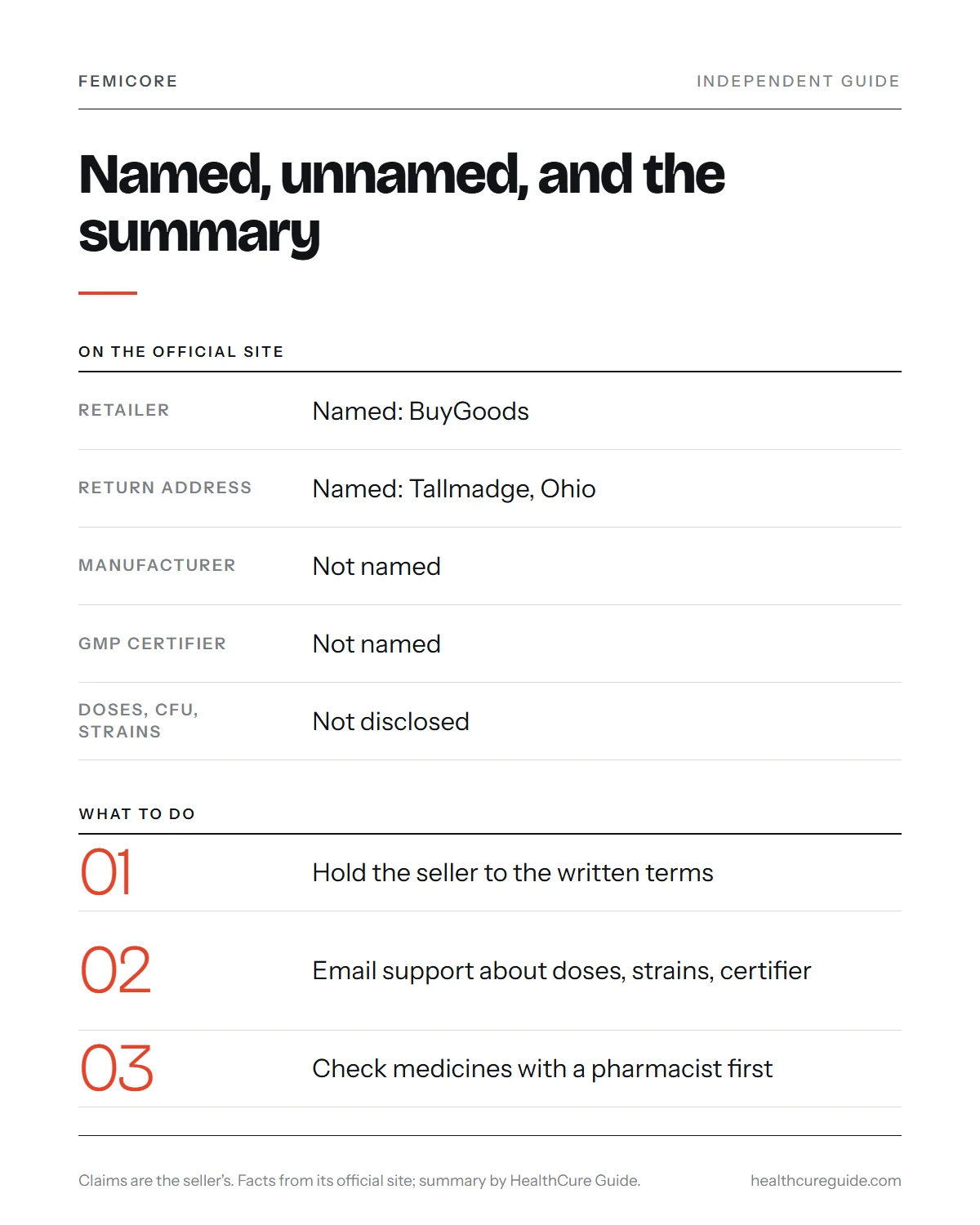
| Retailer that takes the payment | Yes: BuyGoods |
| Order support | Yes: BuyGoods |
| Product support | Yes: the vendor, by email |
| Return address | Yes: Tallmadge, Ohio |
| Manufacturer | No |
| GMP certifier | No |
| Certificate of analysis | Not published |
| Dose of each ingredient, CFU count, strain codes | Not disclosed |
The pattern is clear. The parts of the business that handle money and returns are named. The parts that make and test the capsules are not. That is legal and common for supplements sold from a single sales page, but it means a careful buyer has no outside party to check the quality claims against. Most fake-seller trouble happens on other sites using the FemiCore name, which our scam check covers.
The trust summary
| Area | Overall grade | What it means for you |
|---|---|---|
| Buying terms (price, payment, refund) | Verifiable | Hold the seller to them; keep your records |
| Who sells and who supports | Verifiable | BuyGoods and the vendor are reachable |
| Health claims | Not verifiable | Treat as the seller’s aims, not results |
| “Clinically researched” | Partly verifiable | True of ingredients, not of the product |
| Quality seals | Not verifiable | No names to trace |
| Sales page numbers | Mostly not verifiable | Ignore when choosing a package |
| Label detail | Not disclosed | You cannot match doses to research |
If you want each ingredient’s role and research in more depth, our ingredients list guide walks through all nine.
What would make FemiCore easier to trust
None of these would cost the seller much, and each would move a statement from “not verifiable” to “verifiable”:
- The amount of each ingredient per capsule.
- The CFU count and the strain code for each Lactobacillus.
- The cranberry PAC content and the bearberry arbutin content.
- The manufacturer’s name.
- The name of the GMP certifier, with a certificate number.
- A certificate of analysis from an outside lab.
- Any trial of the finished formula, even a small one.
- A link to the reviews behind the 19,263 figure, negatives included.
How to act on a mixed trust picture
You do not have to settle the trust question in the abstract. You only have to decide how much of it you need for your own purchase.
- Lean on what is verifiable. Buy only on the official site so the refund terms apply, note the delivery date and keep every bottle and the packing slip.
- Ask about what is not. Email support with the doses, strain and certifier questions before ordering. A clear answer is worth more than any seal.
- Bring in a professional. Berberine affects many medicines and lowers blood sugar, bearberry is meant for short courses, and cranberry has warfarin case reports. A pharmacist or doctor can tell you whether any of that matters for you. The official site’s own advice is to see a physician before starting during pregnancy or nursing, alongside medication, or with a health condition.
- Skip the supplement for warning signs. Visible blood in the urine, a fever, pain in the side, stinging when you urinate or bladder control that suddenly worsens all call for a doctor, not a capsule.
For prices, ingredients, safety and our editorial score on one page, see the FemiCore product page.
Common questions
Which FemiCore statements can I check for myself?
The commercial ones. Package prices, the single payment with no autoship, the payment methods, the shipping times and the refund terms are all shown on the official site and its help pages, and the checkout names BuyGoods. You can confirm each one before paying and again on your receipt. The health and quality statements are much harder to check from the outside.
Can I find out who manufactures FemiCore?
Not from the official site, which does not name the manufacturer. It names BuyGoods as the retailer and gives a return address in Tallmadge, Ohio, but neither of those tells you who makes the capsules. If the maker matters to you, email support before ordering, ask directly, and keep the reply.
Does the phrase clinically researched ingredients mean FemiCore was tested?
No. The phrase refers to the ingredients in general. Cranberry, berberine, bearberry and some Lactobacillus species have been studied on their own, often in other forms and doses. There is no trial of the finished FemiCore formula, so the phrase tells you nothing about how this particular capsule performs.
What would make the GMP seal checkable?
A name. A GMP seal becomes something you can verify when the site tells you which company holds the certificate and which body issued it, ideally with a certificate number. FemiCore's site shows the GMP Certified seal but names neither the manufacturer nor the certifier, so for now it is a statement from the seller.
How much weight should the 96 percent figure get?
Very little. The sales page says 96% of customers order 6 bottles, but gives no source, period or method, so nobody outside the company can test it. It also sits right beside the largest package, which is where a figure like that does the most selling work. Read it as marketing and pick a package for your own reasons.
What questions should I send support before buying?
Five questions cover the main gaps: the amount of each ingredient, the CFU count, the probiotic strain codes, who manufactures the capsules and who issued the GMP certificate. You can also ask whether a certificate of analysis exists. Clear answers raise trust, vague ones tell you something too, and either way you will know more than the label says.
Is a supplement with hidden doses automatically untrustworthy?
No. Proprietary blends are common and legal, and plenty of honest brands use them. The cost falls on the buyer, who cannot compare the product with the research behind its ingredients, since those results depend on dose. So hidden doses lower how far you can verify FemiCore, without proving anything bad about it.
Sources
- Wolfe AJ et al. Evidence of uncultivated bacteria in the adult female bladder. J Clin Microbiol. 2012.
- Pearce MM et al. The female urinary microbiome: a comparison of women with and without urgency urinary incontinence. mBio. 2014.
- Williams G et al. Cranberries for preventing urinary tract infections. Cochrane Database Syst Rev. 2023.
- Stapleton AE et al. Randomized, placebo-controlled phase 2 trial of a Lactobacillus crispatus probiotic given intravaginally for prevention of recurrent urinary tract infection. Clin Infect Dis. 2011.
- National Center for Complementary and Integrative Health. Uva Ursi.