Genius Song Reviews: Who Writes Reviews of The Genius Song?
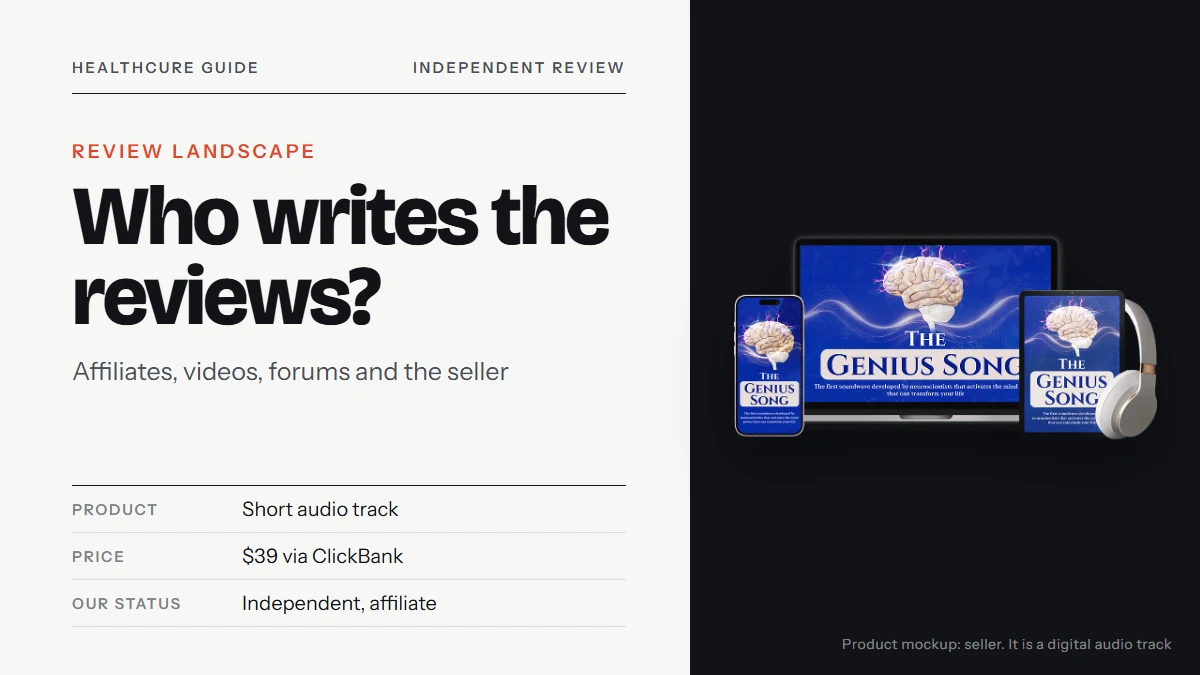
Search for opinions on this $39 audio track and you will meet affiliate blogs, video uploads, forum threads and the seller's own pitch. Each has its own incentive. Here is how to tell which ones are worth your time, starting with an admission about this site.
- Written by
- HealthCure Guide Editorial Team
- Reviewed by
- HealthCure Guide Editorial Team
- Updated
- Reading time
- 9 min read
This guide contains affiliate links. If you buy through them we earn a commission at no extra cost to you. It does not change the verdict. Disclosure.
Genius song reviews are easy to find and hard to trust, and the reason is money. This guide maps the main places opinions about The Genius Song come from, explains how affiliate commissions can tilt a verdict (including ours), and gives you a checklist for separating a careful review from a recycled sales pitch.
First, our own position. HealthCure Guide is independent of the seller, and the buttons on this page are affiliate links that can earn us a commission. We have not purchased the track. What follows is based on the seller’s sales pages, its 39-minute video, its Terms of Sale and the ClickBank checkout, as they stood when we checked them on 2026-10-09.
Genius song reviews online: the four sources
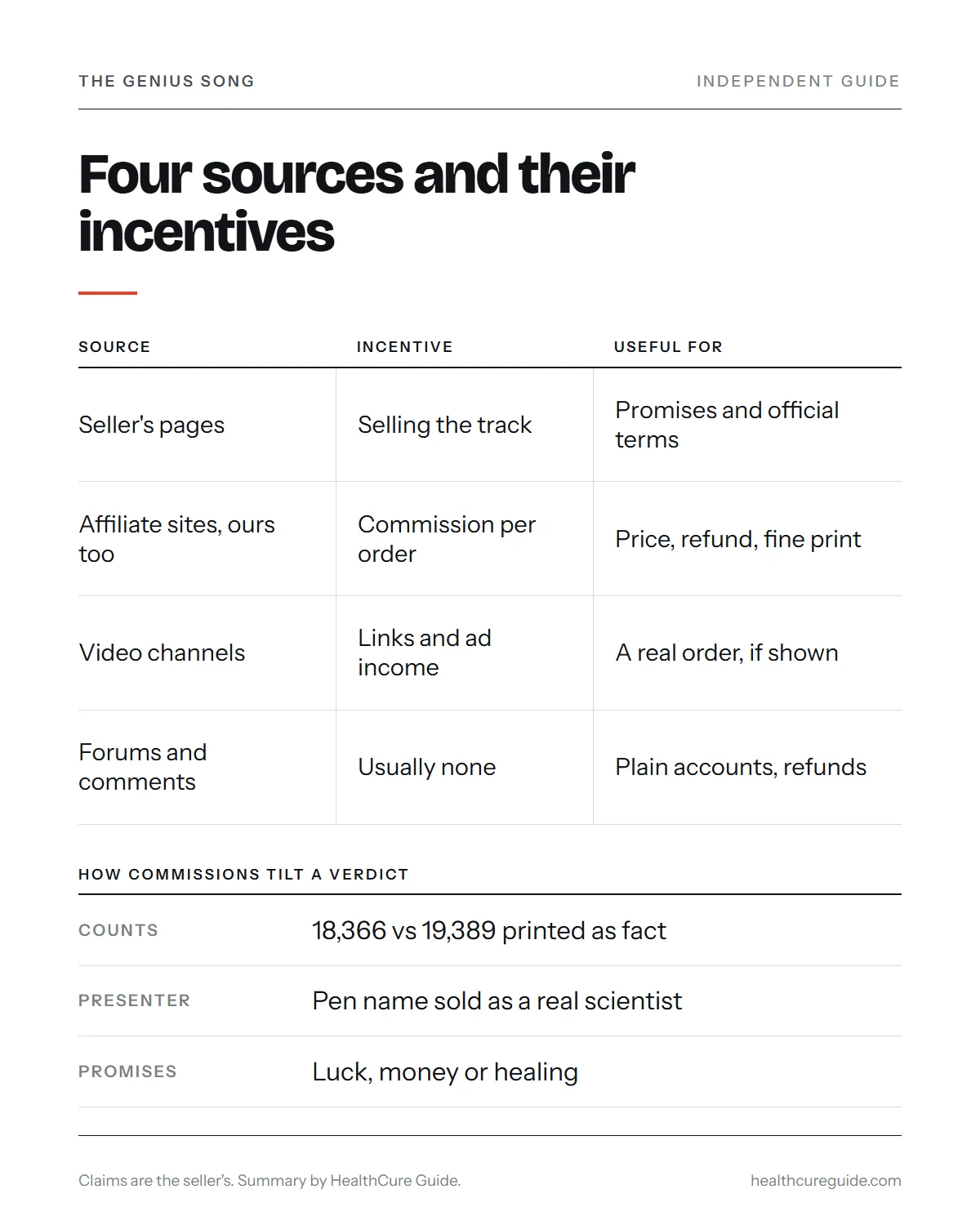
Almost everything you will read falls into one of four groups.
| Source | Typical incentive | What it can tell you | What to watch for |
|---|---|---|---|
| The seller’s own pages | Selling the track | What is promised and the official terms | Stories the Terms say may be acted |
| Affiliate review sites, ours included | Commission per order | Price, delivery, refund rules, fine print | Copied claims and hidden incentives |
| Video channels | Affiliate links, ad revenue | A real order or delivery, if shown | Uploads posing as the track |
| Forums and comment threads | Usually none | Plain experiences, complaints, refunds | Anonymity, no proof of purchase |
None of these groups is useless. Each answers a different question, and the mistake is letting one of them answer all of them.
Affiliate review sites, including this one
The product is sold through ClickBank, which runs an affiliate program. A site that wants to promote it gets a tracking link; when a reader clicks and orders, the network credits that site. The link at the top of this page works exactly that way, and it carries a code that tells ClickBank the visit came from us.
That arrangement creates a quiet pressure. A page that says “skip it” earns nothing, while a page that says “this changed my life” might earn a lot. Some affiliate writers respond by checking very little and praising a great deal. Others, we hope including us, earn their commission by being useful enough that a reader trusts the page.
You can tell the two apart by asking whether the page adds anything the seller did not already say. A useful affiliate review tells you the seller’s own disclaimer calls the presenter’s name a pen name. It quotes the Terms section headed “For Entertainment Purposes Only”. It points out that the refund page on the site belongs to a different product. A weak one repeats the sales video in a friendlier font.
For our own close reading of the testimonials the seller shows, see The Genius Song reviews.
Video channels and uploads
Video reviews have one real advantage: a creator who bought the track can show the order confirmation, the delivery email or portal, and the length of the audio on screen. That is the strongest evidence any review can offer, and it is rare.
The risks are also specific to video.
- Affiliate talking heads. Many videos are spoken versions of an affiliate blog post, with the link in the description. Check whether the creator ever shows the product rather than the sales page.
- Uploads posing as the product. Audio labeled with the product name may appear on video or music platforms. According to the sales video, the seller’s own site is the sole outlet, and anything on streaming or video platforms is a different recording. An upload is not a review, and it is not the track you would pay for.
- Clips of the sales video. Excerpts of the pitch, with or without commentary, are still the pitch.
Forums, comment threads and social posts
Unpaid posts are the closest thing to word of mouth. Their weakness is that nobody checks them, and a few lines of praise or anger tell you little about a typical listener.
When you read them, look for detail rather than mood. A post that says “it arrived by email within minutes, the track is short, I asked ClickBank for a refund after a month and got it” is worth ten posts that say “amazing” or “scam”. Watch too for posts that use the seller’s exact phrases about gamma, luck or a “seven-second trick”. People rarely talk like a sales page unless they are copying one.
How a commission can tilt a verdict
Pressure to sell shows up in predictable ways. These are the patterns we look for when we read other pages about this track.
- Repeating the customer count as fact. The seller says 18,366 Americans have been helped in its video, and 19,389 in the headline of its text page. These are the seller’s own figures, they disagree, and nothing outside the seller backs either one. A review that prints either number without comment has not checked it.
- Promoting the presenter. The headline calls him a top NASA scientist. Read the footer, though, and the site admits Robert Lake is a pen name, adopted with the agreement of a neuroscientist it never names. A review that sells the man on screen, who uses the pen name Dr. Robert Lake, as a real and verified scientist never scrolled that far.
- Treating testimonials as independent. According to the Terms, the stories may carry altered names, staged scenes and voices supplied by actors or avatars, some people are connected to the founders or were paid, and the results shown are exceptional. A reviewer quoting the video’s customers as proof has missed this.
- Promising outcomes. Luck, money, promotions, weight loss, IQ and healing are all claimed in the pitch. No published study tests the track. Research on related binaural beats cuts both ways. Pooled data in a 2019 analysis showed a moderate effect on certain measures, but a 2023 look at entrainment trials found that most did not detect the brain-rhythm change. Promises are a red flag.
- Overstating the format. Some pages describe a specific file type. The seller never states the format. Worse, its pages disagree on delivery itself: the video talks of a file you download from an email, and the text page of logging into a “Private Audio Portal”.
- Skipping the refund trap. Click the refund link at /TOS/refunds/ and you get a 60-day returns policy meant for NeuroActivate bottles. The Terms of Sale and ClickBank’s checkout give 90 days for this digital purchase. A review that never mentions the mismatch may leave a reader following the wrong policy.
A checklist for an honest review
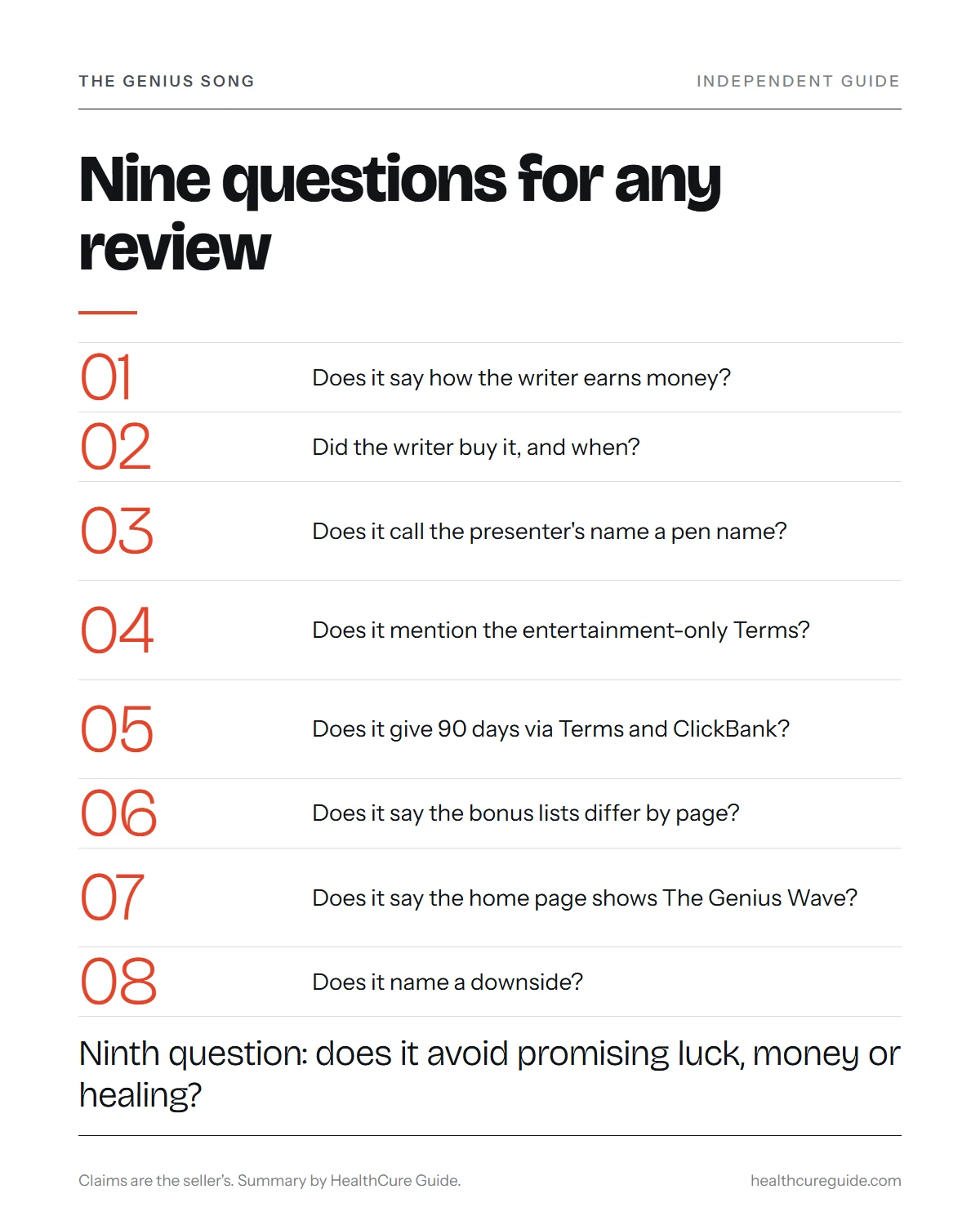
Run any page, video or post through these questions. A careful review answers most of them; a recycled one answers almost none.
| Question | Why it matters |
|---|---|
| Does it disclose how the writer earns money? | Commissions shape tone |
| Did the writer buy it, and when? | Separates experience from rewritten copy |
| Does it say the presenter’s name is a pen name? | The site’s disclaimer says so |
| Does it mention the entertainment-only Terms? | The seller’s own framing |
| Does it give 90 days via Terms and ClickBank? | The site’s refund page is for another product |
| Does it note the bonus lists differ by page? | Video and text page list different extras |
| Does it say the home page features another product? | Explains a confusing landing |
| Does it name a downside? | No product is all upside |
| Does it avoid promises of luck, money or healing? | No study supports them |
Facts any honest review should get right
If a review contradicts these, be skeptical. Each comes from the seller’s own pages or the ClickBank checkout.
- The product. One short audio track, about seven minutes according to the seller, for daily listening with headphones. Not an app, not a game.
- The price. $39, shown beneath crossed-out reference prices of $200, $100 and $49. Outside the US, the checkout shows local currency plus local tax.
- The bonuses. They differ between the seller’s pages. The video says three and describes four: a children’s focus audio called The Genius Child, a classic book on financial success, a guided visualization and a five-habit infographic. Over on the text page the count rises to four while only three appear, and the kids’ audio is gone.
- The seller. Happy Consumer LLC in Puerto Rico, with ClickBank as the retailer. The card statement reads CLKBANK*Genius Song.
- Where the link lands. The official site is geniussongoriginal.com. For now, its home page is given over to a sister audio from the seller, The Genius Wave, a separate 12-minute product. The Genius Song pitch itself is found at the /video/ address on that domain. A review that does not mention this may leave you confused when you click.
- Support. Product questions go to [email protected]. For money back, ClickBank’s order line is 1-800-390-6035. Hold on to the receipt.
- The email list. Buying subscribes you to marketing emails that may include third-party offers, with an unsubscribe link in each.
Our five-minute Genius Song review fits these points onto a single page. A longer review has more room, so it has even less excuse to miss one.
What no review can promise you
The seller’s Terms say the products are for entertainment and describe brain entrainment as not an exact science. The seller’s fine print calls it “not intended to diagnose, treat, cure, or prevent any disease”. Even a perfectly honest review is one person’s experience of a product that has never been studied directly.
Our own safety advice applies whatever you read. Keep the sound at a volume that feels comfortable. Skip it whenever you are driving or using machinery. If you live with epilepsy, have ever had a seizure or have trouble hearing, speak to a doctor before trying any audio-entrainment product.
The fairest review you will ever get is your own, inside the 90-day refund window, with the ClickBank receipt saved. Our disclaimer explains how we handle affiliate links across the site.
This guide is general consumer information, not medical advice.
Common questions
Why do so many Genius Song review pages sound alike?
Many of them are affiliate pages built from the same sales video, so they repeat the same stories, customer numbers and presenter titles. Affiliates earn a commission when a reader buys through their link, which rewards enthusiasm more than checking. Similar wording across many sites usually points to one shared source, not to many independent buyers.
Does HealthCure Guide earn money from The Genius Song?
We may. The buttons on this page are ClickBank affiliate links with a tracking code, so if you order through them we may receive a commission at no extra cost to you. We say so up front, we did not buy the track, and we do not publish ratings or testimonials for it.
Are Genius Song videos on YouTube a good way to judge it?
Only with care. A video can show a real order screen and a real download or portal, which is useful. It can also be an affiliate pitch, or an upload claiming to be the track. In its video the seller insists its own website is the only place it sells the track, and it warns that versions found on YouTube or Spotify are something else.
Can I trust forum posts about The Genius Song?
Forum and comment posts are usually unpaid, which helps, but they are anonymous and rarely checked. Give more weight to posts that describe the order, the delivery and the refund process in plain detail, and less to posts that repeat sales claims about luck, money or memory in the seller's own phrases.
What is the single best sign that a Genius Song review is honest?
It tells you something the seller would rather you did not notice. Examples include the pen-name disclaimer for the presenter, the leftover NeuroActivate refund page, the bonus lists that differ between pages, or the home page selling The Genius Wave. A page that only repeats the pitch has added nothing.
Should a review that gives The Genius Song a score worry me?
Not by itself, but ask what the score measures. No study has tested this track, and nobody outside the seller has published listening results. A number can only reflect the writer's opinion of the offer, the terms and the price. If it is presented as a measure of effectiveness, it is promising more than anyone knows.