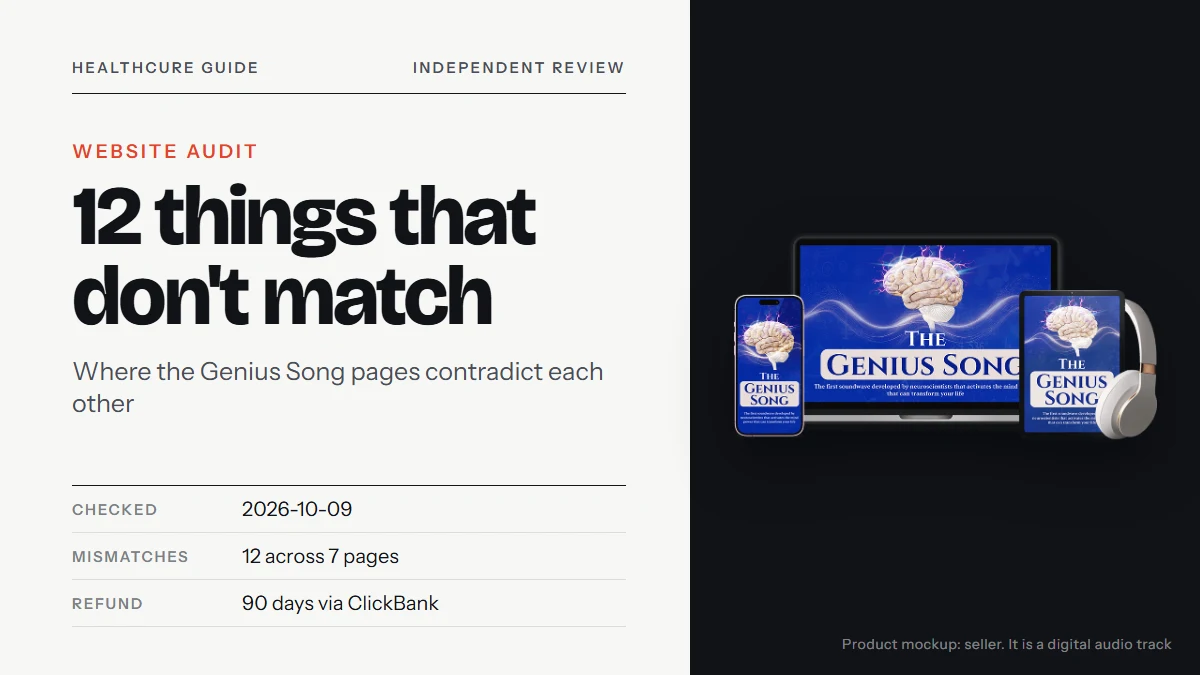
Genius Song Website Audit: 12 Mismatches on The Genius Song Site
We read every page of the seller's site on 2026-10-09 and logged each place where one page contradicts another. Here are the twelve mismatches, what each one means, and which documents to rely on if you still want to pay.
- Written by
- HealthCure Guide Editorial Team
- Reviewed by
- HealthCure Guide Editorial Team
- Updated
- Reading time
- 10 min read
This guide contains affiliate links. If you buy through them we earn a commission at no extra cost to you. It does not change the verdict. Disclosure.
Read The Genius Song website slowly and the seams start to show. On 2026-10-09 we opened every page we could reach on the domain, from the home page and the /video/ presentation to its /text/ twin, an older /vsl/ page, the Terms, the footer’s refund link and ClickBank’s order form. This audit lists each mismatch, where it sits and what it means for someone weighing a $39 purchase. We did not buy the track, so everything here comes from the pages themselves.
This audit is our own work, not the seller’s. When a reader pays after clicking one of our buttons, the seller’s network can send us a commission. Our methodology page explains how we read sales pages.
The genius song website at a glance: 12 mismatches
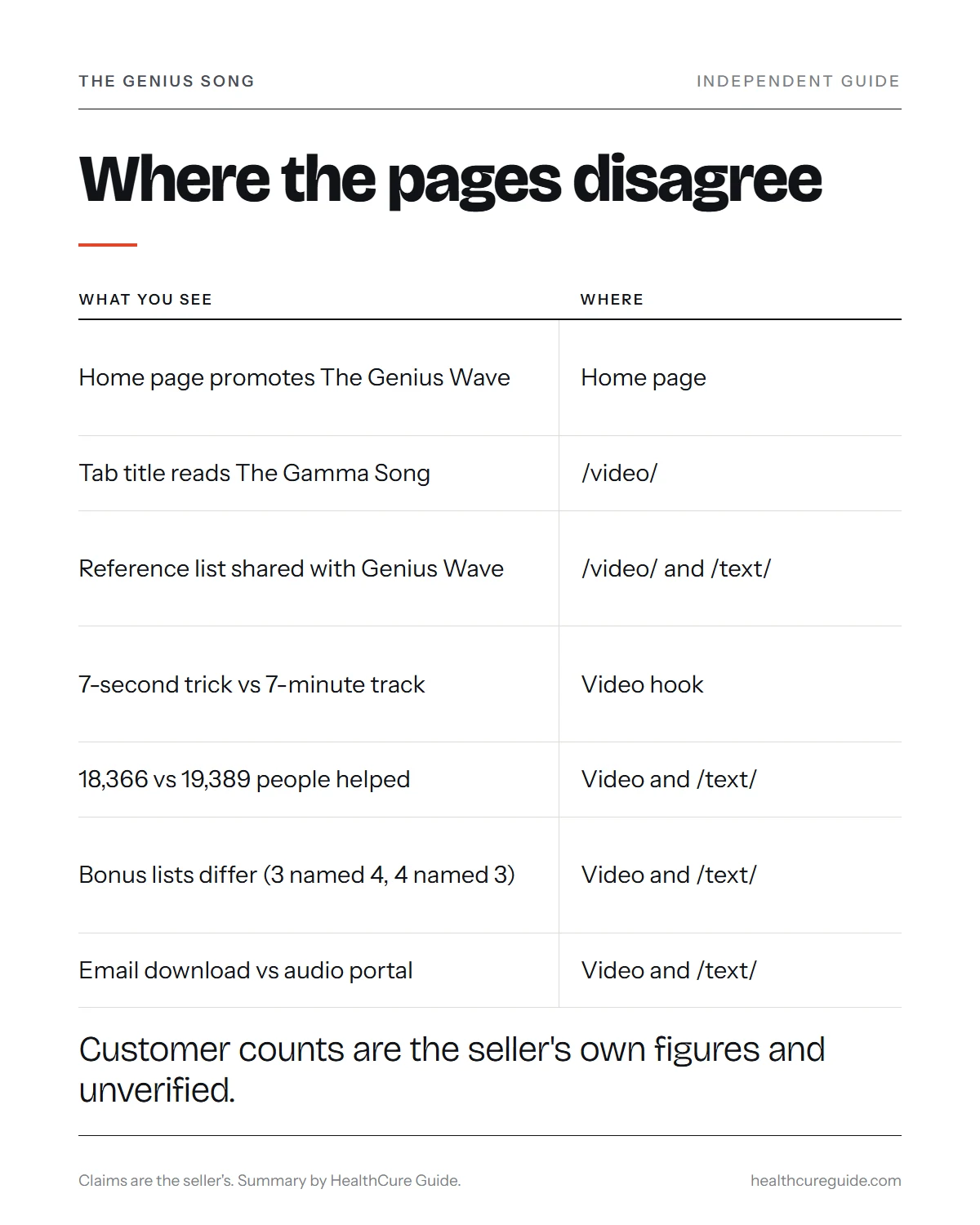
| # | What you see | Where | Why it matters |
|---|---|---|---|
| 1 | Home page promotes The Genius Wave | Home page | You may not land on the product you came for |
| 2 | Tab title reads “The Gamma Song” | /video/ | Points to a reused or renamed page |
| 3 | Footer year coded as 2023 | Page source | Odd next to a “2026 discovery” |
| 4 | Reference list copied from the Genius Wave page | /video/ and /text/ | Sources cite theta and creativity, not gamma |
| 5 | “7-second trick” vs a 7-minute track | Video hook | The headline promise is not the product |
| 6 | 18,366 vs 19,389 people helped | Video and /text/ | Seller figures disagree with each other |
| 7 | Bonus count and list differ | Video and /text/ | Unclear what is included |
| 8 | Email download vs audio portal | Video and /text/ | Delivery method is unclear |
| 9 | Princeton and Berlin vs NASA and Japan | Video and /text/ | The origin story shifts |
| 10 | Refund page for NeuroActivate bottles | /TOS/refunds/ | Wrong policy for a digital track |
| 11 | “Entertainment only” vs “substantiated” | Terms | Same document, opposite tone |
| 12 | “Whatever time you need” vs 90 days | Video and Terms | Only the written 90 days counts |
The sections below take these one group at a time.
The page you land on sells a different audio
Most review sites, ours included, send readers through a ClickBank tracking link. That link opens the home page of geniussongoriginal.com. When we checked, the home page was a short pitch titled “12-Minute Audio Session” for The Genius Wave, which the seller describes as a 12-minute theta audio. Its button reads “Buy Genius Wave Now” and leads to a separate checkout item.
The Genius Song pitch sits elsewhere on the same domain, on the /video/ page, with a text version at /text/. The two are separate products by the seller’s own descriptions: a 12-minute theta session on one side, a 7-minute track built around gamma on the other. Do not assume one is a new name for the other. We tested from India and could not check whether visitors in the US are routed differently.
There is a second, quieter link between the two. In the checkout code, the seller’s settings for The Genius Song give the brand as The Genius Song but the statement descriptor field as TheGeniusWave. The visible checkout text says the charge appears as CLKBANK*Genius Song, so that is what to look for on your card.
Titles, dates and a borrowed reference list
Three small details point to pages built from templates.
The tab title. Open /video/ and your browser tab reads “The Gamma Song”, although every heading on the page says The Genius Song. No explanation is given anywhere.
The copyright year. In the HTML of the /video/ and /text/ pages, the footer’s copyright year is written as 2023. A short script swaps in the current year when the page loads, so most visitors will see 2026. The hard-coded year still suggests the template predates the “brand new discovery in twenty twenty six” that the video announces.
The reference list. Both sales pages close with a 14-item list of “Scientific References”. It is identical to the list on The Genius Wave page. The entries cover theta rhythms, general brain entrainment and creativity, including pieces from Inc.com and Medium and a TED talk. The video, by contrast, is about gamma. A list assembled for a theta product cannot back up a gamma product’s claims, and none of the entries tests The Genius Song recording.
For context, gamma is a genuine brain rhythm, somewhere around 30 to 100 Hz, that researchers tie to attention and to how memories are handled. The best known 40 Hz work, from MIT, used flickering light and sound in mice bred to model Alzheimer’s, followed by a handful of small human pilots. None of it concerns IQ, luck or money.
Seven seconds or seven minutes
The video opens with a “seven second brain trick” and later a “seven second morning ritual”. The product it sells is a seven-minute audio track, played with headphones and closed eyes once a day. The video never shows a separate seven-second step beyond the track itself.
This matters because the hook is what most people remember. If you came for a few seconds of effort each morning, know that the seller’s own instructions describe seven minutes of listening, and that missing a day is described as “okay”.
Numbers that change from page to page
People helped. The narrator claims “eighteen thousand three hundred sixty six everyday Americans” have been helped, a figure the /text/ body copies as 18,366. Scroll up to that page’s headline and it has grown to 19,389. These are the seller’s own figures, unverified, and they do not agree with each other. The video also mentions “thousands of five star reviews” and “hundreds of emails” without showing any of them.
Bonuses. The video promises “three free bonuses” and then names four. Its list runs: The Genius Child, pitched as focus audio for kids; an old book about attracting wealth that the narrator links to The Secret; a visualization from a creator he says is popular on Calm; and a five-habit printable. The /text/ page instead advertises “$197.00 In Free Gifts” and “4 free bonuses”, then lists three: the book, a “Genius Visualization” and a “Create Your Ideal Future” infographic. The Genius Child is missing there. The lists simply differ, so you cannot know in advance which extras arrive.
Two descriptions of how you get the track
In the video, the narrator says the track lands in your inbox “in a matter of minutes” and that you save it onto a phone or computer. Above the order button on /text/, the promise changes to a “Private Audio Portal” with emailed sign-in details and streaming on any device. Then the FAQ lower on that very page switches back to a download.
Because we did not buy, we cannot say which one buyers receive, or whether it is both. ClickBank’s order form adds little: it lists a digital item and ties access to the moment your payment clears. Our guide to the Genius Song download walks through both routes and what to save on day one.
The presenter and the story change too
The video is narrated by a man who calls himself Dr. Robert Lake, but the small print at the foot of the page admits this is a pen name, adopted with the agreement of what it calls “our leading neuroscientist”. The /text/ page goes further and labels him a “NASA-Trained Neuroscientist” under a “Top NASA Scientist” headline. A pen name with no verifiable person behind it cannot carry those credentials, and we treat none of them as fact.
The research story also shifts. The video credits a Princeton report and an Einstein Center in Berlin. The /text/ page tells the same tale with NASA in place of Princeton and “colleagues in Japan” in place of Berlin. When a story’s key sources swap between two versions of one sales page, the details are better read as narrative than as citations.
The testimonials carry their own small print. Per the Terms, customer names were swapped, pen names appear, parts of the marketing were dramatized, and actors or avatars may voice the stories. Some speakers may be relatives, friends or early backers of the founders, they were paid for their time, and their results are described as exceptional, not typical.
Fine print copied from other products
The clearest leftover is the refund page. Follow the /TOS/refunds/ link and you reach rules written for NeuroActivate, a bottled product: a 60-day window, returns accepted only while sealed, mail sent to Tallmadge in Ohio, plus its own phone line and inbox. None of that fits a download.
The Terms carry a similar leftover: a physical Shipping Policy describing orders sent from Ohio. The site footer also asks buyers to retain the original packaging. A digital track has no packaging and no shipping, which the checkout confirms by marking the item as a non-shippable digital product.
What does apply is the Terms’ own line for digital products, which allows a refund on any purchase requested within 90 days, and ClickBank’s checkout, which promises returns within 90 days of purchase. If you want your money back, go through ClickBank and quote your receipt; ignore the bottle policy.
Terms that pull in two directions
The Terms, last updated 20 January 2026 and issued by Happy Consumer LLC of Puerto Rico, contain two lines that are hard to read side by side. Under the heading “For Entertainment Purposes Only”, the seller concedes entrainment is “not an exact science” and files the products under entertainment. A few paragraphs on, the same text insists its focus and mental energy claims rest on “established scientific research”. Both cannot guide a buyer at once.
The sales video, meanwhile, describes an “ironclad” guarantee and says you can take “whatever time you need”, with no number of days. The written number lives only in the Terms and the checkout: 90 days.
The footer adds the usual FDA notice, with the phrase “not intended to diagnose, treat, cure, or prevent any disease”. In plain words, it is not a treatment, whatever the video’s stories about migraines, smoking or weight suggest.
What the mismatches mean if you are thinking of paying
Taken together, the twelve points describe a seller running several audio products from one account, The Genius Wave among them, and reusing pages between them. The same company, Happy Consumer, also publishes The Genius Switch. Reused templates are common in this market. They are not evidence that your payment is at risk, because ClickBank processes the sale and states its own 90-day refund window.
They are evidence that nobody checked the copy closely, which is a fair reason to discount the claims about luck, money, promotions and health. Even the narrator, when he tells a casino story, admits there is “no evidence” that the track was behind the win.
If you still want to try it, these checks cost five minutes:
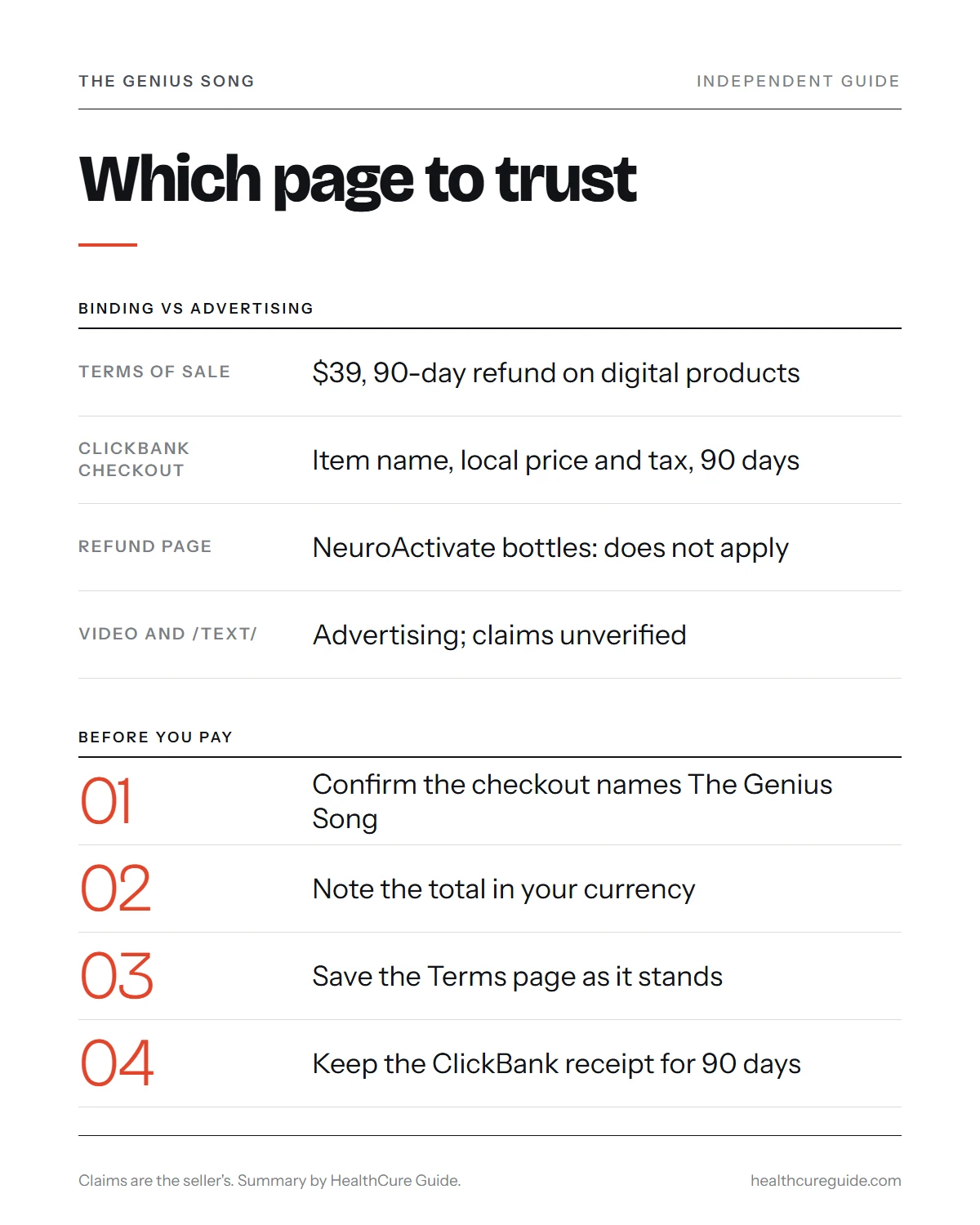
- Confirm the checkout item reads “The Genius Song (90-Day 100% Money Back Guarantee)” and not The Genius Wave.
- Note the total in your currency; ClickBank adds local tax, so it may differ from $39.
- Save a copy of the Terms page as it stands on the day you pay.
- Keep the ClickBank receipt until the 90 days have passed.
- Expect marketing emails: buying signs you up to lists run by Happy Consumer Publishing that may promote third-party offers. Each email has an unsubscribe link.
Bottom line on the genius song website
The site works, the checkout is ClickBank’s, and the refund window is written down. Almost everything else on the pages, from the tab title to the bonus list, the customer count and the refund link, contradicts something else on the same domain. Read the sales pitch as advertising, read the Terms and checkout as the deal, and keep your receipt.
If you do listen, keep the volume comfortable and never play it while driving or near machinery. Anyone with epilepsy, past seizures or hearing trouble should talk to a doctor before the first session. This audit is general information, not medical or financial advice; see our disclaimer.
Related reading
Common questions
Why does the Genius Song sales tab say The Gamma Song?
The browser title of the /video/ page reads "The Gamma Song" while every heading on the page says The Genius Song. The seller gives no explanation. The likeliest reading is a working title or a reused page template that was never updated. It does not change what you would pay for, but it is one of several signs that the pages were assembled quickly.
Is the reference list on the Genius Song pages about gamma waves?
Mostly not. The 14-item list at the bottom of the sales pages is the same list that appears on the seller's Genius Wave page. It cites theta and general brain entrainment research plus creativity articles from Inc.com, Medium and a TED talk. None of the entries is a study of The Genius Song track, and the list was not written around the gamma story the video tells.
Which customer number on the Genius Song site is right, 18,366 or 19,389?
We cannot tell, and neither figure can be verified. The video and the body of the /text/ page say 18,366 everyday Americans have been helped, while the /text/ headline says 19,389. Both numbers are the seller's own claims. Since they disagree on the same page, treat them as marketing copy rather than a customer count you can rely on.
Does the NeuroActivate refund page apply to The Genius Song?
No. The page at /TOS/refunds/ describes a 60-day policy for unopened NeuroActivate bottles with a return address in Tallmadge, Ohio. That cannot apply to a digital audio track. The Terms of Sale give 90 days for refunds on digital products, and the ClickBank checkout shows the same 90-day window. Ask ClickBank for any refund and keep your receipt.
Do the website inconsistencies mean The Genius Song is a scam?
Not on their own. Payment runs through ClickBank, and the Terms and checkout both state a 90-day refund window, which gives buyers a real exit. What the mismatches show is copy reused across several products and not checked closely. That is a good reason to read the sales claims with caution and rely on the written refund terms instead.
Which Genius Song page should I trust if two pages disagree?
Trust the documents that bind the seller over the sales copy. Those are the Terms of Sale, last updated 20 January 2026, and the ClickBank checkout page, which names the item, the price in your currency and the 90-day guarantee. The video and the text page are advertising, and they disagree with each other on bonuses, delivery and customer numbers.
Is the Genius Song website safe to pay on?
The payment step is handled by ClickBank at geniusbr.pay.clickbank.net, a large online retailer for digital products, and the card statement line shown at checkout is CLKBANK*Genius Song. Before entering card details, confirm the checkout item reads The Genius Song with the 90-Day 100% Money Back Guarantee, not a different product, and keep the receipt ClickBank sends you.