Does The Genius Switch Work? Claims Against Evidence
The sales video promises sharper thinking, luck and even weight loss from 8 minutes of listening. Here is what the evidence can and cannot say about those promises, and how to run your own honest test before the refund window closes.
- Written by
- HealthCure Guide Editorial Team
- Reviewed by
- HealthCure Guide Editorial Team
- Updated
- Reading time
- 9 min read
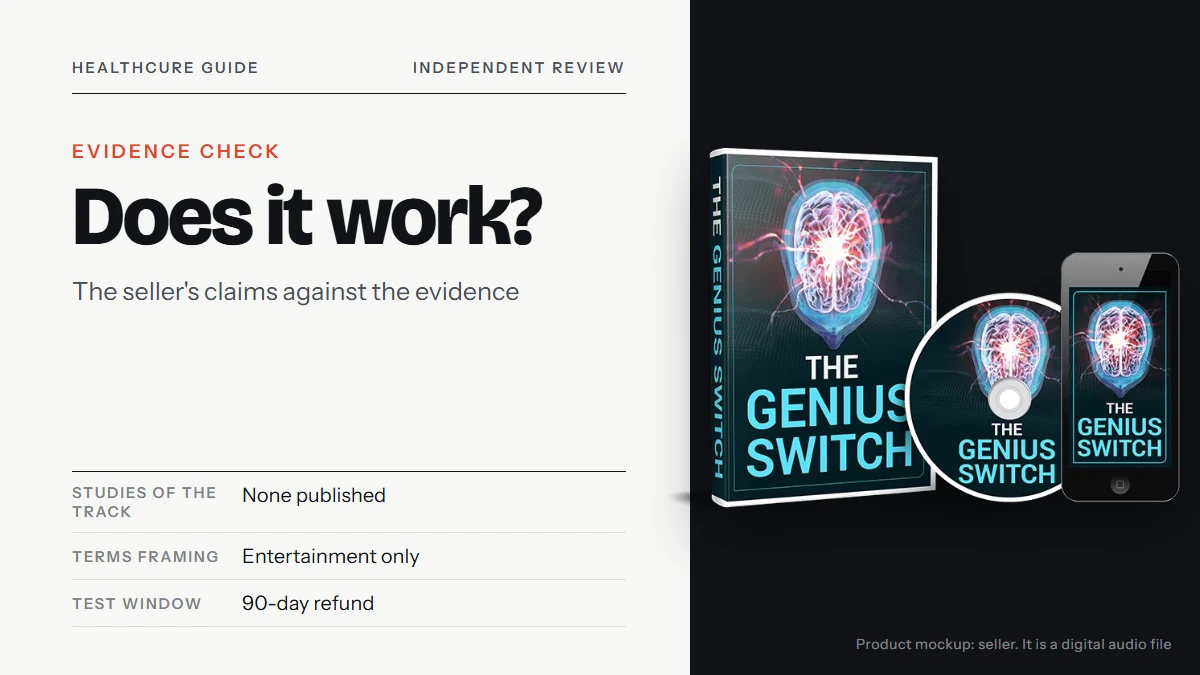
This guide contains affiliate links. If you buy through them we earn a commission at no extra cost to you. It does not change the verdict. Disclosure.
Does the Genius Switch work? The question sounds simple, but it hides two separate ones. First, is there any outside evidence that the track changes thinking, memory or luck? Second, could you personally notice something worth $39? This page answers the first from the seller’s own materials and the wider research, then sets out a plain, fair way to answer the second for yourself.
HealthCure Guide is independent of the seller and may earn a commission if you buy through our links. We have not bought or listened to the track. Our sources are the sales page, the 36-minute sales video, the site’s Terms and the ClickBank checkout.
What “working” would have to mean
The video attaches a very wide list of outcomes to one 8-minute track. They are not all the same kind of claim, and they cannot all be judged the same way. Grouping them helps.
| Group | What the seller claims | Could a listener notice it? |
|---|---|---|
| Thinking | Eureka moments, faster learning, better memory | Partly, with simple notes and tasks |
| Mood and calm | A clearer, settled feeling after listening | Yes, but many things cause that |
| Life events | Luck, coincidences, promotions, money, relationships | Not in any way you could link to the track |
| Body | Weight loss, quitting smoking, easier headaches and joint pain | Only with a doctor, and not from audio alone |
| Children | Better school grades | No, too many other causes |
The first two rows are the only ones where a personal test can tell you anything. The rest depend on so many outside factors that a single listener could never connect them to a recording.
Does the Genius Switch work? What the evidence covers
Start with the most important fact: no published study tests The Genius Switch track. Whatever the video says about results, nobody outside the seller has measured them.
The seller does point to research, though. Its reference list is built around two topics: 40 Hz binaural beats and gamma stimulation. One of them, a 2020 study by Ross and Lopez, looked at a short-term attention effect called the attentional blink. Studies of this kind report that some people show small, brief changes in attention or mood after listening to particular tones.
Looked at as a whole, the binaural beat field gives a split answer. A 2019 meta-analysis pooled the trials and reported a medium-sized effect overall across cognition, anxiety and pain, yet a 2023 review found that most studies looking for the brainwave change did not see it. That is a long distance from promotions, luck or weight loss, and it says nothing about this specific recording.
So the honest summary is short. There is a mixed, unsettled body of research on a related technique. There is no research on the product.
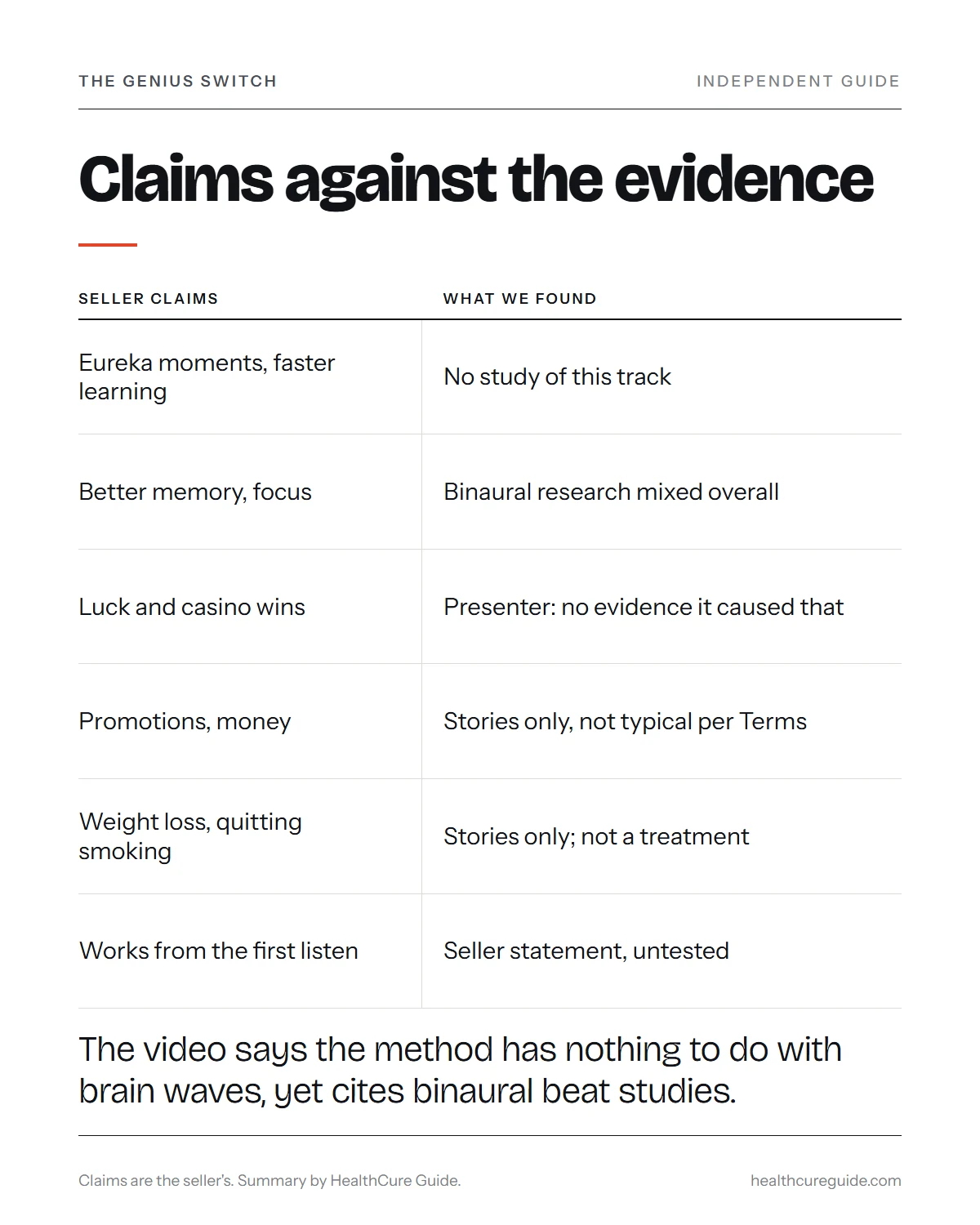
The explanation contradicts itself
A product does not need a perfect theory to help someone. But when the theory keeps shifting, it becomes hard to judge what you are buying.
Brain waves, then not brain waves
Partway through the video, brain waves are ruled out as the mechanism, with the line that the method “has nothing to do with” them, and plain sound waves are dismissed as “incomplete”. Scroll down the sales page, though, and the evidence offered is binaural beat and gamma research. Binaural beats are all about brain wave activity. If the track is not about brain waves, those references do not support it. If it is, the video misdescribes it.
A Nobel Prize for something else
The core promise is “whole brain activation”: left and right hemispheres supposedly brought into step with each other. To lend it weight, the video brings up Roger Sperry’s Nobel Prize. Sperry did win in 1981, but for his work on split-brain patients. No medical textbook uses “whole brain activation” as a diagnosis or treatment; it is marketing language, and Sperry’s prize does not back it.
An hour squeezed into 8 minutes
Then comes “neural sync technology”, with the claim that sixty minutes of it have been packed into an 8-minute recording. We could find no description of what that means, how it was done or how anyone could measure it.
What the seller itself admits
Some of the strongest evidence about the track comes from the seller’s own paperwork, and it does not support the bigger claims.
- The entertainment clause. The Terms include a section titled “For Entertainment Purposes Only”, which says brain entrainment is not an exact science and should not be treated as one.
- The casino story. After a listener’s casino win is described, the presenter adds that there is of course no evidence the track caused it. That admission fits every other life-event story in the video too.
- The testimonials. Per the Terms, actors or digital avatars may perform the customer stories, some featured people have personal ties to the founders, and the results shown are exceptional rather than typical.
- The health disclaimer. In the site’s own words, it is “not intended to diagnose, treat, cure, or prevent any disease”.
On screen, the host introduces himself as Dr. Daniel Barone, with a New York neurology background. Nothing we found confirms who he is or whether he has any role in the product, so his title adds no evidence either way.
Timing claims against a realistic test window
The video makes three timing promises: an effect from the very first session, a noticeable change for many buyers by day two or three, and results for most people inside roughly two weeks.
Whatever you think of those claims, they are useful in one way: they tell you how long a test should take. If nothing has happened after several weeks of daily use, the seller’s own timeline says something should have. And because the Terms and the ClickBank checkout both allow refunds for 90 days, you have time to test properly and still get your money back.
| Seller’s timeline | What it implies for your test |
|---|---|
| First listen | Note how you feel right after day 1 |
| 2 to 3 days | Compare your notes from days 1 to 3 |
| A couple of weeks | Do a proper review around day 14 |
| 90-day refund window | Decide by about day 60 to leave room |
A fair personal test inside 90 days
One person’s experience is not science, but it can still be honest. The aim is to give the track a real chance without fooling yourself. Here is a simple plan.
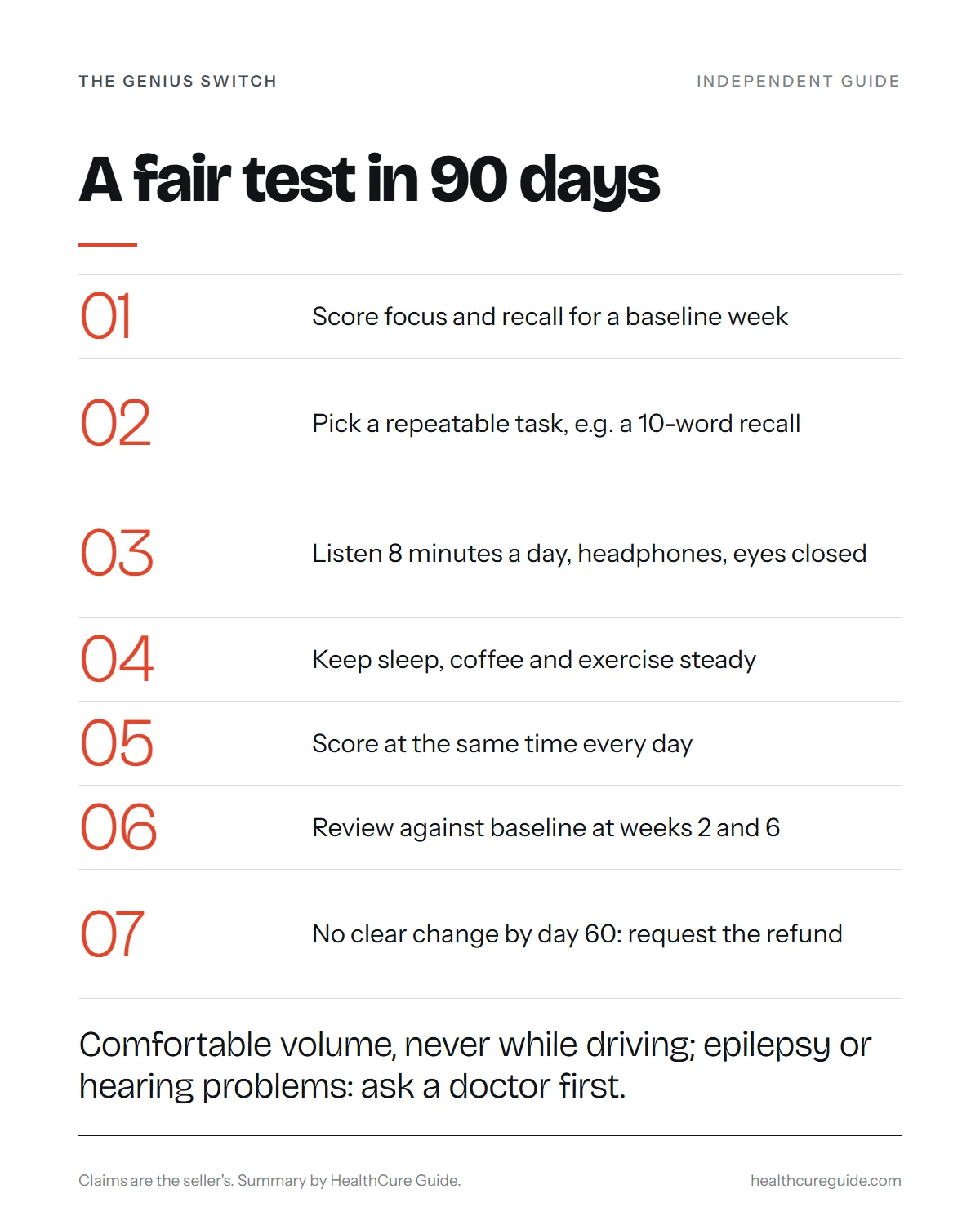
- Write a baseline first. Before your first listen, spend a week noting two or three things you care about, such as how focused you felt at work or how easily you recalled names. Use a 1 to 10 score once a day.
- Pick tasks you can repeat. A short memory exercise, like recalling a list of ten words after five minutes, gives you something firmer than a feeling.
- Listen the way the seller says. Headphones on, eyes closed, 8 minutes a day. The video says missing a day is fine, but steady use makes the test fairer.
- Keep everything else steady. Changing your sleep, coffee or exercise at the same time will blur the result.
- Score on the same schedule. Same time of day, same scale, every day.
- Review at two and six weeks. Compare your scores with the baseline week. Be strict: a small change that comes and goes is not a clear result.
- Decide early. If you see no difference by day 60, request the refund. Waiting until day 89 leaves no margin for delays.
One more caution. Simply sitting quietly for 8 minutes may feel calming. If that is what you notice, it is a real benefit of a quiet break, but it does not show the track does anything special.
Who is likely to be disappointed
Based on the gap between the claims and the evidence, some buyers are far more likely to feel let down than others:
- Anyone hoping for luck, a promotion or more money. Nothing links an audio track to those events.
- Anyone hoping for weight loss, help quitting smoking or pain relief. These need proven care, and the site itself says the product is not a treatment.
- Anyone expecting an app, a game or a full program. There is no app; you get a single audio file plus four digital bonuses.
- Anyone persuaded mainly by the doctor framing or the testimonials.
People most likely to be content are those who simply want a short daily listening habit, accept that the outcome may be small, and are happy to use the refund if it is not for them.
Listening safely during your test
If you try it, a few precautions apply to any audio routine of this kind. These are our suggestions:
- Keep the volume at a level that feels comfortable through headphones.
- Do not listen while driving or using machinery; you are meant to sit with your eyes shut.
- Anyone with epilepsy, past seizures or a hearing problem should check with a doctor before starting.
- Keep up any existing treatment. Talk to a doctor about real memory, attention, mood or pain concerns.
Our answer
Does the track work? On the evidence available, nobody can say it does. No study has tested it, the research the seller leans on is mixed and about a technique the video says it does not use, and the seller’s own Terms describe the product as entertainment. The life-changing outcomes in the video rest on stories that the seller admits may be acted and are not typical.
What remains is a modest, low-cost personal experiment. If you are curious, set a baseline, listen as directed for a few weeks, keep honest notes and use the 90-day refund if nothing changes. If you need proof before spending money, that proof does not exist yet.
This article is general information, not medical advice.
Related reading
Common questions
Is there any published study of the Genius Switch track itself?
We found none. The sales page lists research on 40 Hz binaural beats and gamma stimulation, including a small attentional-blink study from 2020, but those studies used their own sounds and their own volunteers. None of them played this 8-minute track, so they cannot tell you whether it does what the video says.
Can the Genius Switch bring luck, money or weight loss?
Those outcomes appear in the sales video as stories, not as measured results. When the video describes a casino win, the presenter himself says nothing shows the track caused it. The same caution applies to promotions, income and the 17-pound weight story. Treat all of them as marketing rather than as something the track can deliver.
Why does the video deny brain waves but cite binaural beat research?
We cannot explain it, and the seller does not. The video says the method has nothing to do with brain waves and calls sound waves incomplete. The reference list then points to studies of binaural beats, which are a brain wave idea. Both cannot be the full explanation, so neither gives the track solid support.
How many weeks should I give the Genius Switch before judging it?
The seller says many people notice something within two to three days and most within a couple of weeks. A fair test therefore fits comfortably inside the 90-day refund window. Four to six weeks of daily listening, with simple notes before and during, gives you an answer while leaving time to ask for a refund.
Should I stop medication or therapy while I try the Genius Switch?
No. The site says the product is not intended to diagnose, treat, cure, or prevent any disease, and its Terms call it entertainment. Keep any treatment you already have and speak to your doctor about memory, focus, pain or mood problems. An audio track is not a substitute for medical care.
What should I do if the Genius Switch makes no difference for me?
Ask for your money back inside the window. The Terms and the ClickBank checkout both give 90 days. Call ClickBank order support on 1-800-390-6035 with the order number from your receipt email. You do not need to prove anything about the track; a plain request within the window is enough under the stated policy.
Could the 8 minutes feel relaxing even if the claims are not true?
Possibly. Sitting still with your eyes closed for 8 minutes is a quiet break, and some people find any calm audio pleasant. That is a different thing from the claims in the video. If you enjoy the routine, that is a fair personal result, but it is not evidence of whole brain activation or any lasting change.