The Genius Switch Audio for Brain: The Claims, Checked
The sales video promises that 8 minutes of sound can get both halves of your brain working as one. We test each brain claim against what is on the record, explain what Roger Sperry was honored for, and set out the safety basics.
- Written by
- HealthCure Guide Editorial Team
- Reviewed by
- HealthCure Guide Editorial Team
- Updated
- Reading time
- 9 min read
This guide contains affiliate links. If you buy through them we earn a commission at no extra cost to you. It does not change the verdict. Disclosure.
The search phrase genius switch audio for brain sums up what the sales video for The Genius Switch asks you to accept: that a short recording can change how your brain works. This page looks only at those brain claims. We take each one in turn, compare it with what is actually on the record, and explain in plain terms what research on sound and the brain can and cannot tell you.
Everything about the product here comes from material the seller publishes, namely its sales page, its video, its Terms and the ClickBank order page. We are an independent publication rather than the seller, and a purchase made through our buttons may earn us a commission. We have not tested the track on anyone.
Genius Switch audio for brain claims, one by one
The video packs several separate brain claims into one story. Pulled apart, they look like this.
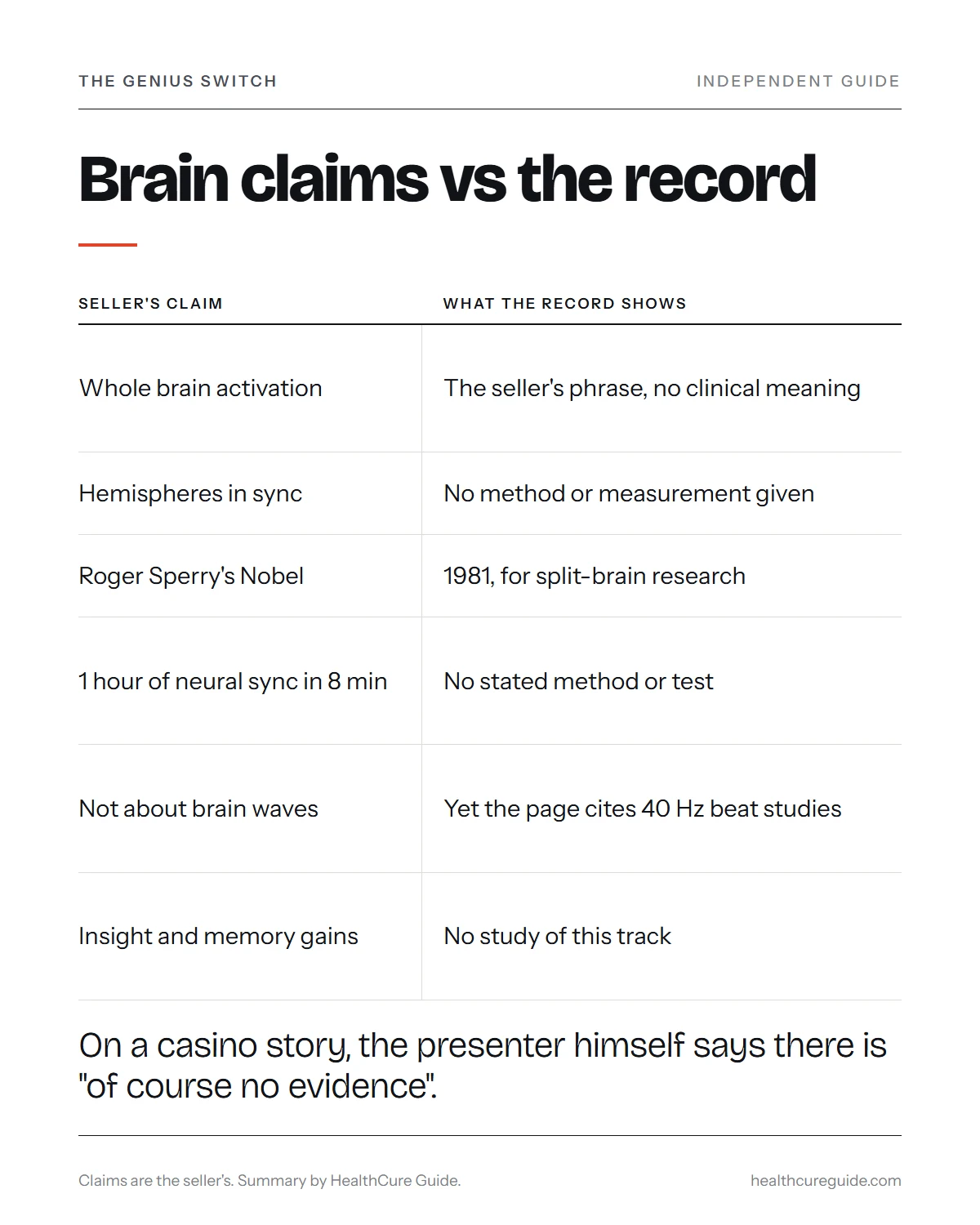
| Brain claim | How the seller puts it | What we found |
|---|---|---|
| A new brain state | “Whole brain activation” | The seller’s phrase, with no clinical meaning |
| Hemispheres in step | The two sides synced by sound | No method, no measurement offered |
| Scientific backing | Roger Sperry’s Nobel Prize | Awarded in 1981 for split-brain research |
| The mechanism | “Neural sync technology” | Never defined |
| Speed | An hour of neural sync in 8 minutes | No stated method or test |
| Brain waves | Denied in the video | Binaural beat studies cited on the sales page |
| Thinking gains | Insight, faster learning, better memory | No study of the track |
Every row on the left is a claim. None of them has been tested on this recording by anyone outside the company.
Whole brain activation: a sales phrase with no clinical meaning
“Whole brain activation” is the idea at the center of the pitch. It suggests that most of us run on half power and that the track switches on the rest. That is a vivid picture, and it explains the product’s name.
The trouble is that the phrase has no agreed meaning outside the sales material. It is not a diagnosis, a scan result or a treatment target that a neurologist would write in a chart. The video does not say what an “activated” brain looks like on any test, how you would know you had reached that state, or how it would differ from the brain you woke up with this morning. A claim with no way to check it cannot be confirmed or ruled out, and that is exactly where this one sits.
Syncing the hemispheres: what the idea assumes
The video describes the goal as getting the left and right halves of the brain working in step. For that to mean anything, a typical listener’s hemispheres would first need to be out of step in some measurable way, and a sound recording would need a way to correct it.
As basic anatomy, the two hemispheres are joined by a thick band of nerve fibers and pass information between them constantly. The seller does not describe what would be wrong with that normal traffic, which test would show it, or how 8 minutes of audio would change it. Without those three pieces, “syncing the hemispheres” is a metaphor, not a mechanism.
What Roger Sperry’s Nobel Prize was for
The video leans on a real name to give the hemisphere story weight. Roger Sperry did win a Nobel Prize, in 1981, and his work did concern the two halves of the brain. The prize honored split-brain research: studies of how each hemisphere behaves when the connection between the two has been cut.
That research is about what happens when the hemispheres are separated. It is not about activating the whole brain, syncing healthy hemispheres or using sound to do either. “Whole brain activation” is the seller’s term, not Sperry’s, and his prize says nothing about any audio product. Citing a Nobel laureate makes a pitch sound grounded. In this case the citation and the claim are about different things.
What sound can and cannot do to a brain, in broad strokes
Everyday life already shows that sound affects how we feel. A slow piece of music can settle you; a smoke alarm can jolt you awake. That is a long way from rewiring how you think, and research on special listening techniques has so far produced mixed results.
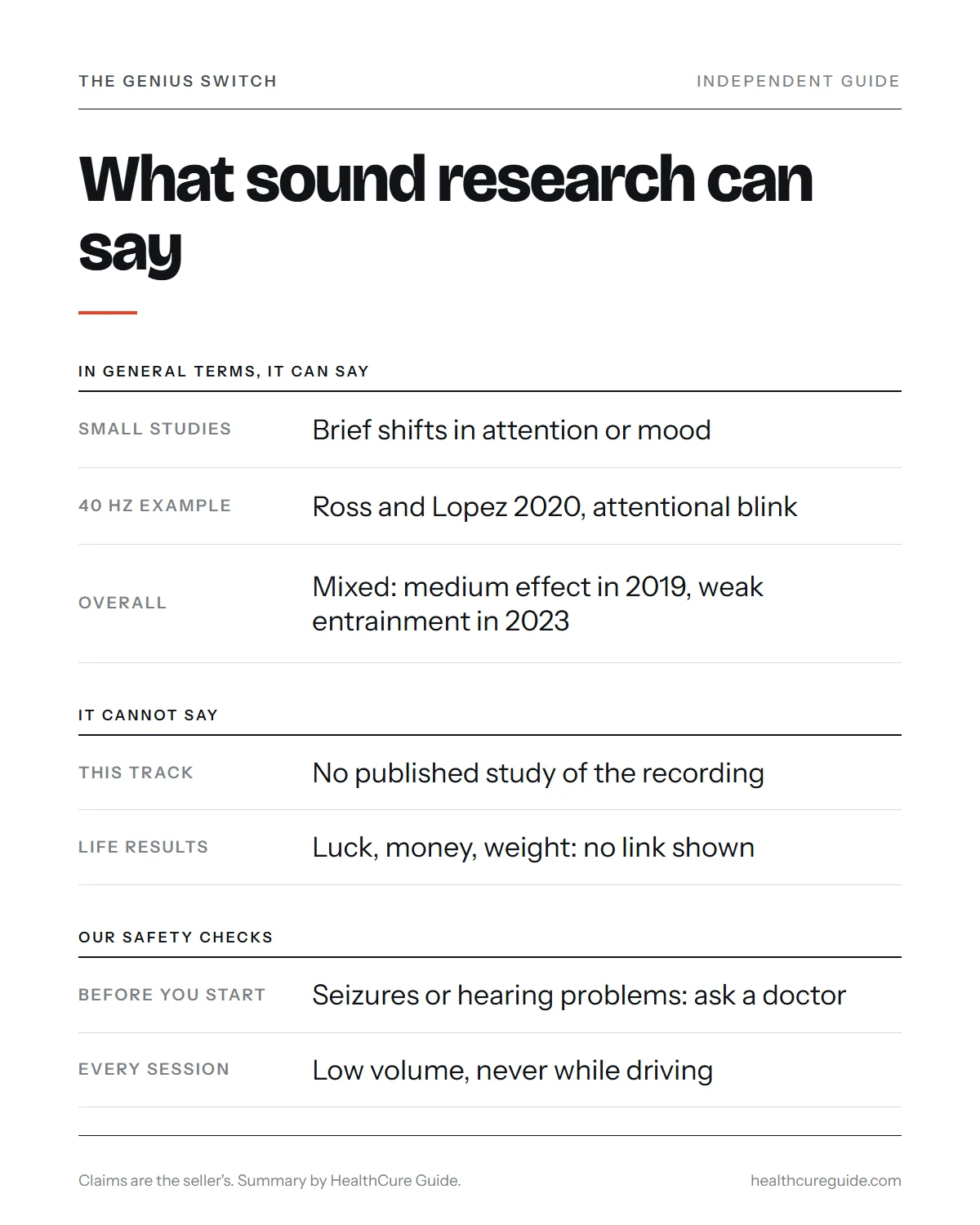
| Research on sound in general can say | It cannot say |
|---|---|
| Some small lab studies of binaural beats report brief shifts in attention or mood | That The Genius Switch track has any of those effects |
| A 2020 study by Ross and Lopez looked at 40 Hz beats and a short attention task called the attentional blink | That memory or learning improves over weeks or months |
| Reviews split: one finds a medium overall effect, another little brainwave change | That luck, money, weight or pain can change through listening |
| Quiet listening with eyes closed can feel restful | That a restful feeling is a sign of brain activation |
No published study tests this recording. Results from other sounds in other labs do not carry over to a commercial file whose contents the seller has not described.
When the video denies brain waves
Here the pitch trips over itself. Brain waves, the presenter tells viewers, are not what his method is about, and he brushes sound waves aside as “incomplete”. The written sales page tells a different story: its reference list is built on 40 Hz binaural beat and gamma stimulation papers, which is research precisely about sound and brain rhythms.
Both cannot describe the same track. If the recording does rely on brain rhythms, the video misdescribes it and what matters is the mixed binaural literature. If it does not, those cited papers concern a different technique altogether. Either way, the brain claims are left with no direct support.
The presenter’s own admission
All of these brain claims come from one speaker. On camera he introduces himself as Dr. Daniel Barone, and he is billed in the headline as a “Top NYC Brain Doctor”. We could not verify his identity or his part in the product, so his title adds no evidence on its own.
What he says on screen is worth noting, though. After telling a story about a listener’s luck at a casino, he concedes there is, in his words, “of course no evidence” tying that win to the recording. The same reasoning fits the brain claims. Feeling sharper on a given day, having a good idea in the shower or doing well on a test can all happen for countless reasons, and none of them proves that a recording changed your brain.
The video also features customer stories about thinking more clearly. According to the Terms, avatars or actors may play the people giving that feedback, that some people featured may be connected to the founders, and that the results shown are exceptional rather than typical.
Where the Terms draw the line on brain and health
The video talks like a neurologist; the Terms talk like a cautious lawyer. A section headed “For Entertainment Purposes Only” says brain entrainment is not an exact science, asks buyers not to treat it as one, and describes the products as entertainment. Another line, in the site’s health disclaimer, calls it “not intended to diagnose, treat, cure, or prevent any disease”.
Read together, those lines settle the brain question better than the pitch does. The Genius Switch is not a treatment for memory loss, attention problems, low mood or any other condition. It is not an app or a game either, just an audio file you play in any media player. If you are worried about your memory or focus, see a doctor rather than a sales page, and keep any care you already receive.
Protecting your brain while you listen
Audio is low-risk for most people, but a product sold as acting on the brain calls for a few precautions. These are our suggestions, not the seller’s.
- Volume first. Begin quietly and raise the level only until it is comfortable; louder will not make it work better.
- No driving. Never listen while driving, cycling or operating machinery; a session means 8 minutes with your eyes shut.
- Seizure history. People with epilepsy or past seizures should get a doctor’s view before trying any audio built on tones or pulses.
- Ears. Hearing loss, tinnitus or other ear problems are another reason to ask a doctor first.
- Stop signals. Dizziness, headache, ringing ears or feeling unwell mean stop, not push through.
Cost and the refund route
If you still want to try the brain claims for yourself, the practical terms are simple. The live price on the sales page is $39, and checkout adds local currency and any tax, so the total can vary by country. The video calls that price “not guaranteed beyond today”, which is a sales line rather than something you can check. The charge appears as CLKBANK*GeniusSwitch.
For digital products, the Terms give you 90 days from the first purchase to ask for your money back, and the ClickBank order page names the same 90 days. Ignore the site’s separate Refund page, which was written for a bottled product called “NeuroActivate” and does not fit a download. Save the receipt email, because refund requests start there; the number for ClickBank order support is 1-800-390-6035.
Our reading of the brain pitch
Taken claim by claim, the brain story does not hold together. “Whole brain activation” has no clinical meaning, the hemisphere idea comes with no method or measure, Sperry’s Nobel was for split-brain research rather than anything the track does, and the video denies the very brain-wave mechanism its references describe. The presenter himself admits there is no evidence for at least one of his stories, and the Terms call the whole thing entertainment.
What remains is modest: a quiet 8-minute break with headphones on and eyes closed, which may feel restful the way any calm audio can. If that is worth $39 to you with a 90-day refund behind it, listen carefully and keep your expectations at that level. This guide is general information, not medical advice.
Related reading
Common questions
Is whole brain activation a term doctors use?
No. It is the seller's own phrase. You will not meet it as a diagnosis, a test result or a treatment goal in ordinary medical practice. The video uses it to describe the two halves of the brain working in step, but it never explains how that state would be measured, confirmed or told apart from normal brain activity.
Did Roger Sperry ever study audio tracks?
Nothing in the seller's material shows that, and his Nobel Prize was for something else. Sperry won in 1981 for split-brain research, which looked at how the two hemispheres behave when the link between them has been cut. The video borrows the prestige of that prize, but the research says nothing about this recording.
Are my hemispheres out of sync if I feel foggy?
Nothing in the seller's material describes a test for that, and foggy thinking has many everyday causes, from short sleep to stress, illness or medicines. If memory lapses or poor focus are new or getting worse, a doctor is the right first stop. A recording sold for entertainment cannot tell you what is behind them.
Has anyone scanned listeners' brains while they played The Genius Switch track?
We found no such study. No published research tests The Genius Switch recording at all, whether with brain scans, memory tests or anything else. The references on the sales page concern 40 Hz binaural beats and gamma stimulation in general, and results from other sounds cannot be credited to this file.
Could the track help a child do better at school?
The video links the track to children's grades, but that is an anecdote, not a measured result. School performance depends on sleep, teaching, health and much else. If a child is struggling, talk to the school and the child's doctor. Any young listener should use a low volume, and a child with seizures needs a doctor's view first.
Why does the presenter admit there is no evidence?
While telling a casino story, the presenter says there is no evidence the track caused the win. It is a candid line, and the same logic covers the other life stories in the video. Coincidences happen all the time, and one person's good fortune after listening cannot show that the audio was responsible.
Is it safe to listen if I have a seizure history?
Ask your doctor before you try it. That is our advice for any audio built on tones or rhythms, not something the seller states. If you get the go-ahead, keep the volume low, listen seated or lying down and never while driving, and stop at once if you feel unwell during or after a session.