Is Energy Revolution System Legit? What to Check Before You Pay
A reassuring but careful check of the seller, the retailer, the refund route and the lookalike pages, so you can see how the purchase is set up before you pay.
- Written by
- HealthCure Guide Editorial Team
- Reviewed by
- HealthCure Guide Editorial Team
- Updated
- Reading time
- 7 min read
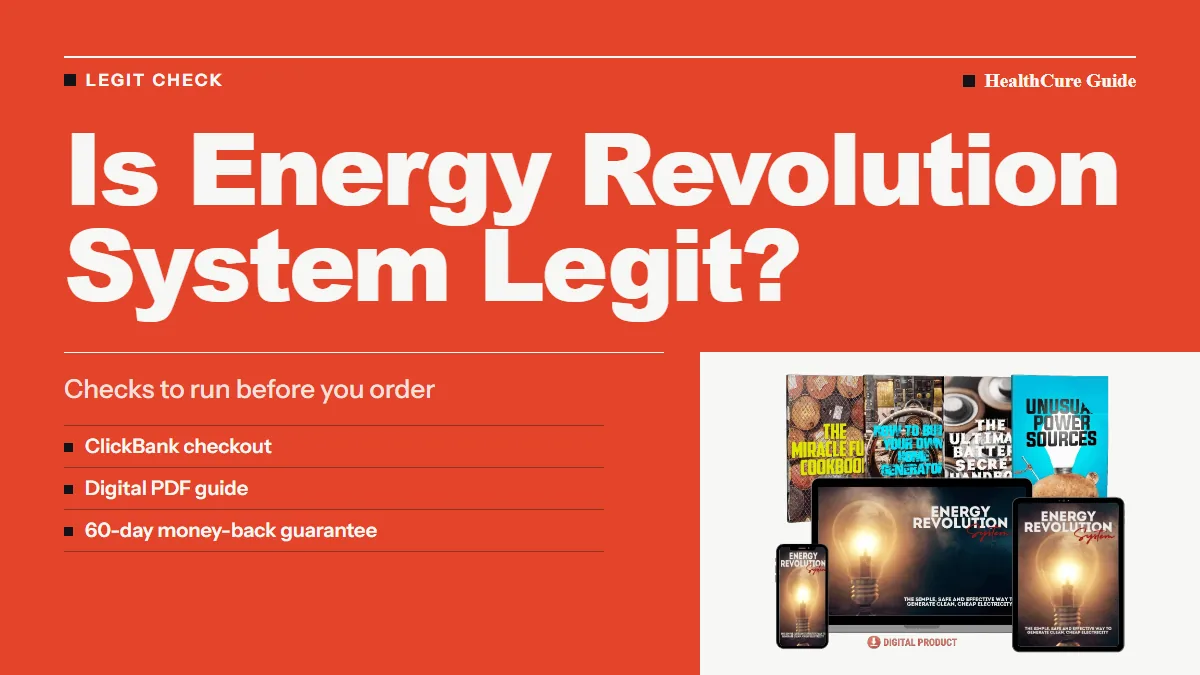
Shoppers who type “is Energy Revolution System legit” tend to be near the point of paying and want some reassurance first. That instinct is sound, and this is the right moment to check how the sale is set up instead of relying on a sales video alone. Below we walk through the retailer, the contact routes, the refund terms and the lookalike pages you might run into, and we flag every place where the vendor’s own wording leaves questions open.
Our short answer is that the purchase runs through a recognized marketplace, the refund route is written out in full, and the product is a genuine digital PDF sold for one payment of $39. Those three points carry most of the weight. The remainder of this page explains how we arrived there and what that conclusion does not cover.
For context on the guide itself, begin with the product hub and then read our Energy Revolution System review. This page keeps its attention on legitimacy.
Is Energy Revolution System legit? Our checklist
We ran the checks a careful buyer would run. Each point below comes from the vendor’s pages or from the public setup of the retailer, and we mark anything we could not confirm.
- Retailer. The vendor’s refund page names ClickBank as the retailer for its products. ClickBank operates a marketplace for digital goods, and its help desk is available at clkbank.com.
- Statement name. The vendor says the charge should appear on your card or bank statement as CLKBANK*EnerRevolution. A different label is worth a look at your confirmation message before you draw any conclusion.
- Contact routes. The vendor lists an email address and a phone line, and it runs a contact form. The phone line answers during set afternoon hours, so email is the more dependable channel.
- Refund page. The vendor publishes a dedicated refund page with steps, a timeline and a plain note that access ends once a refund is processed.
- Refund window. The guarantee is a 60-day refund promise. Your confirmation message is the record to keep.
Taken together, these points describe an ordinary digital product with a named seller, a named retailer and a written refund process. That is a reassuring starting position, though it is not a verdict on how useful the guide will be.
What the vendor’s disclaimer says
The disclaimer is brief, and it is worth reading slowly before you pay. It states that the narrative and presentation exist purely for promotional purposes. It describes the product as an experiment that was not technically assessed and has not been produced at any scale. It also warns that some home alterations could be illegal in your town, city, state, province or country, and it puts the job of checking with your local authority on the buyer.
The disclaimer page goes a step further. It says the byline is a pen name and that some customer-style accounts on the sales page are performed by actors. None of that cancels the refund route, but it does mean the sales page should be treated as marketing copy rather than independent proof.
Refund route, step by step
Requesting a refund is straightforward. Send an email to the vendor address published on its contact page. Include your full name and your order number, and title the message Refund Request. Keep your ClickBank confirmation, since the refund desk will want the order details it contains.
The vendor says it processes a request within 48 hours. The money then moves back through your bank, which may take three to five business days. The vendor asks buyers not to open a bank dispute while a request is in progress. If the vendor does not respond, ClickBank support is the second route. Our money-back guarantee post walks through the same steps as a checklist.
Why the contact details matter
A seller should be reachable when something goes wrong, and the contact details are where you find that out. The vendor’s pages list an email address, a phone line that answers during set afternoon hours and a contact form. Start with email, because it creates a written trail of your question and any reply. Keep those replies with your confirmation message so the whole exchange sits in one folder.
Ask the practical questions before you order. You can ask which statement name will appear, whether any checkout upgrade is compulsory and how a refund request is handled. A seller with clear answers to those points gives a careful buyer what is needed. A seller who sidesteps them gives you a reason to look elsewhere.
Here is one more practical habit. Before you enter payment details, check that the page you are on matches the product name, the amount and the seller information described here. A mismatch is worth a pause, even when everything else looks in order. Pausing costs nothing, and the refund route only helps once the purchase is made through the genuine order page.
Lookalike pages and copies
Legitimacy depends on more than the seller. The copies that circulate matter too. You may find marketplace listings, file-sharing sites or pages offering the PDF without charge or through an unfamiliar checkout. Those copies do not carry the vendor’s refund route, and they are not the genuine guide. A purchase made through one of them can leave you with no refund path at all.
The safest route is the button on our site, which leads to the vendor’s order page. On that page you should find the product name, the single payment of $39 and any extra items that checkout offers. Our official website page covers how to recognize the genuine order page in more detail, and our official website post adds a walkthrough of the same checks.
What legit does not mean
Legitimacy and results are different questions. A real product with a fair refund process can still disappoint, and the vendor promises no particular outcome from the guide. Our reading addresses the purchase, not the file’s content. The product hub collects what the vendor publishes in one place. The vendor does not list the contents, parts or cost of any build, and we have not assembled anything from the PDF.
For that reason we would call the offer sound in its setup and cautious in its content. A written primer can be a useful read for a curious DIY hobbyist. It does not replace a licensed professional, a permit office or the manufacturer’s instructions for any equipment you own.
Warning signs to watch for
A handful of patterns should slow you down. Be cautious of any page that requests card details outside the ClickBank checkout, offers the PDF as an immediate download with no order number, or shows a figure other than the $39 you were told. Also be cautious of pages that promise exact results. If you notice any of these, close the tab, return through our button and begin again.
None of these signs proves that a page is fraudulent, but each one is a reason to pause and recheck the retailer and refund details. The vendor’s refund route is the same whichever way you reach the order page, so the official pages remain the reference point.
Safety comes before any project
Home electrical and generator projects bring fire and shock risks, and a legitimate purchase does nothing to reduce them. Follow local codes and permits. A licensed electrician should handle anything connected to home wiring. Never run fuel-burning equipment indoors, and keep fuel and batteries well away from living areas.
Treat the guide as a reference to check with a professional, not as a green light. The vendor says the product was not technically assessed, so responsibility for any build rests with you, your local authority and the people you hire.
Is it worth buying after the checks?
For a reader who wants one written primer, the answer can be yes. The purchase is a single payment, the refund process is written out, the retailer is named and the file arrives by email. Those foundations are solid. If you need the contents, parts and cost before paying, the sales page will not supply them, and you should weigh that gap carefully.
Our review explains the trade-offs at greater length and closes with a recommendation for the right kind of buyer.
Common questions
Is Energy Revolution System a real product?
It is a digital PDF guide sold through ClickBank, which is the retailer of record. The seller lists a statement name, an email contact and a refund page.
Who is the seller?
The seller's pages give an email contact and a phone line. The author name on the sales page is a pen name, as the seller's disclaimer states.
Does it come with a refund?
Yes. The seller offers a 60-day money-back guarantee. You email the seller with your full name, your order number and the subject Refund Request.
What is the seller's disclaimer?
The seller says the presentation is for promotional purposes only, that the product is an experiment that was not technically assessed, and that some home alterations may be illegal where you live.
How do I avoid copies of the guide?
Buy only through the button on our page, which leads to the seller's order page. Skip file-sharing sites and marketplace listings.
Can I start a home power project after reading it?
Only after you follow local codes and permits, and have a qualified electrician review anything connected to home wiring.