Last Wish Manifestation and The Last Wish: Money and Real Help
A careful guide for anyone drawn to wish-based practices: what to keep, what to question, how to limit what you spend, and where to go when the problem is a bill rather than a belief.
- Written by
- HealthCure Guide Editorial Team
- Reviewed by
- HealthCure Guide Editorial Team
- Updated
- Reading time
- 9 min read
People who look up last wish manifestation or The Last Wish are often at a moment when they would love some good news, and some are under financial strain. This page is written for that reader. It stays respectful of belief and spiritual practice, says plainly what the evidence does and does not show, and points to practical help.
You should know where we stand: we are independent of the seller and do not sell the product. We did not buy the recordings. The facts below come from the seller’s pages, Terms and ClickBank checkout, read on 2026-10-09.
Five ground rules for Last Wish manifestation
Whatever you decide about this product, these rules keep a hopeful practice from becoming a costly one.
- Money you need stays yours. Rent, food, medicine, utilities and debt payments come first. Pay for nothing from those funds.
- Hope is a feeling, not a forecast. A wish can motivate you. It cannot be counted on in a budget.
- Every claim gets a source. If a pitch names no study, no verifiable person and no records, it is a story.
- Decide slowly. A countdown clock is built to hurry you. You can close the tab and return tomorrow.
- Know the exit before you enter. Read the refund terms and keep the receipt.
Rule three applies directly here. The order page cites Harvard and the University of Michigan and says modern neuroscience agrees. It names no study, author or link, though, so there is nothing to check.
Respecting faith without mixing it up with a sales pitch
For many readers, prayer, scripture and sacred symbols are central to life. Nothing in this guide questions that. A person can pray, meditate, light a candle or hold a wish in mind because it brings peace, meaning or community, and those benefits do not depend on a study.
The Last Wish video draws on religious material, including a story about a priest and a parchment said to be held in the Vatican’s archives. We cannot verify that story, and the Terms say marketing details may be dramatized. The narrator calls himself Danny Kelly, and the Terms also say names may be pen names. The reasonable approach is to keep two questions apart.
The first question is whether a practice is meaningful to you. Only you can answer that. The second is whether a particular product does what its sales video says. That one can be checked, and so far nothing supports the claims about wealth.
Protecting your money before you click
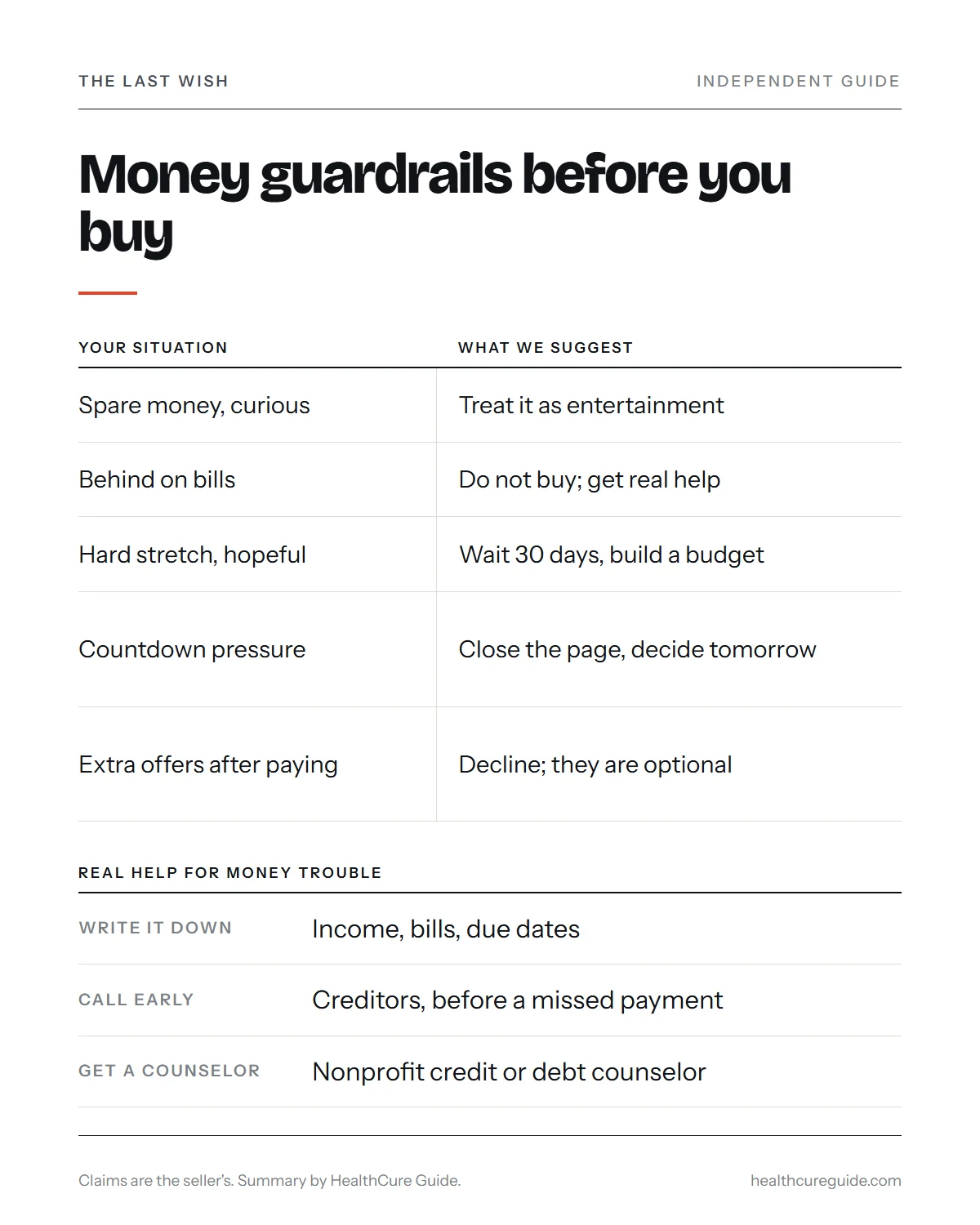
A short table covers the common situations.
| Your situation | What we suggest |
|---|---|
| You have spare money and curiosity | Treat $37.44 as entertainment; set a refund reminder |
| You are behind on bills | Do not buy; use the help section below |
| You are in a hard stretch but hopeful | Wait 30 days, build a budget, then decide |
| You feel pressure from the timer | Close the page; the offer is not a deadline you must meet |
| You see extra offers after paying | Decline; they are optional |
| Your card charges a foreign fee | Check the total with tax before paying |
The final price depends on where you live. Checkout shows your local currency plus tax; from India it showed ₹4,039.62 and ₹727.13 tax. The card statement should read CLKBANK*TheLastWish.
Buyers may also be added to marketing email lists, which can promote third-party offers on spirituality, astrology and similar topics. Each email has an unsubscribe link, and an email address you can afford to let fill up is a sensible choice.
If money is tight, real help comes first
When bills are the problem, recordings are the wrong tool. Some steps have a track record:
- Write it all down. Income on one side, every bill and debt with its due date on the other.
- Contact creditors early. Many will discuss a plan before a payment is missed, and fewer options remain after.
- See a nonprofit credit or debt counselor. They can review the numbers with you and help set up a repayment plan. Ask what they charge before you share details.
- Cut one cost this week. A single subscription or habit, to start.
- Look for local assistance. Community organizations often help with food, rent or utilities in an emergency.
This is general guidance, not financial advice. The seller’s own Terms agree on one point: its content is not a substitute for professional help in legal, medical or financial matters.
How to turn a wish into a plan
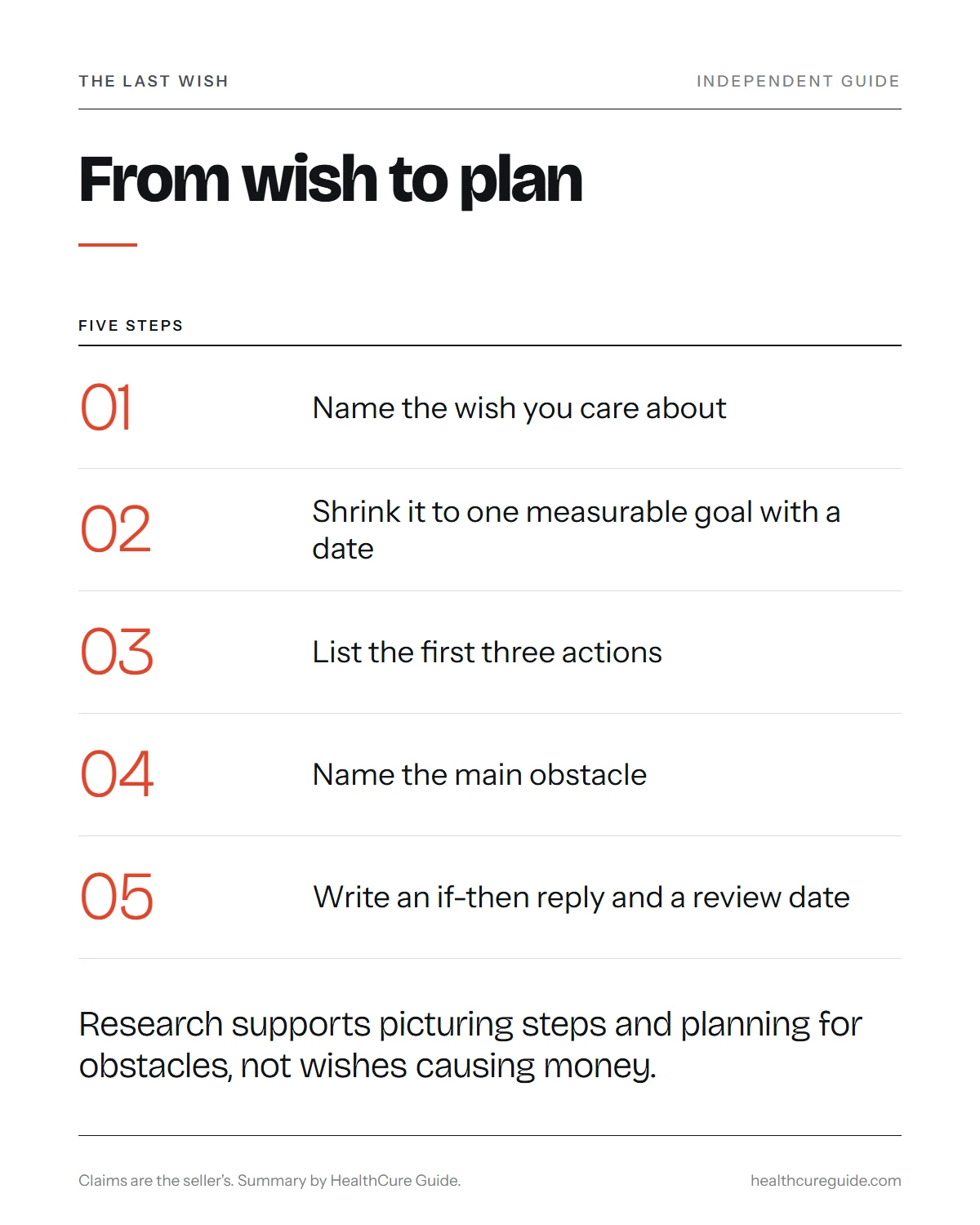
Wishing and planning are not enemies. A wish tells you what matters. A plan tells you what to do on Tuesday. Research supports picturing the steps toward a goal and mental contrasting, which means imagining the goal, then the obstacle, then writing an if-then plan.
| Step | Example |
|---|---|
| The wish | “I want to be free of my credit card debt” |
| The goal | “Pay $200 a month and clear $1,200 in six months” |
| First three actions | List balances; set up an automatic transfer; call the lender |
| The obstacle | Weekend spending after payday |
| The if-then plan | If it is payday, then the $200 moves first |
| Review date | The last Friday of every month |
Notice that every row is something you do. Listening to a recording can sit alongside this, as a quiet routine, but it cannot replace a single line of the table.
What you would actually be buying
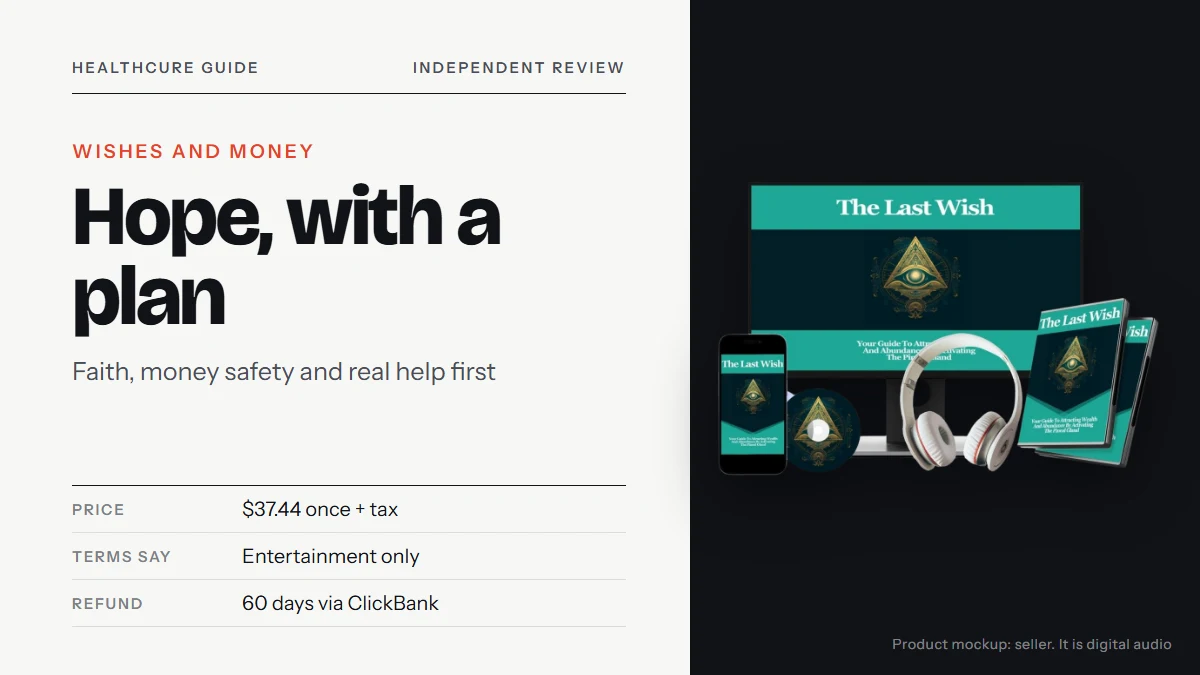
What arrives is digital audio, priced at $37.44, along with three gifts the seller names: a guide, a plan about decalcifying the pineal gland, and scripts to read while listening. The sales pages show a pile of devices and disc cases; that artwork is the seller’s, and checkout lists only a digital product. The number of recordings and their running time are both unconfirmed. The video says 11 minutes a night, while the order page says under 7.
The seller says the audio works without prayer, meditation, visualization or hard work. We state that as a claim. The gland idea, including the notion that sound activates it, has no supporting evidence that we could find. As for sound in general, binaural-beat studies show mixed results, and none involves these recordings.
The refund promises, and which one to rely on
The funnel contains four refund statements, and they do not agree:
- The Terms and the ClickBank checkout: 60 days.
- Sales page badges: 365 days, with no text explaining them.
- Terms on another company’s site (abundant-life.co), reached from the video page’s footer: a 90-day window that requires proof of 30 straight days of use, with the company’s decision final.
- The privacy page on that same site: a full refund within 90 days, no conditions listed.
Rely on the 60 days. Request the refund through ClickBank (1-800-390-6035 or clkbank.com), keep the receipt, and do it early. If you feel any doubt after the first couple of weeks, you do not have to wait.
Slowing down the pressure
If you want to see how other review pages are written and who profits from them, our guide to Last Wish reviews explains.
Several parts of the sales funnel push speed. A countdown timer runs on the video page. The page shows a “Today Only” price, and the video claims it might be pulled offline without notice and that powerful people want it gone. These are sales tactics. They tell you nothing about whether the product works or whether the price will really change.
A simple habit helps: when you feel the pull to buy right now, write the reason down, wait one night, and read it again. If the reason is “I am afraid of missing out,” that is the pressure talking. If the reason is “I have spare money and want to try a quiet evening routine,” that is a decision.
Signs it is helping, and signs to stop
Some people find a nightly ritual settling. If you notice you sleep more easily or end the day calmer, that is a real and welcome effect, whatever its cause. Credit the routine for that, and nothing more.
Stop and step back if you notice any of these:
- You are skipping bills or spending beyond your means because you expect money to arrive.
- You feel more anxious or guilty when “results” do not appear.
- You are tempted to buy the extra offers to fix a lack of progress.
- You are pulling away from friends, family or professional help.
If worry is heavy, talk with your doctor or a counselor. A wish is never a reason to ignore a bill or a symptom.
Listening safely
If you try the audio, keep the volume at a comfortable level and never play it behind the wheel or during tasks that demand focus. The order page footer says it is not meant to diagnose, treat, cure or prevent any disease, and it advises anyone who is pregnant, nursing, on medication or managing a health condition to check with a physician first. Ask a doctor too if you have a seizure history or hearing problems.
Our verdict in words
Hope, ritual and faith are part of how many people cope, and we have no quarrel with them. As a product, The Last Wish is an inexpensive, refundable digital audio set that its own Terms call entertainment, wrapped in claims about wealth that nothing supports.
The safest way to engage with it, or with any wish-based practice, is to protect your essentials, hold the claims loosely, keep a written plan and know your exit. If bills are the worry, start with a budget and a nonprofit counselor, and let the wish be an addition rather than the plan.
Related reading
Common questions
Can I be religious and still try The Last Wish or a similar manifestation product?
Yes, and many people do. Faith and a wish-based practice are personal choices, and nothing here argues with either. The only caution is practical: a product that borrows sacred imagery is still a product, with a price and terms. The seller labels it entertainment, so decide with the same care you would use for any purchase.
How much is reasonable to spend on something like this?
Only an amount you would not miss, ideally from money set aside for fun rather than bills. The Last Wish is a single $37.44 payment, converted to local currency with tax added at checkout. If that figure would delay rent, food, medicine or a debt payment, skip it. No recording is worth falling behind on essentials.
Where can I get free or low-cost help with debt?
Look for a nonprofit credit or debt counseling agency, which can review your income and bills and help you build a repayment plan. Ask what it charges before you share details, and be wary of anyone demanding large fees up front. Calling your creditors early, before a payment is missed, also tends to open more options.
What if I buy and it makes me feel worse about money?
Stop listening and use the refund. Ask ClickBank within the 60 days stated in the seller's Terms and the checkout. If worry about bills is heavy, speak with a counselor or your doctor. Hope is fine, but when a wish raises pressure instead of easing it, a practical plan helps more than another recording.
How do I turn a wish into something I can act on?
Shrink it into one measurable goal with a date, then list the first three actions. Name the main thing likely to block you, and write an if-then response to it. Research supports picturing steps and planning for obstacles. It does not support wishes causing money, so the plan carries the weight.
Should I accept the extra offers shown after I pay?
They are optional. The Terms of Sale name two later offers at $97.19 and $47.19, and checkout may show an add-on called The Wealth Wave Technique. We could not see what any of them contain. A safe approach is to decline all of them, finish your trial of the main item, and revisit later if you still want more.
Can I trust the money stories in the sales video?
Treat them as the seller's anecdotes. The video mentions earning $3,617 in a day, a $10,137 IRS refund and a $2,000 scratch-off win, and none of it is verified: these are unverified seller stories. The Terms also allow pen names and dramatized scenes. Never base a money decision on a story told in a sales pitch.