How Does FemiCore Work? The Proposed Mechanism, Tested
The bottle gives you nine ingredients and three label claims, but no explanation of what happens in between. We pieced together the implied chain from capsule to bladder and checked every link against the research.
- Written by
- HealthCure Guide Editorial Team
- Reviewed by
- HealthCure Guide Editorial Team
- Updated
- Reading time
- 9 min read
This guide contains affiliate links. If you buy through them we earn a commission at no extra cost to you. It does not change the verdict. Disclosure.
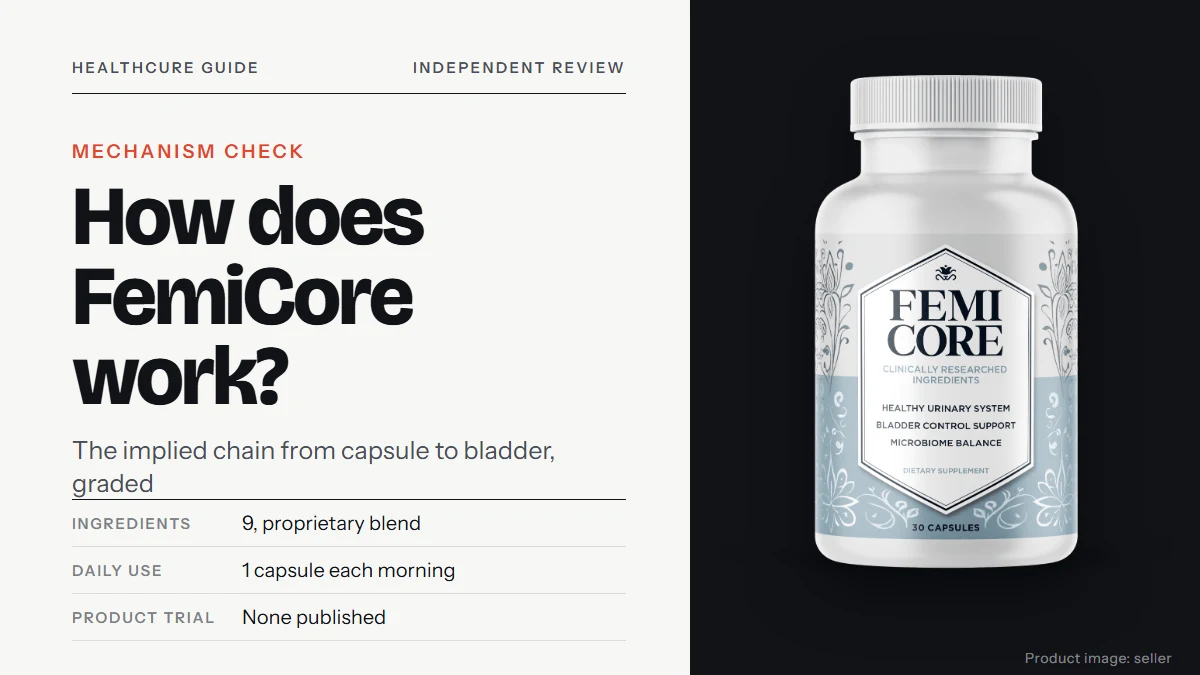
How does FemiCore work? The honest starting point is that the seller never spells it out. The label makes three short claims, “Healthy urinary system”, “Bladder control support” and “Microbiome balance”, and prints nine ingredients beside them. Everything that is supposed to happen between swallowing a capsule and seeing those claims come true is left for the buyer to imagine.
This page does the imagining carefully. We lay out the chain of events the formula implies, then grade each link as supported, partly supported or unsupported by the research we could check. Results, timelines and who might benefit are handled in a separate piece: does FemiCore really work. If the name is new to you, begin with what FemiCore is.
We are an independent site and not the seller. If you click through to the store and buy, we may be paid a commission; that does not shape the grading below.
What is in the bottle and how it is taken
Before the mechanism, the physical facts. Each bottle holds 30 capsules. You take one capsule each morning, washed down with a big glass of water, which makes each bottle a one-month supply. The seller describes the product as free of stimulants and non-GMO, and suggests giving it a minimum of 3 months before you judge it.
Five badges appear on the official site. One says the capsules come from an FDA registered facility; the others read GMP Certified, Non-GMO, Natural ingredients, and Made in USA with imported ingredients. Those badges are the site’s own; the manufacturer and the certifying body are not named. Every dietary supplement sold in the US falls under the FDA’s supplement rules, and facility registration describes the factory. It is not a review of what goes into this particular capsule.
That leaves one more fact that shapes everything below: the label is a proprietary blend.
Nine ingredients, nine possible jobs
A proprietary blend names its contents but not the amount of each one. So FemiCore tells you what is inside, in the order below, and stops there.
| Ingredient | Type | Likely job in the chain (our reading) |
|---|---|---|
| Mimosa pudica | Herb extract | Calm an overactive bladder |
| Bearberry (uva ursi) | Herb, source of arbutin | Antibacterial action in urine |
| Cranberry extract | Fruit extract | Make it harder for E. coli to cling |
| Granular berberine | Plant compound | Unclear for the bladder |
| L. crispatus | Probiotic species | Restore bladder and vaginal Lactobacillus |
| L. acidophilus | Probiotic species | General probiotic support |
| L. plantarum | Probiotic species | General probiotic support |
| L. gasseri | Probiotic species | General probiotic support |
| L. casei | Probiotic species | General probiotic support |
What the label leaves out matters as much as what it lists. There are no individual doses, no colony-forming unit (CFU) count for the probiotics, no strain codes, no figure for cranberry PACs, no arbutin content for the bearberry, no berberine dose and no certificate of analysis. Each of those gaps reappears as a weak link further down. For a longer write-up of all nine, see our FemiCore ingredients guide.
How does FemiCore work, link by link
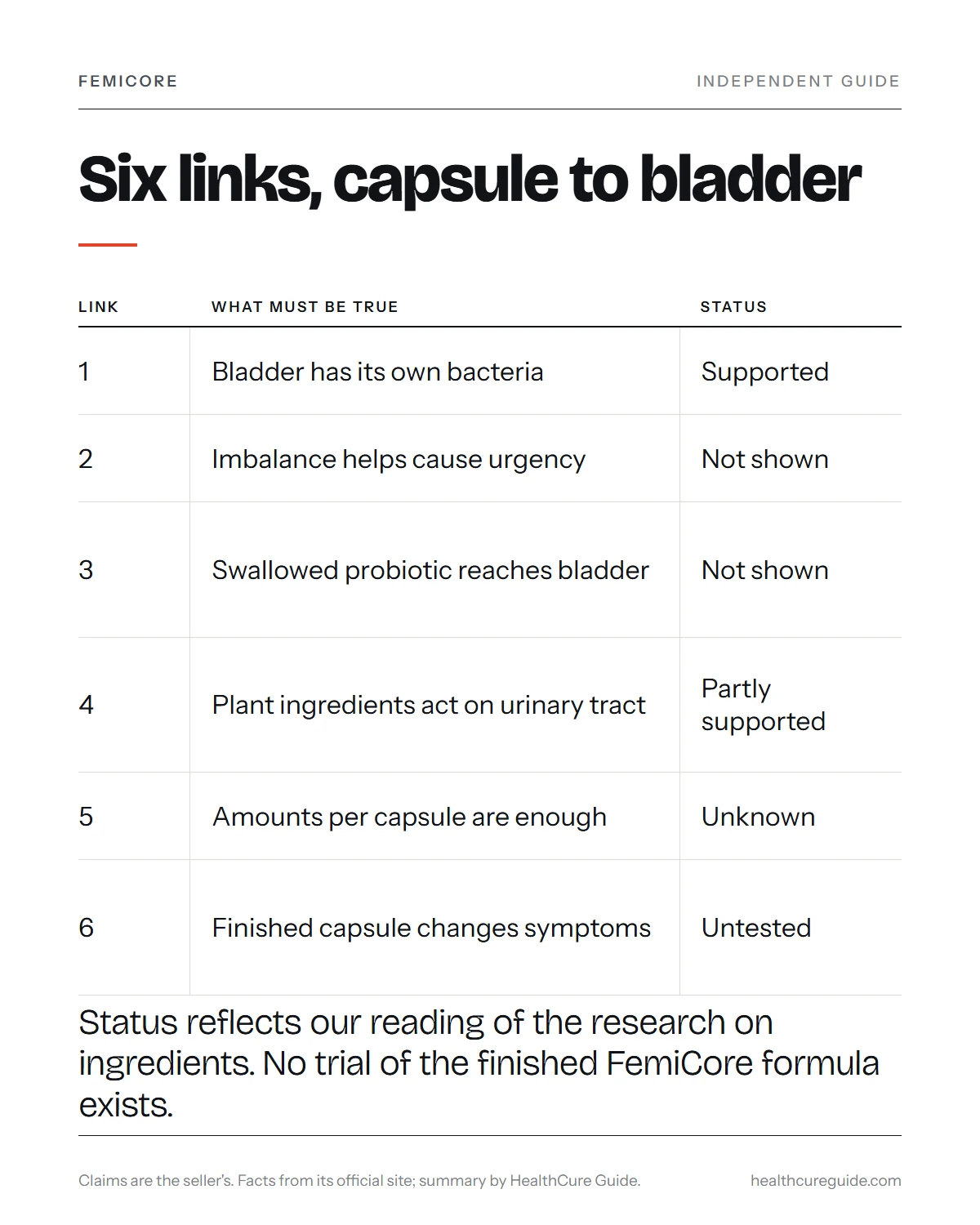
Put the label claims and the ingredient list side by side and a six-step chain appears. For FemiCore to do what its marketing implies, every one of these has to hold.
| Link | What would need to be true | Status |
|---|---|---|
| 1 | The bladder has bacteria that can be out of balance | Supported |
| 2 | That imbalance helps cause urgency or leaks | Not shown |
| 3 | A swallowed probiotic reaches the bladder | Not shown |
| 4 | The plant ingredients act on the urinary tract | Partly supported |
| 5 | The amounts in one capsule are enough | Unknown |
| 6 | The finished capsule changes symptoms | Untested |
Link 1: the bladder is not sterile
For a long time, healthy urine was taught to be free of bacteria. Sequencing work that began around 2012, with a team at Loyola University Chicago among the first, showed otherwise: the female bladder carries a small bacterial community of its own (Wolfe and colleagues). A 2014 comparison went further and found fewer Lactobacillus on average in women with urgency incontinence than in women without it (Pearce and colleagues). This link is solid.
Link 2: does the imbalance cause the symptoms?
Here the evidence thins. Those studies describe a difference between groups of women. They do not show which came first. Fewer Lactobacillus might help drive urgency, urgency might change the bacteria, or something else might affect both. FemiCore’s design assumes the first option, and that has not been demonstrated.
Link 3: from mouth to bladder
This is the weakest step. The most encouraging probiotic result for urinary health comes from a small placebo-controlled trial in which an L. crispatus product reduced repeat urinary infections. That product was used vaginally. FemiCore is swallowed, and we found no evidence in our sources that an oral probiotic travels to the bladder and settles there. On top of that, results with probiotics are tied to individual strains, and the label stops at species names. Its bacteria therefore cannot be matched to that trial or any other.
The plant track: what each herb is meant to add
The four plant ingredients form a second, separate track. Each one has its own story and its own strength of evidence.
Cranberry extract. The active compounds are A-type proanthocyanidins (PACs), which reduce how well E. coli bacteria stick. A 2023 Cochrane review found cranberry products can lower the number of repeat urinary infections in women prone to them, after earlier reviews had mixed results. Two limits apply. The benefit depends on the PAC dose, which FemiCore does not print. And the research is about infections, not urgency or leaks.
Bearberry. Its arbutin is turned into hydroquinone in urine, a compound that kills bacteria in the lab. In people, the results so far are limited and point in different directions. Herbal regulators in Europe accept it for mild lower urinary complaints, but over short courses of about a week rather than nonstop daily use.
Mimosa pudica. Lab and animal reports describe anti-inflammatory, antimicrobial and antispasmodic effects. The antispasmodic one is the property you would point to for “bladder control”. No human trial has tested it for bladder symptoms, which makes it the thinnest ingredient in the blend.
Granular berberine. Where berberine shines in human research is metabolic health: trials on blood sugar and cholesterol, typically at about 1,000 to 1,500 mg daily. We found no bladder evidence. It is also the ingredient with the most potential drug interactions.
So link 4 is a mixed picture: one ingredient with a decent human record for a related problem, one with short-course traditional use, and two whose bladder role is a guess.
Where the chain breaks
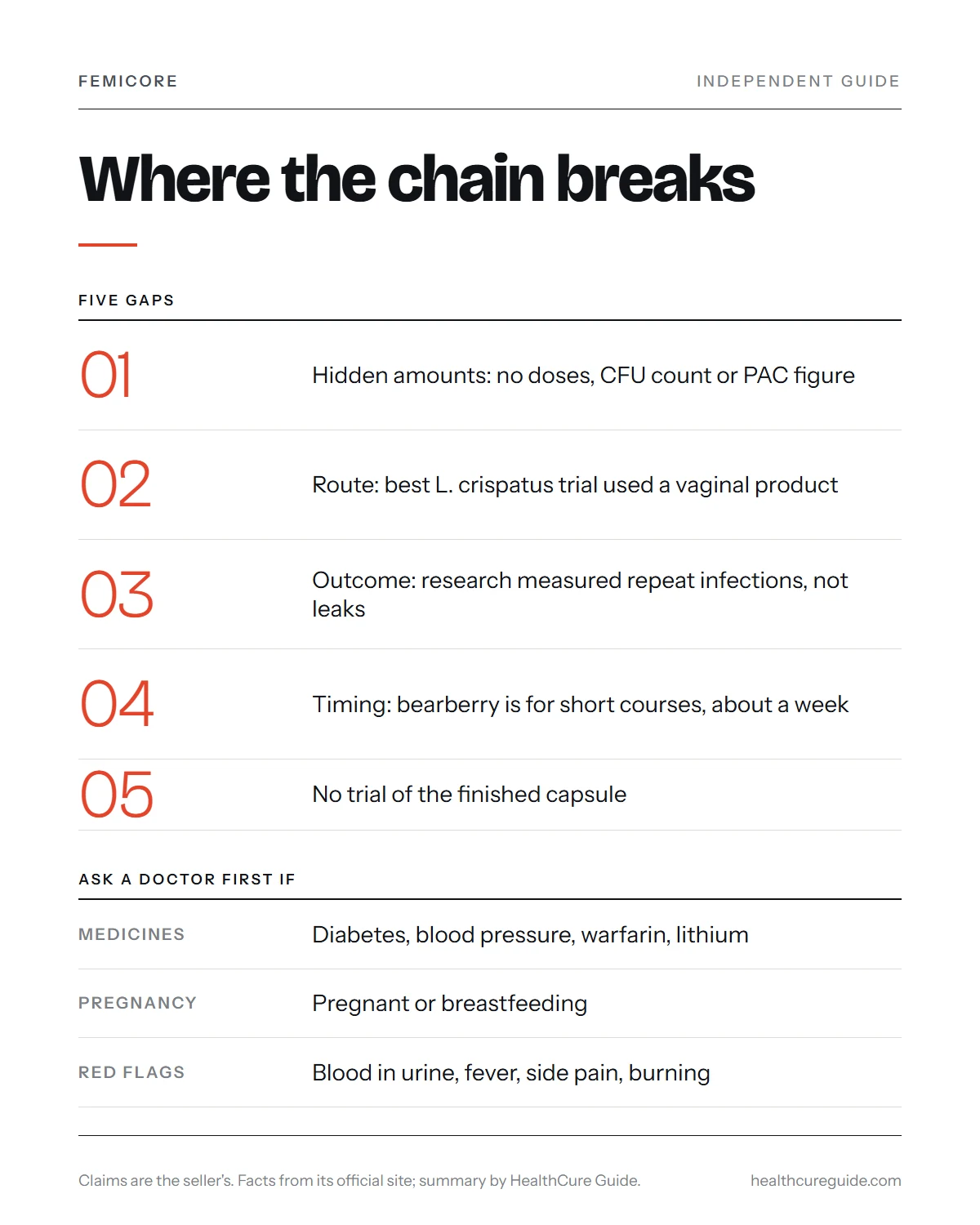
Lay the six links end to end and the gaps fall into five groups.
- Hidden amounts. Without doses, nobody can say whether the cranberry reaches the PAC levels in the research or whether the berberine is anywhere near studied amounts. Link 5 stays unknown.
- The wrong route. The best probiotic data used a vaginal product. A capsule taken by mouth is a different delivery path.
- The wrong outcome. The strongest human evidence, for cranberry and L. crispatus, measured repeat infections. Women buying FemiCore often want fewer urges and fewer leaks, which those studies did not test.
- A timing mismatch. Bearberry is described for courses of about a week. FemiCore is designed for a capsule every morning for months.
- No product trial. The label line “Clinically researched ingredients” refers to research on ingredients in general. Nobody has run a trial on the complete FemiCore capsule, so link 6 has never been checked directly.
None of these proves the capsule fails. Each one means the mechanism cannot be confirmed from the outside.
Mapping the three label claims to the evidence
Another way to see the mechanism is to start from each label claim and ask what stands behind it.
| Label claim | Ingredients behind it (our reading) | Strongest support | Main gap |
|---|---|---|---|
| Healthy urinary system | Cranberry, bearberry | Cochrane 2023 review on repeat infections | PAC and arbutin amounts not shown |
| Bladder control support | Mimosa pudica, probiotics | Association study, lab and animal work | No human bladder trial |
| Microbiome balance | Five Lactobacillus species | Vaginal L. crispatus trial | Oral route, strains and CFU unknown |
“Healthy urinary system” has the firmest footing, though for infections rather than everyday urgency. “Microbiome balance” rests on sound science with an unproven delivery step. “Bladder control support” carries the most weight in the marketing and has the least direct evidence.
Why it would take weeks, if it works at all
If the probiotic track works the way the formula implies, the change would be gradual. The seller’s own advice, at least 3 months before judging, reflects that. In the first one to two weeks, the most likely thing you notice is gas or bloating as the gut adjusts to new bacteria.
That timing creates a practical tension. The 60-day money-back guarantee is counted from the delivery date, not the order date. A refund means emailing support with “Refund Request” in the subject, sending back all bottles from the order (used ones too) along with the packing slip and a short note, and covering the postage. So a three-month test and a 60-day refund window do not line up neatly, and it pays to decide around week eight.
Safety follows the same chain
An ingredient strong enough to change something in the body can also cause trouble, and FemiCore’s cautions line up with its active parts.
- Berberine: stomach upset, lower blood sugar (a concern with diabetes medicine), possibly lower blood pressure, and slower clearance of many drugs through the CYP3A4 and CYP2D6 enzymes. Not for pregnancy or breastfeeding.
- Bearberry: nausea, harmless green-brown urine, short-term use only; avoid in pregnancy, breastfeeding, kidney disease and children, and with lithium.
- Cranberry: case reports with warfarin, so INR checks matter; oxalate content is a consideration if you have had kidney stones.
- Probiotics: rare infections in people whose immune system is severely weakened.
The official site itself advises speaking to a physician if you are pregnant, nursing, on medication or managing a medical condition. Skip the supplement aisle and book a medical appointment instead if you notice blood in the urine, fever or chills, pain in your side, burning, a sudden change in bladder control, or an older relative with urinary symptoms who suddenly seems confused.
Our take on how FemiCore works
FemiCore follows a coherent idea. The bladder has its own bacteria, women with urgency incontinence may carry fewer Lactobacillus, and cranberry and L. crispatus have human results for repeat infections. The formula turns that into a capsule of probiotics and urinary herbs.
The mechanism breaks where it matters most to a buyer: whether a swallowed probiotic reaches the bladder, whether the hidden doses are enough, and whether the whole capsule changes urgency or leaks. There is no trial of the finished product to answer those questions. The fairest summary is a reasonable hypothesis sold as a supplement, with a refund window you can use if your own results do not show up.
For the full product overview, see our FemiCore buyer guide.
Common questions
Does FemiCore work right away, or does it build up over time?
It is designed as a slow daily habit, not a quick fix. The seller advises taking it for at least 3 months before judging it, which fits a formula built mostly on probiotics. Some people notice gas or bloating in the first one to two weeks as the gut adjusts. Because the finished capsule has never been tested in a trial, nobody can say when, or whether, symptoms change.
Do the probiotics in FemiCore actually reach the bladder?
Nobody has shown that. The bladder research found that the female bladder holds its own bacteria, and the most encouraging Lactobacillus crispatus result came from a product placed in the vagina, not one swallowed. FemiCore lists species only, with no strain codes and no live count, so its probiotics cannot be matched to any study. This is the weakest link in the proposed mechanism.
What is each FemiCore ingredient supposed to do?
Read with the label claims, the five Lactobacillus species are there for microbiome balance, cranberry and bearberry for the urinary system, and Mimosa pudica most plausibly for bladder control because of its antispasmodic reputation in lab work. Berberine is harder to place: its human research covers blood sugar and cholesterol. This mapping is our reading; the seller does not publish one.
Why are the FemiCore doses missing from the label?
All nine ingredients sit in a proprietary blend, which lets a brand list ingredients without printing how much of each is in a capsule. The practical result is that you cannot compare FemiCore with the amounts used in research, and a pharmacist cannot judge interaction risk precisely. The CFU count, strain codes, cranberry PAC content and arbutin content are missing too.
Can FemiCore help with leaks as well as infections?
That is the open question. The ingredients with the best human data, cranberry and Lactobacillus crispatus, were studied for repeat urinary infections, not for urgency or leaks. The link to leaks rests on an association between fewer Lactobacillus and urgency incontinence, plus lab and animal work on Mimosa pudica. Plausible, but untested for this formula.
Why is bearberry in a capsule meant for daily use?
The seller does not explain the choice. European herbal regulators describe bearberry for mild lower urinary complaints over short courses, about a week, not continuous use, while FemiCore is meant to be taken every morning for months. The arbutin content is not disclosed. If you plan a long course, ask a doctor or pharmacist first, and skip it in pregnancy or kidney disease.
Could FemiCore interact with medicines I already take?
It could. Berberine can lower blood sugar and blood pressure and slows the CYP3A4 and CYP2D6 enzymes that clear many drugs, cyclosporine among them. Cranberry has warfarin case reports, and bearberry interacts with lithium. Take the bottle to your pharmacist before starting, especially if you take diabetes, blood pressure or blood-thinning medicine.
Sources
- Wolfe AJ et al. Evidence of uncultivated bacteria in the adult female bladder. J Clin Microbiol. 2012.
- Pearce MM et al. The female urinary microbiome: a comparison of women with and without urgency urinary incontinence. mBio. 2014.
- Stapleton AE et al. Randomized, placebo-controlled phase 2 trial of a Lactobacillus crispatus probiotic given intravaginally for prevention of recurrent urinary tract infection. Clin Infect Dis. 2011.
- Williams G et al. Cranberries for preventing urinary tract infections. Cochrane Database Syst Rev. 2023.
- National Center for Complementary and Integrative Health. Uva Ursi.