The Genius Switch Audio: What the Seller Says Is on the Track
The sales pitch names the recording with a few striking phrases. We take each one apart, list what stays unknown until you press play, and set the track beside the ordinary relaxation audio most people already have.
- Written by
- HealthCure Guide Editorial Team
- Reviewed by
- HealthCure Guide Editorial Team
- Updated
- Reading time
- 9 min read
This guide contains affiliate links. If you buy through them we earn a commission at no extra cost to you. It does not change the verdict. Disclosure.
If you want to know what the Genius Switch audio actually is before paying for it, the seller’s own words are the only map available. Four seller documents exist: the sales page, a long video of about 36 minutes, the Terms, and ClickBank’s order page. Between them they describe the recording with a handful of memorable phrases. This guide takes those phrases one at a time, separates description from evidence, and then puts the track next to the plain relaxation audio you may already use.
HealthCure Guide is independent, is not the seller, and may earn a commission if you order through our buttons. We have not listened to the track, and nothing here reports a personal result.
Genius Switch audio in the seller’s own words
Every description of the recording comes from the seller. Here are the key terms, where they show up, and how much each one tells a buyer.
| Seller’s phrase | Where it appears | What it actually tells you |
|---|---|---|
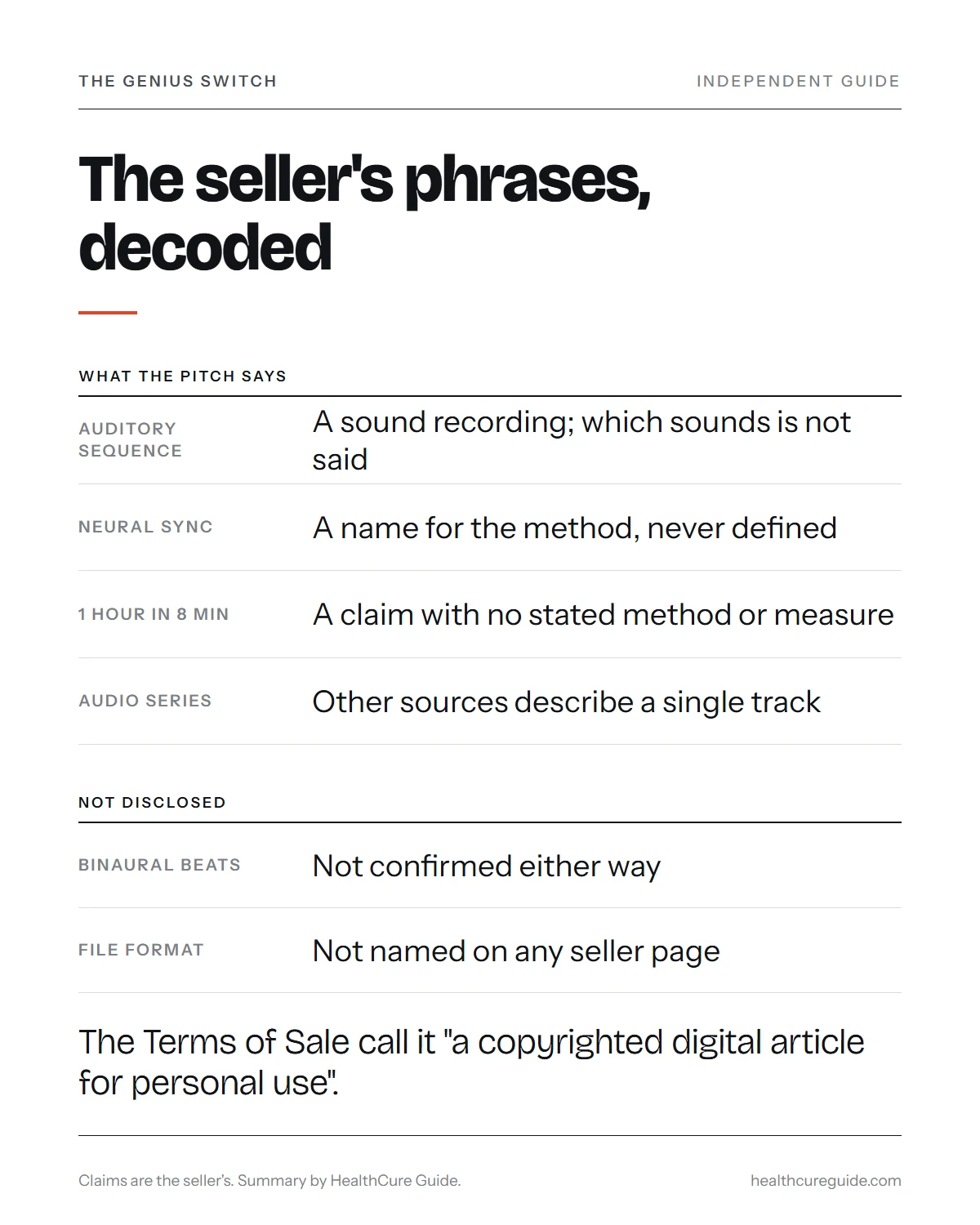
| “Targeted auditory sequence” | Sales video | It is a sound recording; nothing about which sounds |
| “Neural sync technology” | Sales video | A name for the method, with no definition |
| One hour of neural sync in 8 minutes | Sales video | A compression claim with no stated method |
| “Whole brain activation” | Sales video and page | The intended outcome, in the seller’s terms |
| “Genius Switch Audio Series” | Sales page heading | A product name; the other sources describe one track |
| “A copyrighted digital article for personal use” | Terms of Sale | What you legally buy: a licensed digital item |
Only the last row is precise. It comes from the Terms, the document that governs the sale, and it says you are buying a copyrighted digital item for your own use. The rest is marketing vocabulary. That does not make it false, but it does mean none of it can be checked from the outside.
Targeted auditory sequence: a description, not a spec
“Auditory” means heard. “Sequence” suggests sounds arranged in a set order. “Targeted” implies the sounds are aimed at something, presumably the brain changes the video goes on to describe. Put together, the phrase says little more than this: a sound recording designed with a purpose in mind.
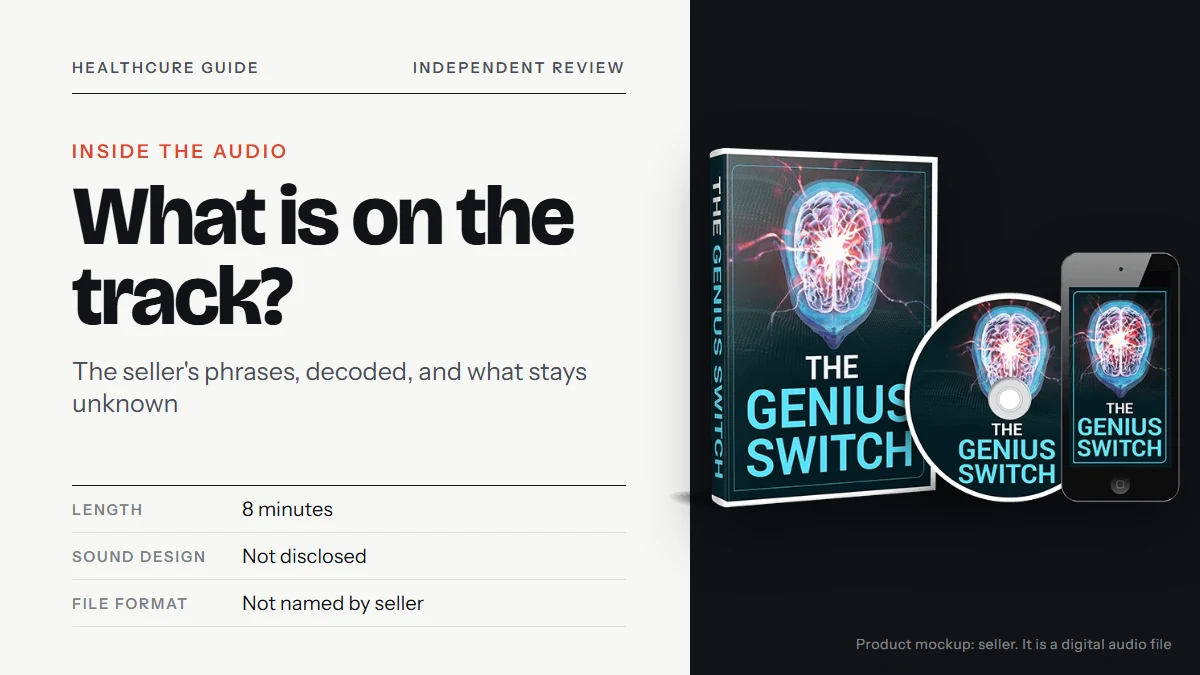
What the phrase leaves out matters just as much. A real specification would list the kind of sound (pure tones, music, speech, noise), any frequencies used, whether the left and right channels differ, how loud the track is mastered and which file type it ships as. The seller publishes none of these. Even the length, 8 minutes, comes from the video rather than from any technical sheet.
For a buyer, that leaves one practical reading. You are paying for a recording whose design is kept private, and you will learn what it sounds like only after checkout.
Neural sync technology and the one-hour claim
The second phrase carries more weight in the pitch. The video’s host (he introduces himself as Dr. Daniel Barone, a neurologist practicing in New York City) credits the effect to what he calls “neural sync technology”, adding that a full hour’s worth of it has been squeezed into the 8 minutes. We could not verify who he is or what part, if any, he played in making the product.
Two problems stand out. First, “neural sync” is never defined. It could refer to bringing the two brain hemispheres into step, which fits the video’s “whole brain activation” theme, but the seller does not explain how sound would do that or how anyone would measure it. Second, shortening a recording is easy; claiming that its effect on a listener has been concentrated six times over is a very different statement, and it needs evidence. None is offered.
So treat the ratio as part of the story the video tells, not as a measured property of the file you receive.
Tones, voice or music: what stays unknown
Here is the list of things our sources leave open. We would rather name the gaps than guess at them.
- Binaural beats or not. According to the video, brain waves play no part, and sound waves on their own are “incomplete”. The sales page, by contrast, cites studies on 40 Hz binaural beats and gamma stimulation. Those positions do not fit together, and the seller never says which one describes the track.
- What you will hear. No source says whether the recording contains tones, music, a guiding voice, natural sounds or a mix.
- The file format. MP3, M4A, WAV or something else: not named anywhere we looked.
- How it reaches you. The video says the track is emailed right after checkout. Whether that means an attachment or a link is not stated.
- Testing. No published study tests this recording, and results from other sounds do not transfer to it.
None of these gaps is unusual for a direct-sale digital product. They do mean you cannot compare the Genius Switch with any other recording on technical grounds before you buy.
How it stacks up against ordinary relaxation audio
Most people can already reach plenty of relaxation audio: guided meditations, rain or ocean recordings, slow instrumental playlists, sleep stories. Many are free or come with a streaming subscription. Here is how the Genius Switch compares on the points a buyer can actually check.
| Point | The Genius Switch | Typical relaxation audio |
|---|---|---|
| Length | 8 minutes, once a day | Anything from a few minutes to hours |
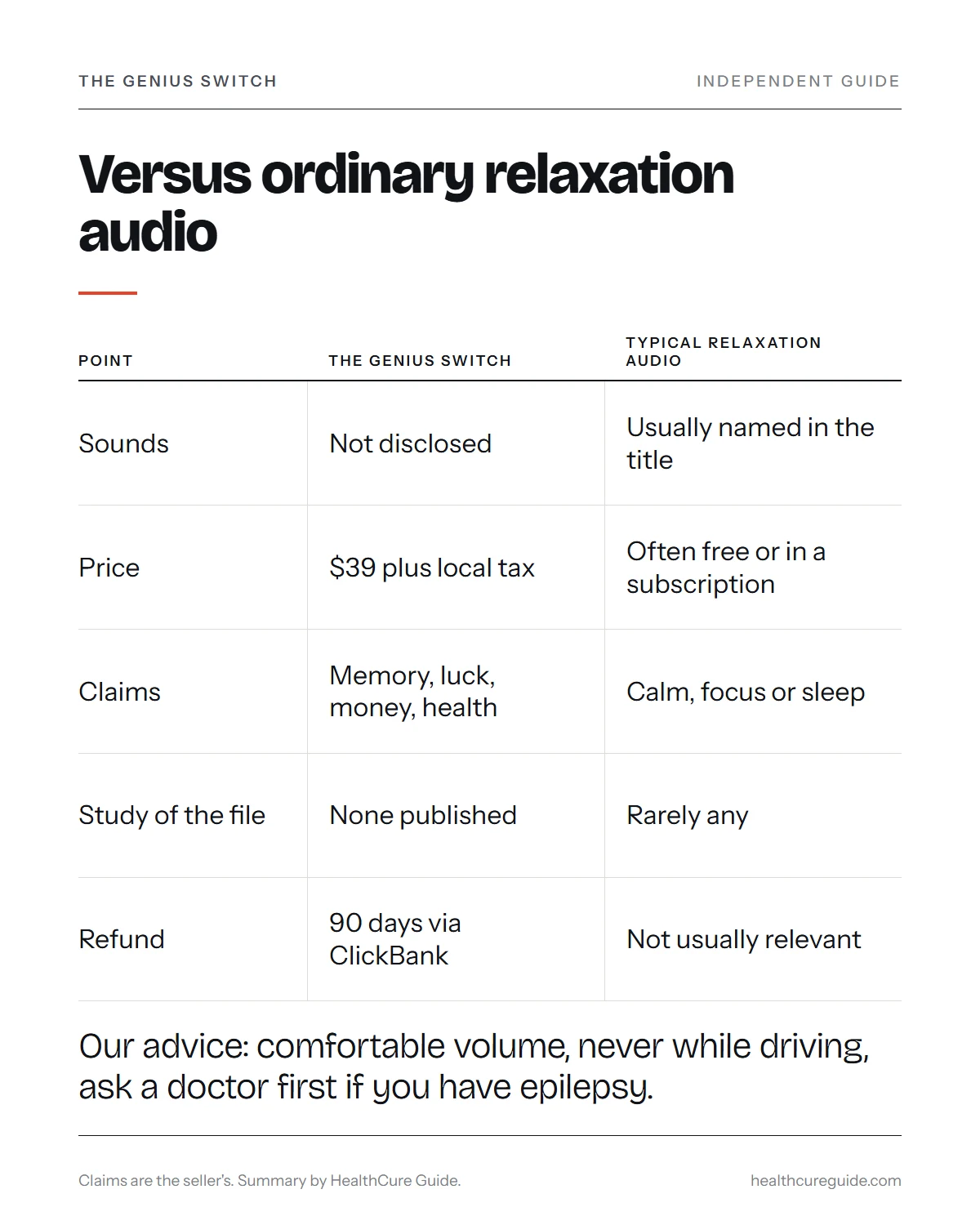
| What the sounds are | Not disclosed | Usually named in the title |
| Price | $39 plus any local tax | Often free or part of a subscription |
| Claimed outcomes | Memory, insight, luck, money, health | Usually calm, focus or sleep |
| Study of the exact recording | None published | Rarely any either |
| Refund | 90 days via ClickBank | Not usually relevant |
| Usage rights | Personal use per the Terms | Depends on the platform |
The real difference sits in the second and fourth rows. Ordinary relaxation audio tends to promise modest things and tells you what it contains. The Genius Switch charges more, discloses less and promises far more. Neither kind is usually tested as a specific recording, so the choice comes down to what you value: a known, modest experience, or an unknown one backed by a refund window.
In fairness to the track, eight quiet minutes in a chair with your eyes shut will rest most people, whatever is playing. If the session feels calming, that may simply be the quiet break doing its work, which any relaxation recording can also give you.
What the seller expects you to notice, and when
The video sets a quick timeline. Something should happen on the first listen, plenty of buyers supposedly feel a shift within two or three days, and the majority are said to see results by the end of week two. The promised results run from eureka moments, quicker learning and sharper memory to luck, promotions, money, better relationships, weight loss, quitting smoking and easier headaches or joint pain.
All of those are the seller’s claims, not measured outcomes. Even the presenter, wrapping up a story about a casino win, admits there is “of course no evidence” linking that win to the recording. The Terms are more sober still. A section headed “For Entertainment Purposes Only” admits brain entrainment is no exact science and tells buyers not to treat it like one. A line elsewhere on the site rules out medical use too: “not intended to diagnose, treat, cure, or prevent any disease”.
The seller says “18,456 everyday Americans” have been helped and talks of “stacks of five star reviews”. We have no means of checking either figure. The Terms add that customer feedback may be dramatized with avatars or actors and may not reflect a typical buyer’s experience.
Listening safely to a track you have not heard before
Because nobody outside the company describes the sound design, the first listen deserves a little care. This is our advice, not the seller’s.
- Start the first session with the volume low, then raise it to a comfortable level.
- Never play it while driving, cycling or operating machinery; the routine asks you to close your eyes anyway.
- Epilepsy, past seizures or hearing trouble? Get a doctor’s view before trying any tone-based or rhythmic audio.
- Stop if you feel dizzy, get a headache or notice ringing in your ears.
- Keep any care you already receive. This is a recording, not a treatment. It is also not an app or a game: it plays in whatever media player you already use.
Price and refund for an unheard track
Buying audio you cannot preview makes the refund terms more important than usual. On the sales page, $39 is the live price, with $200, $100 and $49 struck through as reference prices, and the video calls $39 a special price “not guaranteed beyond today”, an urgency line you have no way to check. Checkout shows local currency plus tax, so the total can vary by country, and the charge appears on your statement as CLKBANK*GeniusSwitch.
For digital items the Terms give you 90 days from your initial purchase to ask for a refund, and ClickBank’s order page repeats that period. The separate Refund page on the site looks copied from a supplement called “NeuroActivate”: it mentions a 60-day limit, bottles that must be unopened and an Ohio return address (Tallmadge). A download has no bottle to send anywhere, so go by the Terms and ClickBank. Hold on to the ClickBank receipt, and phone ClickBank order support (1-800-390-6035) when you decide you want your money back.
Four extras come with the order: a guided visualization by a creator billed as top-rated on Calm, a shopping guide built around foods that, in the seller’s view, feed brain fog, a reprint of a book on financial success first published more than a century ago, and a printable sheet of 5 habits.
Where that leaves the audio
Strip away the vocabulary and the seller’s description reduces to a short list of facts: one recording, 8 minutes long, emailed after payment, licensed for personal use, played with headphones and eyes closed. “Targeted auditory sequence”, “neural sync technology” and the one-hour-in-8-minutes ratio are names and claims, not specifications. Whether the track uses binaural beats, what it sounds like and which format it comes in are things you will only learn after buying.
If an unknown recording with a 90-day refund window appeals to you, it is a small experiment with a clear exit. If you would rather know what you are listening to before you pay, ordinary relaxation audio tells you more up front. This guide is general information, not medical advice.
Related reading
Common questions
What does targeted auditory sequence mean?
It is the seller's own name for the 8-minute recording. The phrase sounds technical, yet the sales page, the video and the Terms never explain what is being targeted, which sounds make up the sequence, or how it was produced. Read it as a description chosen by the marketer rather than a term with an agreed scientific meaning.
Is there any proof that an hour of neural sync fits into 8 minutes?
We found none. The video states the compression as if it were a fact, but it offers no measurement, method or study, and our sources never define neural sync in a way anyone could test. Until the seller publishes how that ratio was arrived at, treat it as a sales claim and nothing more.
Does the track contain spoken words or music?
Our sources do not say. The seller describes the recording only through phrases such as targeted auditory sequence, and we have not listened to it ourselves. It could hold tones, music, a guiding voice or a blend of these. You will only know once the delivery email arrives and you play the file.
How is The Genius Switch different from a free relaxation playlist?
Mostly in price, disclosure and claims. Free relaxation playlists usually say what they contain, such as rain, piano or a guided voice, and promise little beyond calm. The Genius Switch costs $39, does not describe its sounds, and is sold with claims about memory, luck and money that no study of the track supports.
Will the seller explain the sound design if I ask?
We cannot predict the answer. For product questions, the official site gives [email protected]; that is the place to ask about the recording before or after buying. Nothing in the public material we read suggests a technical sheet exists, so base your decision on what is already published.
Can I judge the track by its first listen?
The video claims it works from the very first time you listen, so a first session is a fair moment to take notes. One listen is still a tiny sample. Feeling calmer after sitting still with your eyes closed is common with any quiet audio, so compare a few weeks of notes before you decide.
Why does the seller ask for headphones if it is not about brain waves?
The seller does not explain. Headphones are standard for binaural recordings, where each ear gets its own tone, yet the video says the method has nothing to do with brain waves. Headphones also simply shut out room noise. Follow the instruction as written, keep the volume comfortable, and read no more into it than the seller states.