FemiCore Formula: A Design Critique of the Blend
A supplement formula is a set of design decisions: which ingredients go in, how much of each, and how much of that the buyer is told. We grade FemiCore on all three, with a disclosure scorecard and the questions the label leaves open.
- Written by
- HealthCure Guide Editorial Team
- Reviewed by
- HealthCure Guide Editorial Team
- Updated
- Reading time
- 10 min read
This guide contains affiliate links. If you buy through them we earn a commission at no extra cost to you. It does not change the verdict. Disclosure.
The FemiCore formula can be judged on three separate questions. Did the designer pick a coherent set of ingredients? Did they choose amounts that match the research? And does the label tell the buyer enough to check the first two? FemiCore does reasonably on the first, cannot be scored on the second, and does poorly on the third.
This page is a critique of the formula as a piece of design, not a step-by-step account of what happens in your body. That chain of events, link by link, is covered in our piece on how FemiCore works. For a plain description of each of the nine ingredients, see the FemiCore ingredients guide.
We are an independent site and not the seller. Every button here leads to the seller through an affiliate link, and if you buy, we may be paid a commission. That payment plays no part in the grades below.
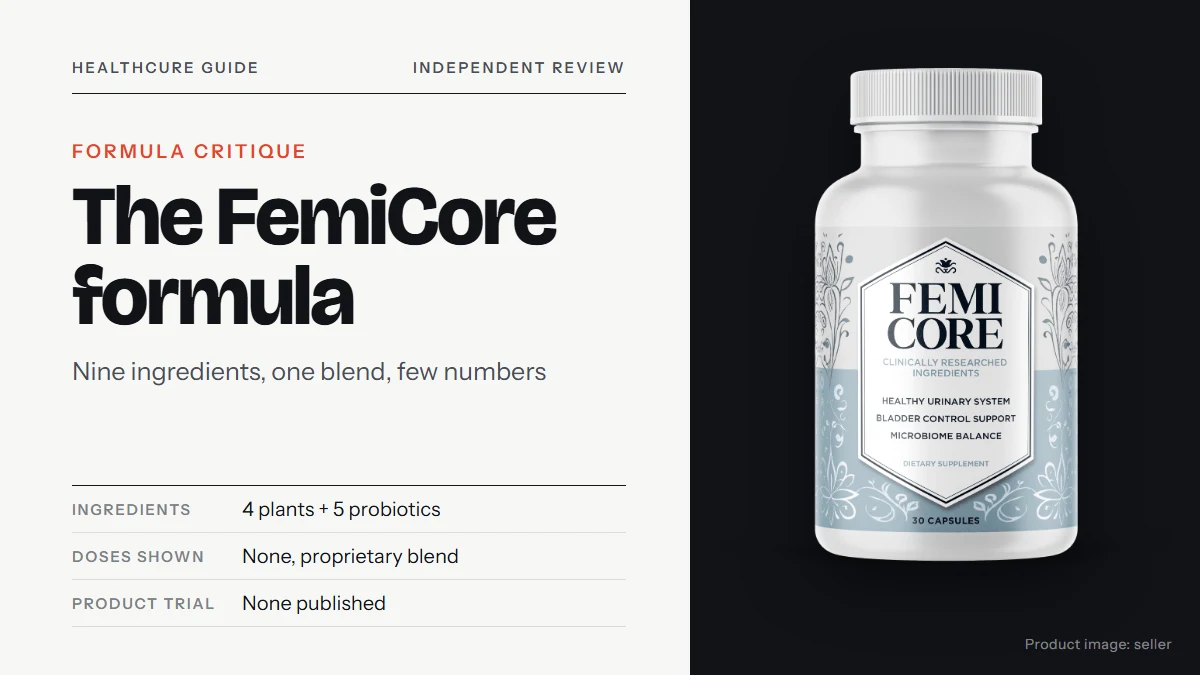
How the FemiCore formula is built
Every capsule carries the same nine ingredients, and the bottle holds 30 of them. The seller’s direction is one capsule per day, taken in the morning alongside a big glass of water, so a single capsule is the whole daily serving. The seller also says the blend contains no stimulants and uses non-GMO ingredients.
The nine split cleanly into two groups.
| Group | Ingredients | Design purpose (our reading) |
|---|---|---|
| Plants (4) | Mimosa pudica, bearberry (uva ursi), cranberry extract, granular berberine | Urinary and antibacterial reputations, plus a calming herb |
| Probiotics (5) | Lactobacillus crispatus, L. gasseri, L. casei, L. plantarum, L. acidophilus | Support the “microbiome balance” claim |
The label sets three goals beside them: “Healthy urinary system”, “Bladder control support” and “Microbiome balance”. Read together, the plants look aimed at the first two and the probiotics at the third. The seller does not publish this mapping, so treat it as our interpretation.
The probiotic half
Five species from one genus is a deliberate choice. L. crispatus is the species with the most specific urinary research: a small placebo-controlled trial found that an L. crispatus product reduced repeat urinary infections. The other four are common, well-known probiotic species. Including them broadens the blend, but none of them comes with bladder-specific research in our sources.
The idea behind this half is the urinary microbiome. Since roughly 2012, gene-sequencing work has shown that the female bladder carries bacteria of its own, and several of those studies reported lower Lactobacillus levels in women with urgency incontinence. That is a plausible starting point and still early science.
The plant half
Each plant brings a different kind of support. Cranberry has the best human data, for repeat infections. Bearberry has traditional use for mild urinary complaints. Mimosa pudica rests on lab and animal reports. Berberine has strong human research, but for blood sugar and cholesterol rather than the bladder. So the plant half mixes one evidence-backed ingredient, one traditional herb, one lab-stage herb and one ingredient whose role is unclear.
What a fully transparent formula would disclose
To judge a formula, you need to know more than the names. For this particular blend, a complete label would answer seven questions.
- The amount of each ingredient per capsule. Without it, no ingredient can be compared with the research behind it.
- A CFU count for the probiotics, ideally the count guaranteed at the end of shelf life rather than at manufacture, because live bacteria decline over time.
- Strain codes for each species. Probiotic effects are tied to strains. A species name covers many strains with different research records.
- The PAC content of the cranberry. The cranberry research points to A-type proanthocyanidins (PACs) as the active part, and the effect depends on the PAC dose.
- The arbutin content of the bearberry. Arbutin is the compound that matters in bearberry, so the leaf weight alone says little.
- The berberine dose, since berberine carries the most drug interactions in the blend.
- A certificate of analysis, an independent lab result showing the capsule contains what the label says.
Two further items sit outside the label but belong to transparency: the name of the manufacturer, and the name of the body that issued the quality seals.
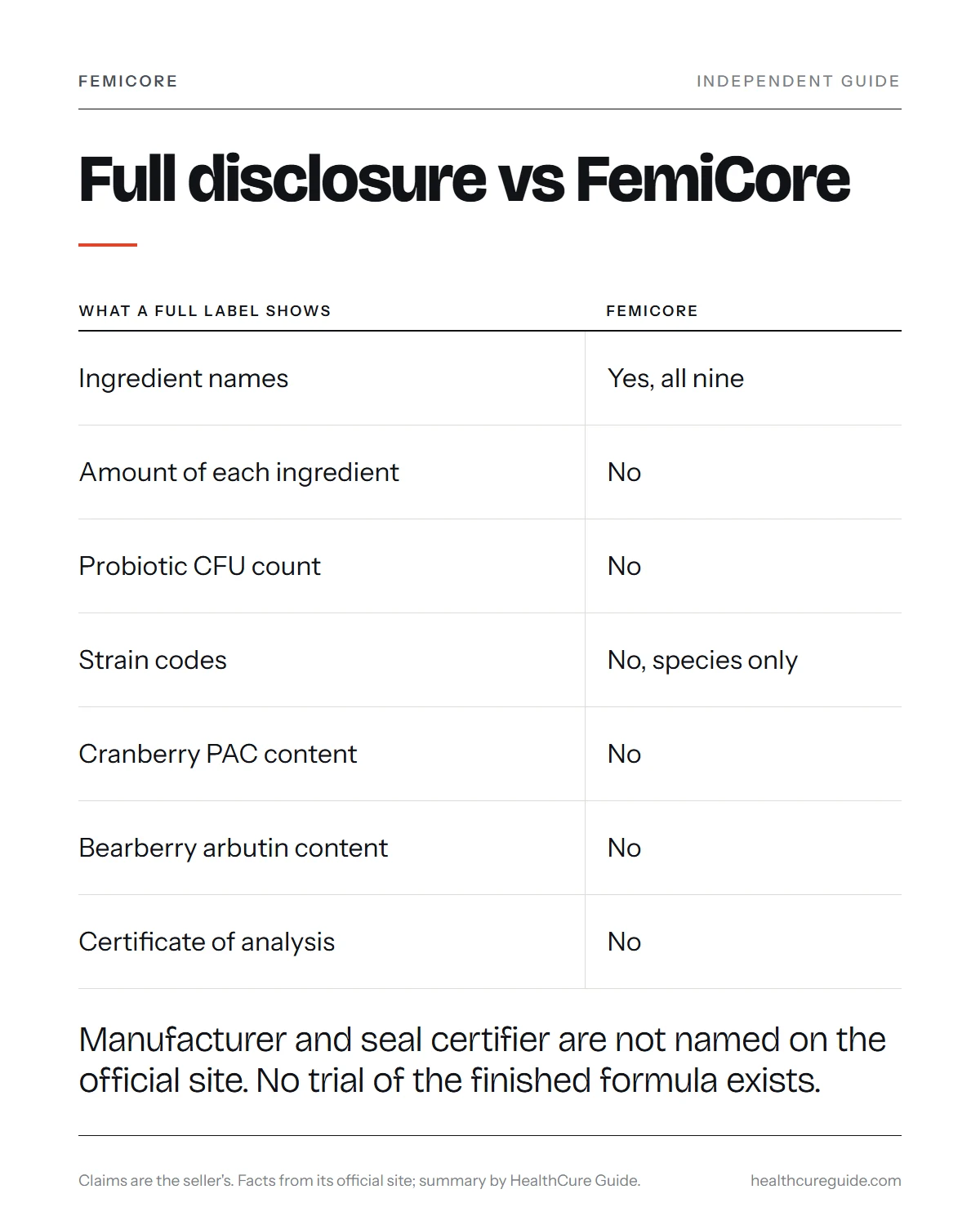
Disclosed vs withheld: a scorecard
Here is how FemiCore’s published information measures against that list.
| Item | Disclosed? | What you get |
|---|---|---|
| Ingredient names | Yes | All nine, by name |
| Amount per ingredient | No | One proprietary blend |
| Probiotic CFU count | No | Species named, no count |
| Strain codes | No | Species only |
| Cranberry PAC content | No | “Cranberry extract” only |
| Bearberry arbutin content | No | “Bearberry (uva ursi)” only |
| Berberine dose | No | “Granular berberine” only |
| Certificate of analysis | No | None published |
| Serving and bottle size | Yes | 1 capsule a day, 30 per bottle |
| Stimulant and GMO status | Yes, as a seller statement | No stimulants, non-GMO |
| Manufacturer | No | Not named |
| Seal certifier | No | Not named |
That is three clear disclosures, one seller statement, and eight gaps. For a product built on ingredients whose effects depend on dose and strain, the gaps fall in exactly the places that matter.
The official site also carries five badges. They read Non-GMO, GMP Certified and Natural ingredients, plus one for Made in an FDA registered facility and one for Made in USA with imported ingredients. The site does not name who certified any of them. Every supplement sold in the US follows the FDA’s rules for dietary supplements, and facility registration is about the factory where a product is made. It says nothing about the contents of this capsule.
Why proprietary blends matter for evidence
The research on FemiCore’s ingredients is real. The problem is that it cannot be connected to the capsule without numbers. Three examples show how.
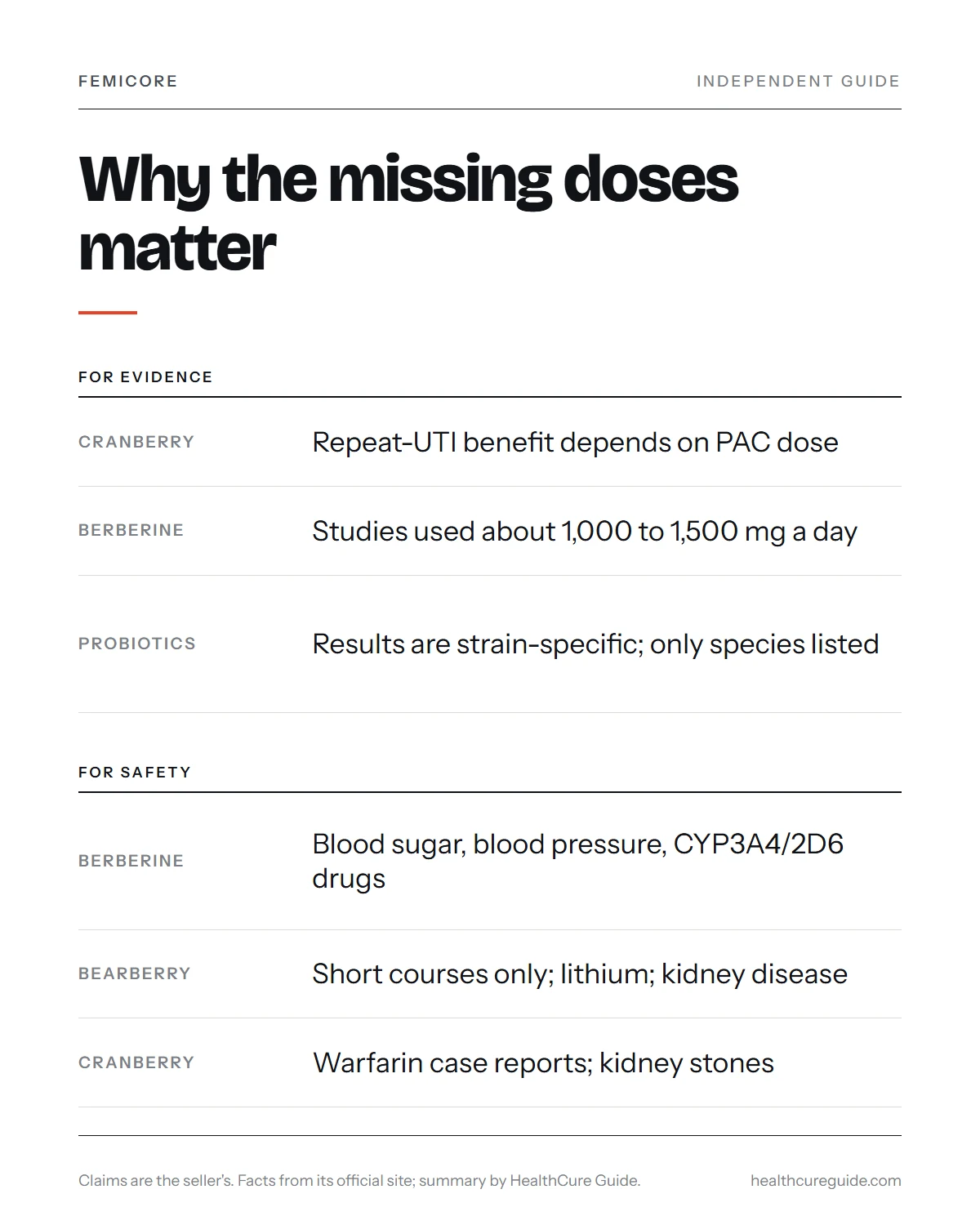
Cranberry. The 2023 Cochrane review concluded that, for women who get repeat urinary infections, cranberry products can cut the number of those infections; earlier reviews had been mixed. The benefit depends on the PAC dose. With no PAC figure, nobody can say whether a FemiCore capsule sits inside or outside the range that worked.
Berberine. Human studies on blood sugar and cholesterol typically used about 1,000 to 1,500 mg a day. A capsule that holds nine ingredients in one blend may or may not contain an amount anywhere near that. The label gives no way to tell.
Probiotics. The most encouraging L. crispatus result came from a vaginal product, a specific strain at a specific count. FemiCore is swallowed, names species rather than strains, and gives no count. Even if the oral route worked, the label would not let you match its bacteria to that trial.
This is why “Clinically researched ingredients” on the label needs careful reading. It refers to the ingredients in general. Nobody has published a trial of the complete capsule, which leaves the research describing ingredients at the amounts other researchers chose, not FemiCore at the amounts its maker chose.
Why the hidden amounts matter for safety
Disclosure is a safety issue as much as an evidence issue. A pharmacist who checks a supplement against your medicines usually wants to know the dose, because many interactions grow with the amount taken.
FemiCore has three ingredients where that question comes up.
- Berberine has a blood-sugar-lowering effect, a possible blood-pressure-lowering effect, and it slows two liver enzymes, CYP3A4 and CYP2D6, which can raise the levels of many drugs (cyclosporine is one example). It is unsafe in pregnancy and breastfeeding.
- Bearberry belongs to short courses only. It is a poor match for pregnancy, breastfeeding, kidney disease or children, and lithium users should mention it to their prescriber.
- Cranberry has been linked with warfarin in case reports, which is why people on warfarin need their INR watched. Its oxalate is a point to raise if you have had kidney stones.
With a dose on the label, a pharmacist could say “this amount is small enough to ignore” or “this amount needs monitoring.” Without one, the careful answer is to treat each interaction as possible. Each one is covered at greater length in our side effects guide. The official site’s own advice is to check with a physician first when pregnant or nursing, when taking medication, or when living with a medical condition.
Design choices that raise questions
Beyond disclosure, a few choices in the blend are worth questioning on their own terms.
A short-course herb in a daily product. In Europe, herbal regulators accept bearberry as a traditional remedy for mild lower urinary complaints, taken for about a week at a time rather than continuously. FemiCore is designed for one capsule every morning, and the vendor suggests giving it no less than 3 months before deciding whether it helps. That gap between the herb’s usual pattern of use and the product’s intended use is the most obvious design tension in the blend.
An ingredient without a bladder role. Berberine’s strong human data concerns metabolic health. Putting it in a bladder formula adds interaction risk without a clear bladder benefit in our sources.
The thinnest ingredient in a headline role. Mimosa pudica is backed by laboratory and animal work only, with reported antispasmodic, antimicrobial and anti-inflammatory activity, and no human trials for bladder symptoms. If it is meant to carry the “bladder control support” claim, that claim rests on the weakest evidence in the capsule.
Outcomes that do not match. The strongest human evidence in the formula, for cranberry and L. crispatus, measured repeat urinary infections. Many buyers are looking for help with urgency or leaks, which those studies did not test.
None of these choices makes the formula unsafe or useless. Each one is a point where the design asks the buyer to trust rather than check.
Questions to put to the seller
If the missing numbers matter to you, ask for them before you order. A short email can cover everything:
- How much of each of the nine ingredients is in one capsule?
- What is the guaranteed CFU count at the end of shelf life?
- What are the strain codes for the five Lactobacillus species?
- How many milligrams of PACs does the cranberry extract supply per capsule, and by which test method?
- What is the arbutin content of the bearberry?
- Can you share a recent certificate of analysis?
- Who manufactures FemiCore, and which organization issued the GMP seal?
If you get answers, take them to your pharmacist along with the bottle. If you do not, that is useful information too.
The FemiCore formula as a purchase decision
For a buyer, the critique comes down to how much you need to verify before you try something.
If you are healthy, take no regular medicine, and are content to test a plausible idea for yourself, the hidden doses are an annoyance more than a barrier. The seller offers a 60-day refund counted from the delivery date. To use it you email support with “Refund Request” in the subject, send back every bottle from the order, used or unused, together with the packing slip plus a brief note that gives your order id along with your name and email address. Return postage is yours to pay.
If your regular medicines include anything for diabetes, blood pressure or blood thinning, or lithium, or a drug cleared through CYP3A4 or CYP2D6, the missing numbers matter more. Talk to your doctor or pharmacist before the first capsule. And book a doctor’s visit first for any of these: blood in the urine, a fever or chills, pain in one side of your back, a burning feeling on urination, or bladder control that changes suddenly. Those symptoms need testing, not a supplement.
For the full product picture, including price and our editorial score, see the FemiCore buyer guide.
Our verdict on the formula
FemiCore’s formula has a coherent shape. It pairs a urinary microbiome idea with five Lactobacillus species and adds plants with urinary reputations, led by cranberry. As a list of names, it is reasonable.
As a disclosed formula, it falls short. Every number that would let you connect the capsule to research, or let a pharmacist size an interaction, is missing, and no trial of the complete blend exists. The design may be sound. The label simply does not let anyone outside the company confirm it.
Common questions
How many ingredients go into each FemiCore capsule?
Nine. Four come from plants: Mimosa pudica, bearberry (uva ursi), cranberry extract and granular berberine. Five are Lactobacillus probiotic species: L. crispatus, L. acidophilus, L. plantarum, L. gasseri and L. casei. All nine sit in a single proprietary blend, so the label names them without saying how much of each one a capsule holds.
What is a proprietary blend, and is it allowed?
It is a labeling format in which a brand lists a group of ingredients together instead of printing the amount of each one. It is a common and permitted format for dietary supplements. The cost falls on the buyer: you cannot compare the amounts with those used in research, and a pharmacist checking for interactions has to work without numbers.
Does the FemiCore label give a probiotic count?
Not according to the information we checked. There is no colony-forming unit (CFU) figure for the five Lactobacillus species, and no strain codes either, only species names. That matters because probiotic results tend to belong to specific strains at specific counts, so a species name alone cannot be matched to any published study.
Has anyone tested the complete FemiCore blend in people?
We found no trial of the finished formula. The "Clinically researched ingredients" line on the label points to studies of the ingredients in general, such as cranberry for repeat urinary infections or berberine for blood sugar. None of that work used FemiCore, its combination of nine ingredients, or the amounts inside one capsule.
Why would a bladder formula include berberine?
The seller does not explain the choice. Berberine has good human research for blood sugar and cholesterol, usually at about 1,000 to 1,500 mg a day, but we found no evidence for bladder symptoms. It is also the ingredient with the most drug interactions, which makes its undisclosed dose the most important missing number for anyone on regular medicine.
What should I ask the seller before buying?
Ask for the amount of each ingredient per capsule, the CFU count at the end of shelf life, the strain codes for all five Lactobacillus species, the PAC content of the cranberry, the arbutin content of the bearberry, and a certificate of analysis. Also ask who manufactures the product and which body issued the GMP seal. Keep the reply for your records.
Could a more transparent formula still have the same ingredients?
Yes. Nothing about the nine ingredients forces a hidden label. A brand could keep the same plants and species and print a dose beside each one, name the strains, state a CFU count and publish a certificate of analysis. The ingredients would be unchanged; what would change is your ability to check them against research.
Sources
- Williams G et al. Cranberries for preventing urinary tract infections. Cochrane Database Syst Rev. 2023.
- Stapleton AE et al. Randomized, placebo-controlled phase 2 trial of a Lactobacillus crispatus probiotic given intravaginally for prevention of recurrent urinary tract infection. Clin Infect Dis. 2011.
- Pearce MM et al. The female urinary microbiome: a comparison of women with and without urgency urinary incontinence. mBio. 2014.
- National Center for Complementary and Integrative Health. Uva Ursi.