The Genius Switch Reviews: Who Writes Them and Why It Matters
Search for an opinion on this 8-minute audio track and you will find plenty of them. Very few come from someone with nothing to gain. This guide maps who publishes the reviews, how those writers get paid and how to sort a useful review from a sales pitch.
- Written by
- HealthCure Guide Editorial Team
- Reviewed by
- HealthCure Guide Editorial Team
- Updated
- Reading time
- 9 min read
This guide contains affiliate links. If you buy through them we earn a commission at no extra cost to you. It does not change the verdict. Disclosure.
Type genius switch reviews into a search bar and the results look like a crowd of independent voices. Look a little closer and most of them share a source, a script or a payment arrangement. This page does not add one more verdict on The Genius Switch track. It maps who writes these pages, how the writers are paid and which details separate an informative review from a sales page in disguise.
HealthCure Guide has no tie to the business behind this product beyond the affiliate link, and that link can pay us a commission when you order through it. We have not bought the track, and we have not gathered customer feedback of our own. The product facts here come from the seller’s sales page and video, its Terms and the ClickBank order form.
Where Genius Switch reviews come from
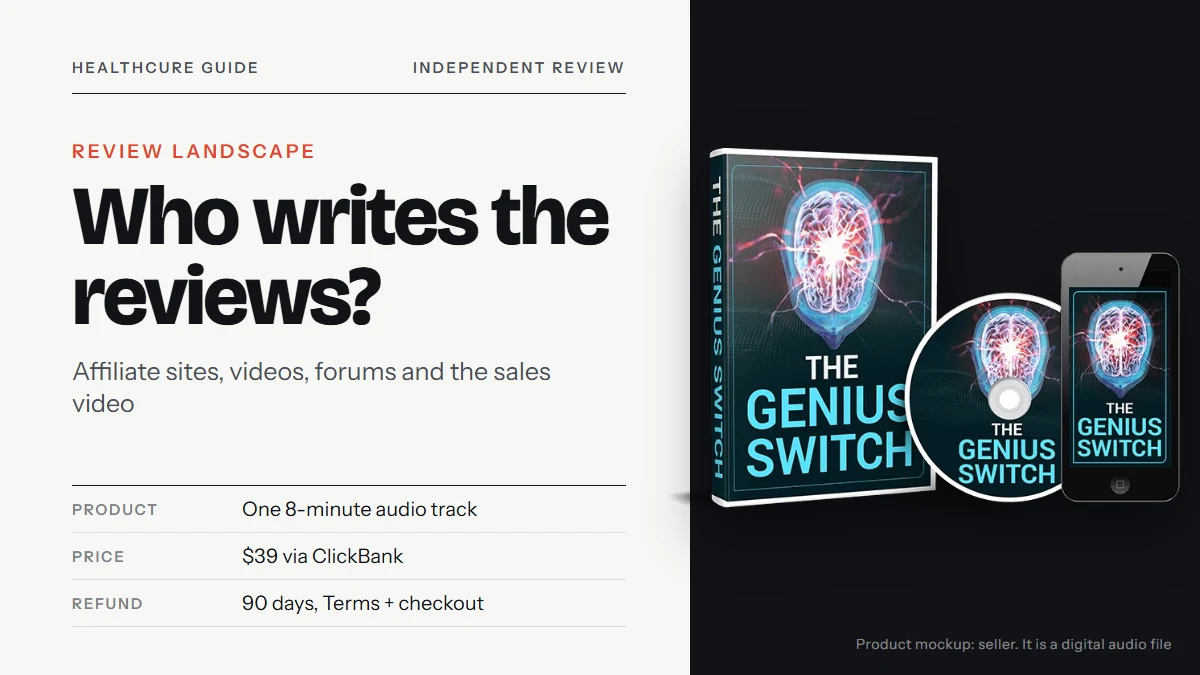
Before you weigh any opinion, it helps to know what is being judged. The thing being judged is a single recording of 8 minutes, described in the marketing as a “targeted auditory sequence” and sold together with four digital extras. It costs $39, the order runs through ClickBank, and nothing is shipped. It is not an app or a game. You play the file in whatever media player you already use.
The pages that discuss it fall into a handful of groups. Each has its own way of earning money and its own blind spots.
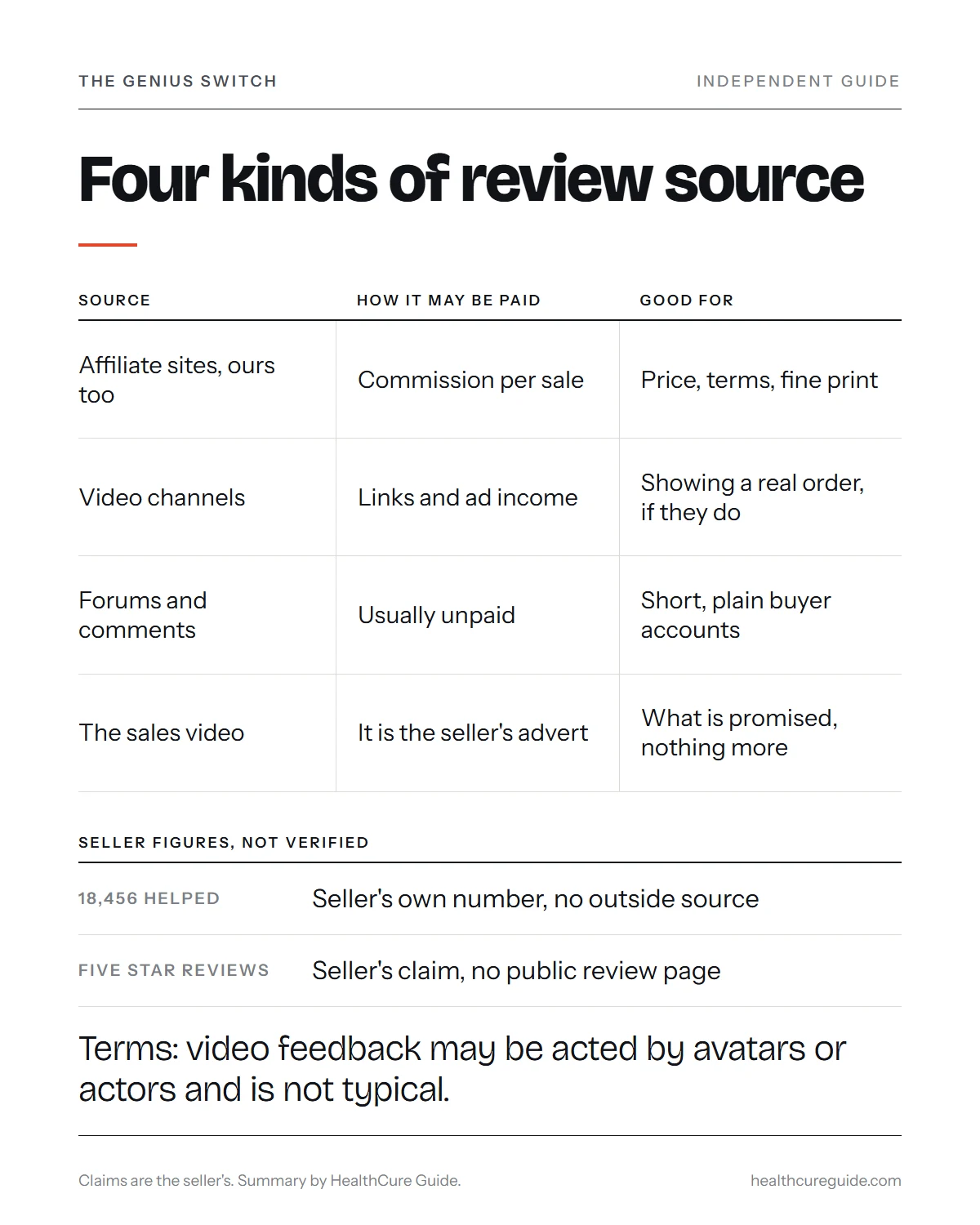
| Source | How the writer may be paid | What it is good for | What it rarely gives you |
|---|---|---|---|
| Affiliate review sites, ours included | A commission when a reader buys through a tracked link | Price, refund terms, fine print | A buyer’s own experience |
| Video channels | Links under the video, plus ad income | Seeing an order or file, if shown | Any record of long-term use |
| Forums and comment threads | Usually unpaid | Short, plain buyer accounts | A way to confirm who wrote them |
| The seller’s sales video | It is the seller’s own advert | What is being promised | Anything independent |
The table explains a pattern you may already have noticed. Pages with the most polish tend to have the strongest reason to sell, and pages with the least reason to sell tend to be short and hard to verify.
Affiliate sites, this one included
ClickBank lets outside publishers promote a product with a tracked link. When a reader clicks that link and orders, the publisher can earn a share of the sale. Our own links work this way: they carry a small tracking code and pass through ClickBank before landing on the seller’s official page.
That arrangement is common across digital products, and it shapes what you read. A site paid per sale benefits when you buy and earns nothing when you decide against it. Some writers handle that pressure well. Others let it decide the verdict.
Where affiliate pages tend to help
Good affiliate pages often do the slow reading that a buyer skips. They compare the sales page with the Terms, spot that the separate refund page on the seller’s site was written for “NeuroActivate” bottles, and point out that the 90 days come from the Terms and the ClickBank checkout. Those are facts a reader can confirm, and they are useful whoever writes them down.
How a commission can tilt the verdict
Watch for these habits, on our pages as much as anyone else’s:
- Every section ends in a button. The page is built to convert, not to inform.
- No real downside. A review that finds nothing wrong with an unverified presenter and acted testimonials has not looked.
- Seller numbers as fact. The “18,456 everyday Americans” figure and the “stacks of five star reviews” line are the seller’s own, with no outside source.
- Borrowed urgency. Repeating that the $39 price is “not guaranteed beyond today” pushes you to skip the checking.
- An “official” label. An independent page calling itself official is borrowing trust it has no right to.
Video channels and short clips
Video opinions feel more personal than text, and that is exactly why they need a careful eye. A clip can be a narrated slideshow of the sales page with a commission link in the description, and nothing on screen tells you whether the creator ever paid.
A video earns more trust when it shows things only a buyer could show: the order email with personal details covered, the four bonus files, the length of the track, a rough count of how many days they listened, and whether they asked for a refund.
Two product facts matter here. First, the presenter in the sales video says the versions floating around YouTube or Spotify differ from the paid recording, so a creator who “plays the track” may be playing something else. Second, under the Terms of Sale the buyer gets a personal-use copy of a copyrighted file. A video that uploads the full paid recording is sharing something the Terms do not allow, which says little for the rest of its advice.
Forums and comment threads
Unpaid posts on forums and in comment sections are often the closest thing to plain buyer feedback. They are usually short, they mention practical points such as a missing email or a slow refund, and they rarely read like copy.
They have weaknesses too. Posts are anonymous, a single thread may hold only a handful of voices, and promotional accounts sometimes drop links into discussions while posing as ordinary buyers. You cannot confirm who wrote any of it.
The way to use them is to look for repeated, checkable details rather than outcomes. If several posts agree that the receipt came from ClickBank, that the charge read CLKBANK*GeniusSwitch and that a refund request worked, that tells you something real about the purchase. A post saying the track changed someone’s luck tells you very little, because nobody, the writer included, can link a life event to a recording.
Why the sales video stories do not count
The sales video is full of customer stories: sudden ideas, faster learning, money, weight loss, easier headaches. It is tempting to treat them as reviews. The seller’s own Terms explain why you should not.
- The marketing may use actors or digital avatars to act out what users said.
- Some of the featured people may have ties to the founders as early backers, friends or relatives, which is a material connection.
- The stories show results the Terms call exceptional, and a typical customer may never see them.
The Terms also carry a section headed “For Entertainment Purposes Only”, in which the seller admits brain entrainment is no exact science and labels its products entertainment. Even inside the video there is a candid moment: after a story about a casino win, the presenter himself concedes that nothing proves the track was the cause.
Then there is the man on camera, a presenter who introduces himself as Dr. Daniel Barone, with a “Top NYC Brain Doctor” headline above him. We could not verify his identity or his role, so his title adds nothing to the case for buying.
For all these reasons, the stories tell you what the seller hopes you will expect. They are advertising, and an honest review should label them that way.
Ten questions to ask of any review
Run any page or video through these questions before you let it shape your decision. A useful review passes most of them. A sales pitch fails most of them.
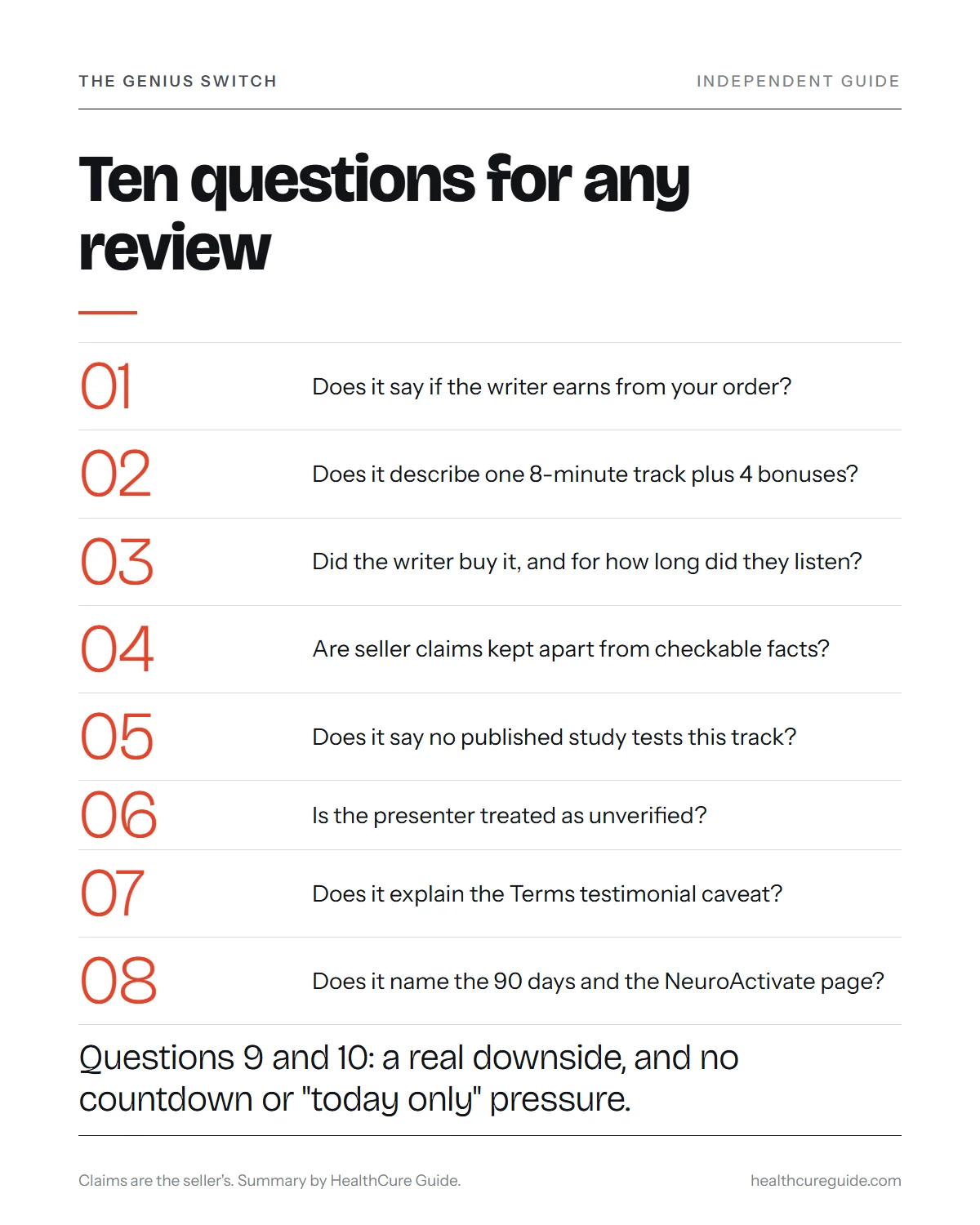
- Does it say clearly whether the writer earns money from your order?
- Does it describe the product correctly as a single 8-minute track with four bonuses?
- Does it say whether the writer bought and listened, and for how long?
- Does it keep the seller’s claims apart from facts anyone can confirm?
- Does it mention that no published study tests this track?
- Does it treat the presenter’s credentials as unverified?
- Does it explain the testimonial caveat in the Terms?
- Does it name the 90-day window and the confusing NeuroActivate refund page?
- Does it list at least one downside that would put some buyers off?
- Does it avoid countdown language and “today only” pressure?
On evidence, a careful review will also note that the seller’s reference list leans on binaural beat research, such as a 2020 study of 40 Hz tones and attention, even though the video insists the method does not involve brain waves at all. Taken together, that body of research is mixed: one analysis pooled a medium effect, another turned up weak brainwave findings, and none of it used this recording.
What the reviews can settle, and what they cannot
Put the better reviews side by side and they tend to agree on the purchase itself, because those facts are written down. The price is $39 on the sales page, though the checkout adds local tax and currency. The order is emailed straight after payment. ClickBank handles the money, and its order line is 1-800-390-6035. The Terms and the checkout both give 90 days for a refund.
What no review can settle is whether the track does what the video promises. There is no study of it, the stories are not typical by the seller’s own account, and one listener’s impression is shaped by expectation, mood and everything else going on that week. A review that claims to know the answer is overreaching.
So the most valuable thing a review can do is help you buy carefully, then leave the judgment to your own use of the track inside the refund window.
If a review persuades you to try it
If you decide to buy, a few habits keep the risk low. Save the receipt email and order number. Download the track and bonuses the day they arrive. Put a reminder in your calendar well before day 90. Product questions go to [email protected], and genuine marketing emails come from GeniusSwitchOfficial.com.
Listening calls for ordinary care. This is our advice for audio of this kind, not the seller’s:
- Keep the headphone volume at a level that never feels loud.
- Skip it while driving or near machinery, because the routine is done with closed eyes.
- Talk to a doctor first if epilepsy, seizures or hearing loss are part of your history.
The track is not a treatment for anything. In the seller’s own disclaimer, the track is “not intended to diagnose, treat, cure, or prevent any disease”, and no review should tell you otherwise. Memory, mood or pain worries belong with a doctor.
Our position on reviews of this product
We are part of the review landscape we have just described, and we earn money the same way many other sites do. The fair thing we can offer is a way to read all of it, ours included, with your eyes open.
Use reviews for the parts that can be checked: what arrives, what it costs, who processes the payment and how the refund works. Set aside the outcome stories, the seller’s figures and the doctor framing, because none of them can be confirmed. If a short daily listening habit appeals to you, the 90-day window lets you form the only opinion that matters, which is your own.
Nothing on this page is medical advice; it is general consumer information.
Related reading
Common questions
Why do so many write-ups about this track point to the same checkout?
ClickBank runs an affiliate program, and a site that sends a buyer to the order page can earn a commission on the sale. We are one of those sites. The link usually ends on the same official checkout, so the destination is rarely the issue. The issue is that the writer has a money reason to sound positive, and a reader should keep that in mind.
Does a paid link make a product write-up dishonest?
Not on its own. A commission is a reason to read carefully, not proof that the verdict is wrong. What counts is whether the writer says plainly that they are paid, keeps the seller's claims apart from checked facts and lists real downsides. A page that does all three can still be useful, even with an order button at the bottom.
Are video opinions of this product more reliable than written ones?
Not by default. A face on camera feels personal, yet the script can still be a reading of the sales page with a link underneath. Check whether the creator shows the order email or the files, says how long they listened, names a downside and discloses any commission. The presenter in the sales video also says uploads of the track on YouTube are not the real product.
How can I tell whether a reviewer actually paid for the track?
Look for details only a buyer would have: a receipt from ClickBank, a card charge that reads CLKBANK*GeniusSwitch, what the four bonuses look like, how the file behaved on their device, and whether they asked for their money back. A writer who only repeats the sales video's stories and numbers has most likely never placed an order.
Why does this page not count the sales video stories as customer opinions?
Because the seller's own Terms describe how that feedback is produced. They allow it to be dramatized with digital avatars or actors, say some featured people may be early supporters, friends or family members of the founders, and call the results exceptional rather than typical. An honest opinion needs an independent author. Those stories belong to the advertising.
Should a write-up that repeats the 18,456 figure be trusted?
Take it as a warning sign. That number, like the line about stacks of five star reviews, comes from the seller and links to no outside source. A careful writer either leaves it out or labels it as unverified. Quoting it as a plain fact suggests the whole page was assembled from the sales material.
Where should I share my own experience if I try The Genius Switch?
Anywhere you like, as long as you keep it plain. Say when you bought it, how many days you listened, what you noticed or did not notice, and whether you kept it or asked ClickBank for a refund. A short, dated account with one honest downside helps the next buyer far more than a polished rave.