What Is FemiCore? A Plain-English Guide to the Capsule
A five-minute answer for anyone who has just come across the name: what the capsule is, what it is meant to do, how you take it and where it is sold.
- Written by
- HealthCure Guide Editorial Team
- Reviewed by
- HealthCure Guide Editorial Team
- Updated
- Reading time
- 5 min read
This guide contains affiliate links. If you buy through them we earn a commission at no extra cost to you. It does not change the verdict. Disclosure.
What is FemiCore, and why does the name keep turning up in searches about bladder leaks? Put simply, it is a daily capsule made for women who deal with urgency, frequent bathroom trips or the occasional leak, and who would rather start with a supplement than a prescription. This page answers the basic questions in order: what it is, what is inside, how you take it, who it is aimed at and how you buy it. It should take about five minutes.
We are an independent review site. Links to the store on this page are affiliate links, so we may earn a commission if you buy. That does not change what we write.
What is FemiCore, in one paragraph
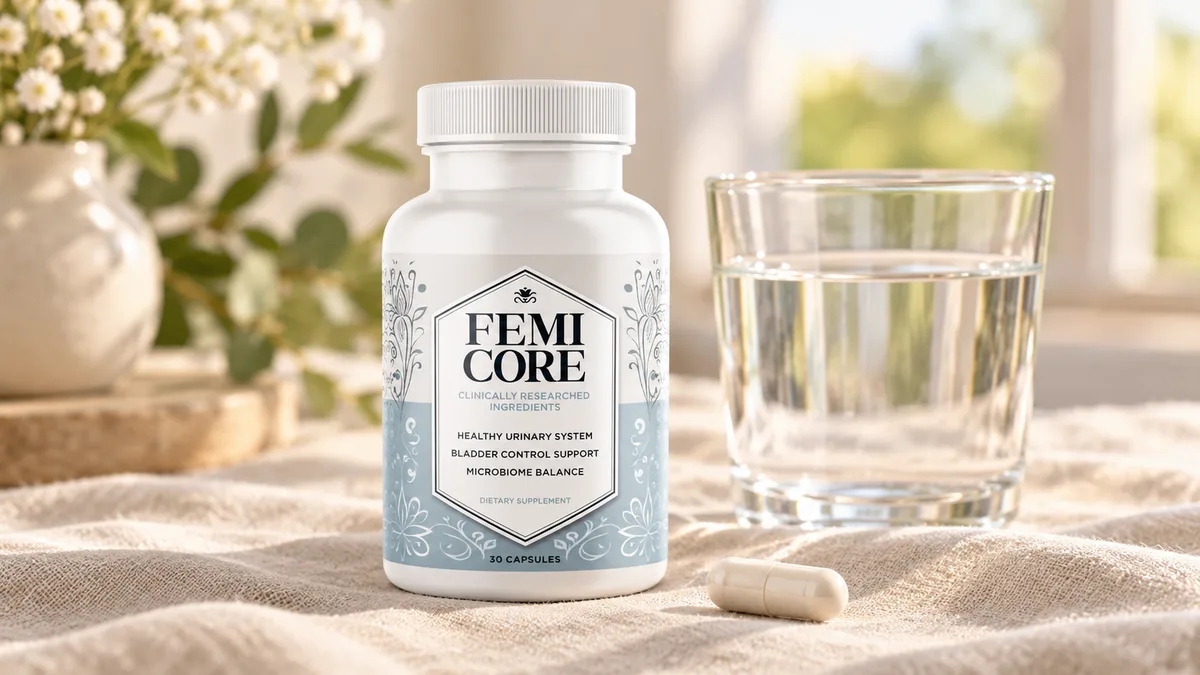
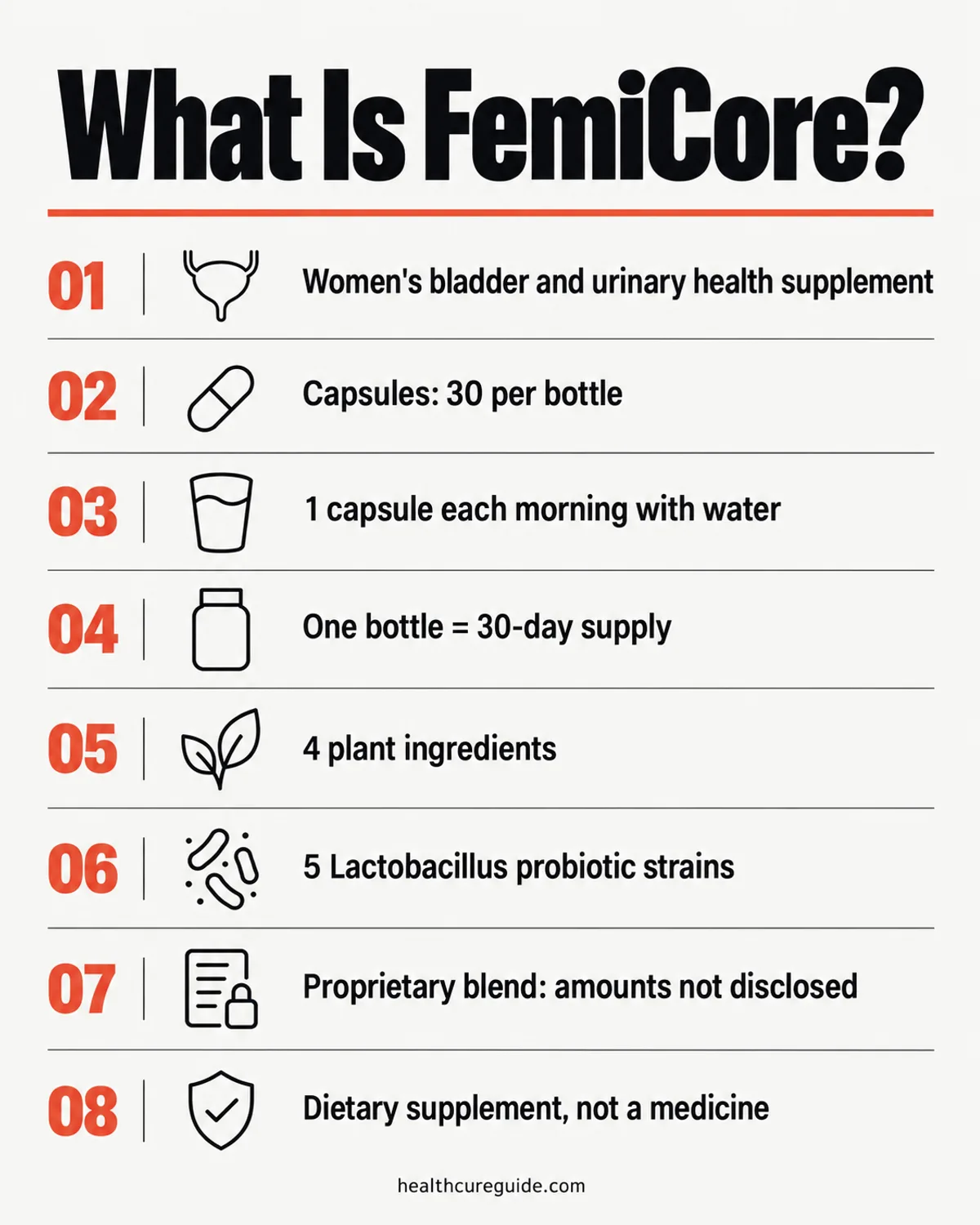
FemiCore is a dietary supplement in capsule form. A bottle contains 30 capsules and the label direction is one capsule each morning with a glass of water, so one bottle lasts 30 days. The manufacturer describes it as a women’s bladder and urinary health formula and says it is manufactured in the USA with imported ingredients, in a GMP-certified, FDA-registered facility, with no stimulants and no GMO ingredients. Those are the manufacturer’s own claims. “FDA-registered” means the factory is on a government register; it is not an approval of the product, and no dietary supplement is FDA-approved.
The idea it is built on
For a long time, urine was assumed to be sterile. In 2012, researchers using DNA sequencing found bacteria in bladder urine from adult women whose standard cultures had come back negative (Wolfe and colleagues, Journal of Clinical Microbiology). A 2014 study then found that women with urgency incontinence tended to have less Lactobacillus in their urinary bacteria than women without it (Pearce and colleagues, mBio).
FemiCore turns that research into a product idea: support the bacterial balance of the urinary tract with probiotics, and add plant ingredients with a history of use for urinary comfort. Whether the capsule changes symptoms for a particular woman is a separate question, and the research on its ingredients only partly answers it.
What is inside the capsule
The label lists nine ingredients in a proprietary blend:
| Group | Ingredients |
|---|---|
| Plant ingredients | Mimosa Pudica, Bearberry (Uva Ursi), Cranberry extract, Granular Berberine |
| Probiotic strains | Lactobacillus crispatus, L. acidophilus, L. plantarum, L. gasseri, L. casei |
“Proprietary blend” means the label names the ingredients but does not give the amount of each one. You know cranberry is in there; you do not know how much. That is the most common criticism of the product, and it matters if you want to compare it with the doses used in studies. Our FemiCore ingredients list goes through all nine and what the research says about each.
Who FemiCore is aimed at
The target customer is an adult woman with mild to moderate bladder symptoms: needing to go suddenly, going often, getting up at night, or leaking a little. The manufacturer frames it as a steady daily habit rather than a fast fix, and advises using it for at least 3 months before deciding.
It is not meant for everyone. Talk to a doctor or pharmacist before starting if any of these apply:
- You are pregnant or breastfeeding.
- You have kidney disease.
- You take medication for diabetes, blood pressure or blood thinning. Berberine can interact with these, and cranberry with warfarin.
- Your symptoms are new, painful or severe, or you have noticed blood in your urine or a fever.
The last point matters most. Those symptoms need a proper assessment, and a supplement should not delay it. Bearberry is also an herb usually advised for short-term use only, which is worth raising with a clinician if you plan to take FemiCore for months. The details are in our guide to FemiCore side effects.
How FemiCore is sold
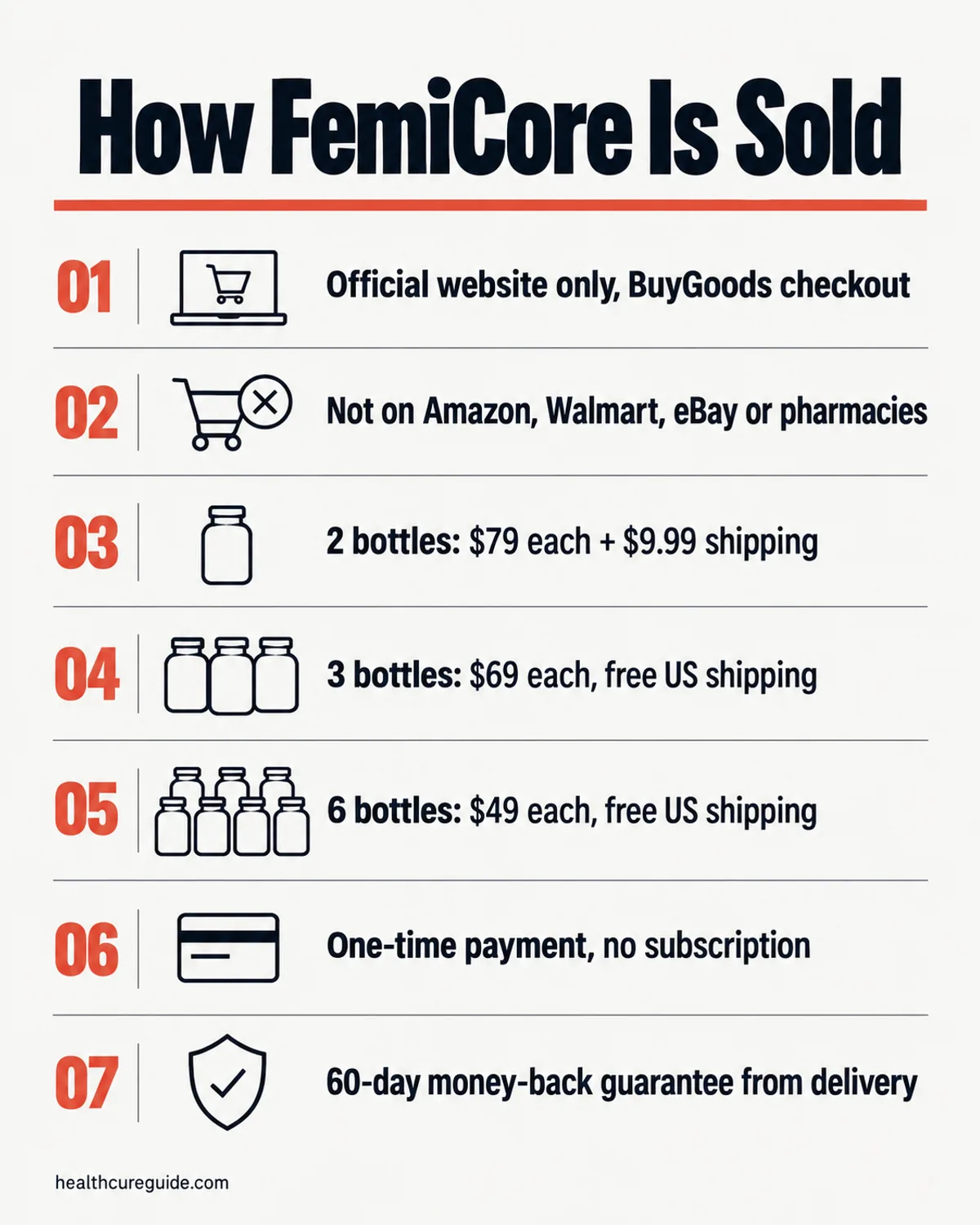
FemiCore is not in shops. You will not find it on Amazon, Walmart, eBay or in pharmacies; it is sold only on its official website, with payment and order support handled by BuyGoods. Orders are one-time payments, not subscriptions.
| Package | Per bottle | Total | US shipping |
|---|---|---|---|
| 2 bottles | $79 | $158 | $9.99 |
| 3 bottles | $69 | $207 | Free |
| 6 bottles | $49 | $294 | Free, plus 3 digital bonus guides |
The site shows a regular price of $179 a bottle, the reference point for the package discounts. Spread across the days of supply, that comes to roughly $2.80 a day on the 2-bottle package (with shipping), $2.30 on the 3-bottle package and about $1.63 on the 6-bottle package.
US orders usually arrive in 5 to 7 business days. Orders to Canada, the UK, Ireland, Australia and New Zealand pay $15.95 for shipping and take 10 to 15 business days.
The guarantee in two lines
Every package carries a 60-day money-back guarantee. You contact support within 60 days of delivery, send back all the bottles, opened or not, with the packing slip, and the purchase price goes back to your original payment method. Return shipping is at your own cost, so keep the box.
What FemiCore is not
A few things are worth clearing up for a first-time reader:
- It is not a drug. As a dietary supplement it was not put through the approval process a prescription medicine goes through.
- It is not proven as a finished product. Some ingredients have human research behind them, such as cranberry for reducing repeat urinary tract infections (Cochrane review, 2023) and L. crispatus given as a vaginal suppository (Stapleton and colleagues, 2011). Neither study tested FemiCore itself.
- It is not quick. A shift in bacterial balance takes weeks, which is why the seller advises using it for at least 3 months before deciding.
- It is not a substitute for a check-up. New urinary symptoms deserve a medical assessment first, and pelvic floor exercises remain a sensible companion to any supplement.
So, is FemiCore worth a closer look?
If you are an adult woman with mild bladder urgency or leaks, no interacting medication and no red-flag symptoms, FemiCore is a reasonable product to read up on. The science it borrows from is real, the guarantee lowers the cost of finding out, and the routine is about as simple as a supplement gets. The undisclosed doses are the drawback to weigh most.
For the full evidence check, the fine print on pricing and our verdict, read our FemiCore reviews guide.
Common questions
What is FemiCore used for?
FemiCore is a dietary supplement designed to support women's bladder and urinary health. It is marketed to adult women with urgency, frequent bathroom trips, night-time waking or occasional leaks. It combines plant ingredients with probiotic strains. It is not a treatment for any disease, and new or painful symptoms should be checked by a doctor first.
Is FemiCore a medicine?
No. FemiCore is sold as a dietary supplement, not a drug. That means it did not go through the clinical approval process used for prescription medicines, and no supplement is FDA-approved. The manufacturer says it is made in a GMP-certified, FDA-registered facility in the USA, but facility registration is a legal listing, not an approval of the product.
How do you take FemiCore?
The label direction is one capsule each morning with water. Each bottle holds 30 capsules, so one bottle is a 30-day supply. The seller advises using it for at least 3 months before deciding, since the formula is built around probiotics, which work gradually rather than overnight.
Does FemiCore contain probiotics?
Yes. Five of its nine ingredients are Lactobacillus probiotic strains: L. crispatus, L. acidophilus, L. plantarum, L. gasseri and L. casei. The other four are plant ingredients: Mimosa Pudica, Bearberry (Uva Ursi), Cranberry extract and Granular Berberine. All nine sit in a proprietary blend, so the amount of each is not disclosed on the label.
How much does FemiCore cost?
On the official website, 2 bottles cost $79 each ($158 plus $9.99 US shipping), 3 bottles cost $69 each ($207 with free US shipping) and 6 bottles cost $49 each ($294 with free US shipping and three digital bonus guides). The site lists a regular price of $179 a bottle. Every package has the same 60-day money-back guarantee.
Where is FemiCore sold?
Only on its official website, with checkout and order support run by BuyGoods. It is not sold on Amazon, Walmart, eBay or in pharmacies. Listings on those platforms are not covered by the 60-day guarantee, and there is no way to check how a probiotic product bought there has been stored.
Can anyone take FemiCore?
Not without checking first in some cases. Speak to a doctor or pharmacist if you are pregnant or breastfeeding, have kidney disease, or take medication for diabetes, blood pressure or blood thinning, including warfarin. Blood in the urine, fever, pain or sudden new symptoms need a medical assessment rather than a supplement.
Sources
- Wolfe AJ et al. Evidence of uncultivated bacteria in the adult female bladder. J Clin Microbiol. 2012.
- Pearce MM et al. The female urinary microbiome: a comparison of women with and without urgency urinary incontinence. mBio. 2014.
- Stapleton AE et al. Randomized, placebo-controlled phase 2 trial of a Lactobacillus crispatus probiotic given intravaginally for prevention of recurrent urinary tract infection. Clin Infect Dis. 2011.
- Williams G et al. Cranberries for preventing urinary tract infections. Cochrane Database Syst Rev. 2023.