The Brain Song Customer Reviews: A Careful Reader's Guide to Opinions
The seller's page quotes no buyers, so any opinion you meet elsewhere needs a careful look. Here is how to weigh it and how to build your own.
- Written by
- HealthCure Guide Editorial Team
- Reviewed by
- HealthCure Guide Editorial Team
- Updated
- Reading time
- 7 min read
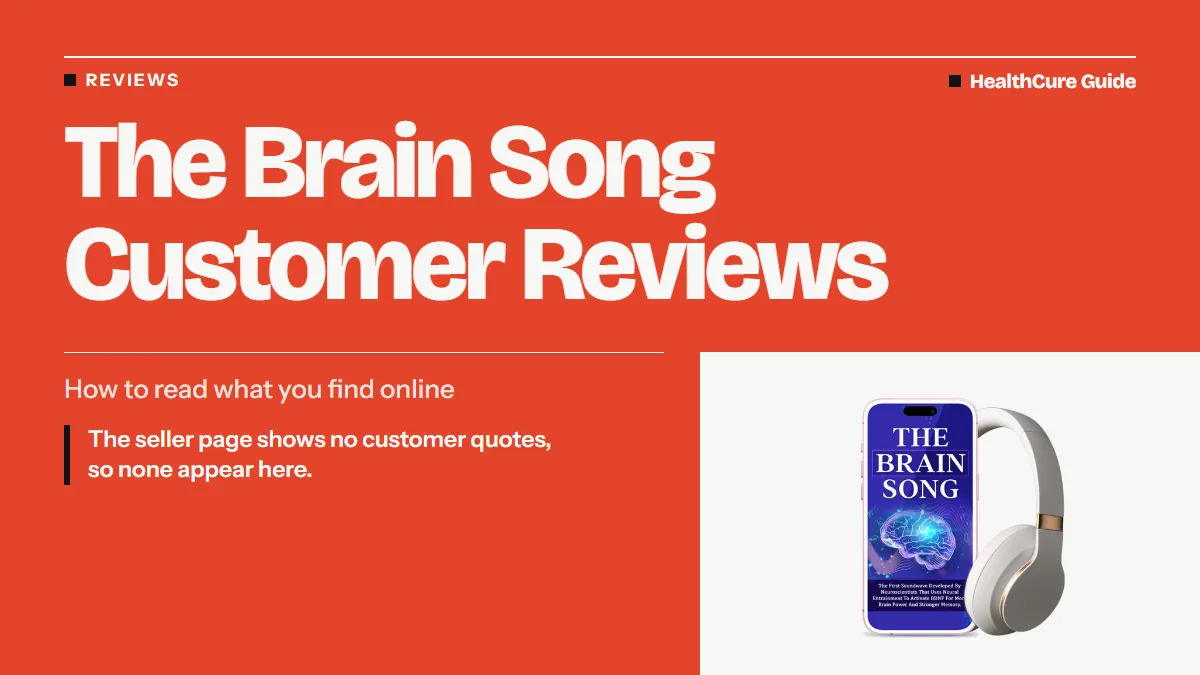
Typing “customer reviews” into a search bar is a sensible habit. Before spending money, most of us want to hear from someone who already tried the thing. With The Brain Song customer reviews, though, the first honest step is to admit what the seller’s page does and does not show.
It does not show any buyer quotes. We will not make some up. What we can do is help you read whatever opinions you meet elsewhere, and describe what a patient first month with the audio could look like.
The Brain Song customer reviews: what the order page shows
The page is brief. It names the product, explains in a few lines what the seller says it does, lists three selling points and states the $39 price with a 90-day guarantee in the footer. It has no star ratings, no quote boxes and no counters of happy buyers beyond a general line about “thousands” using the sound, which is the seller’s own wording.
That is worth saying plainly, because it changes how you should read the rest of the internet. If the seller does not publish testimonials, then any glowing “customer story” you see attached to the product’s name did not come from the order page.
Our own policy is straightforward: we do not quote testimonials we cannot trace, and we do not write fictional ones. Everything we say about the audio comes from the seller’s page and terms.
How to read a review you find online
Reviews are useful when they are specific and honest, and noisy when they are not. Run any opinion through this short filter.
Does it describe a routine? A useful comment says when the person listened, on what device and for how long. A vague burst of enthusiasm tells you almost nothing.
Does it separate fact from feeling? “I liked the sound” and “the audio is twelve minutes long” are different kinds of statement. Trust the reviewer who knows which is which.
Does it promise an outcome? Be cautious with anything that guarantees a specific result. The seller itself speaks in soft terms, such as support for focus, learning and mental wellness, and the terms call the audio entertainment.
Does it repeat itself? Identical sentences on several sites are a sign of copied text.
Does it point you somewhere strange? A review that pushes you to a download link or a different shop is advertising. The genuine order page is the one reached through the seller’s own checkout.
Why experiences will differ
Two people can press play on the same twelve minutes and walk away with different impressions. Headphones, room noise, time of day and expectations all play a role. Add the fact that the seller’s wording is about supporting wellness, not about delivering a set result, and you can see why one buyer’s glowing note is not a forecast for you.
The seller points to general research, such as work on what BDNF is, to explain the idea behind the track. That research is not a test of this audio. So the best “review” of The Brain Song has to be your own, gathered calmly over a stretch of time.
A realistic first month
We cannot promise what you will notice, and we will not invent a timeline of results. What we can describe is how to run a fair test.
Set the scene. Pick one daily slot and one pair of headphones. Keep the volume comfortable. Do not listen while driving or operating machinery.
Begin with notes, not conclusions. Before your first session, write two sentences about how your concentration and mood feel on a typical day. After each listen, add a short line, nothing more than a phrase.
Look for the habit first. In the early stretch, the thing you can measure is consistency: did you actually press play each day? A ritual you keep is the foundation for any benefit the seller describes.
Review the notes yourself. Once you have a few weeks of lines, read them back. Patterns usually show up on paper before they show up in your memory.
Decide before the window closes. Mark the 90-day date in your calendar. If the audio earned its place, keep it. If it did not, ask for your money back.
Our guide on building a daily routine has more ideas for the practical side.
Where genuine answers come from
When a question is about your order, the people who can actually answer it are the seller’s support team and ClickBank. The seller publishes a support address, [email protected], plus a phone number staffed during weekday office hours, while ClickBank looks after order support as the retailer.
For questions about whether the audio suits you, your doctor is the right person if you have a medical condition or use a hearing device. A stranger’s online comment is not.
If you have heard worries and want them addressed head on, our post on common questions and complaints covers the usual ones, and the review sub-page of our hub gives a compact overview.
How the refund fits into a review
Think of the guarantee as the seller’s way of saying: judge it yourself. Ask inside 90 days: send support a message headed “Refund Request” that includes your order number and a line on why, or go through ClickBank instead. Banks differ, so allow five to ten business days for the money to appear.
That process turns the usual worry about reviews on its head. You do not have to decide whether strangers are trustworthy, because you are protected while you listen. For the full steps, see our walk-through of the refund policy.
A word on reviews that sound too perfect
Some praise reads like an advertisement, and it usually is one. If a page tells you that The Brain Song will sharpen your mind, remove stress or change your life, notice that the seller never makes promises that large. Its own language stays careful, talking about support for focus, learning and general wellness of mind. When a third party sounds more certain than the seller, the third party is guessing.
The opposite also holds. A harsh review that blames the audio for an unrelated problem is just as unreliable. The safest stance is middle ground: curiosity, a fair test and a refund option if it does not click.
Our view
With no testimonials to lean on, the offer still earns 9.0/10 from us as an editorial score. It is clear, modestly priced at $39 and wrapped in a refund promise that matches how little the page tells you about other people’s experiences. Read opinions with a calm filter, then run your own month, and keep the product hub handy for the details.
Good to know:
- You receive the audio digitally, with nothing shipped.
- According to the seller’s terms, this is entertainment, and every listener’s experience is their own.
- Check with a doctor first if a health condition or hearing device applies to you.
Common questions
Does the order page show customer testimonials?
No. The page is short and quotes no buyers, so we do not quote or invent any either.
Where can I find opinions from real buyers?
Look for discussions where people describe their routine in detail, and remember that each one is a single person's experience. The seller's support team can also answer order questions.
How do I spot an unreliable review?
Be careful with praise that names no detail, with identical wording across several sites and with any review that promises a specific result.
How long should I listen before judging?
Long enough to build a habit. The refund window runs 90 days from purchase, which leaves plenty of time for a fair opinion.
Can a refund help if my own review is negative?
Yes. If the track does not suit you, ask for your $39 back within 90 days, using the seller's support email or ClickBank order support.
Will my experience match someone else's?
Probably not exactly. Sound, room, timing and expectations vary, and the seller's terms file the audio under entertainment, so each listener's story is their own.