What Is Genius Switch and What Does It Do? The Genius Switch, Day 1 to 90
Forget the theory for a moment. This guide follows the product the way a buyer meets it: the checkout, the email, the first listen, the weeks of routine and the refund deadline, with the seller's claimed effects set beside what you can actually check.
- Written by
- HealthCure Guide Editorial Team
- Reviewed by
- HealthCure Guide Editorial Team
- Updated
- Reading time
- 9 min read
This guide contains affiliate links. If you buy through them we earn a commission at no extra cost to you. It does not change the verdict. Disclosure.
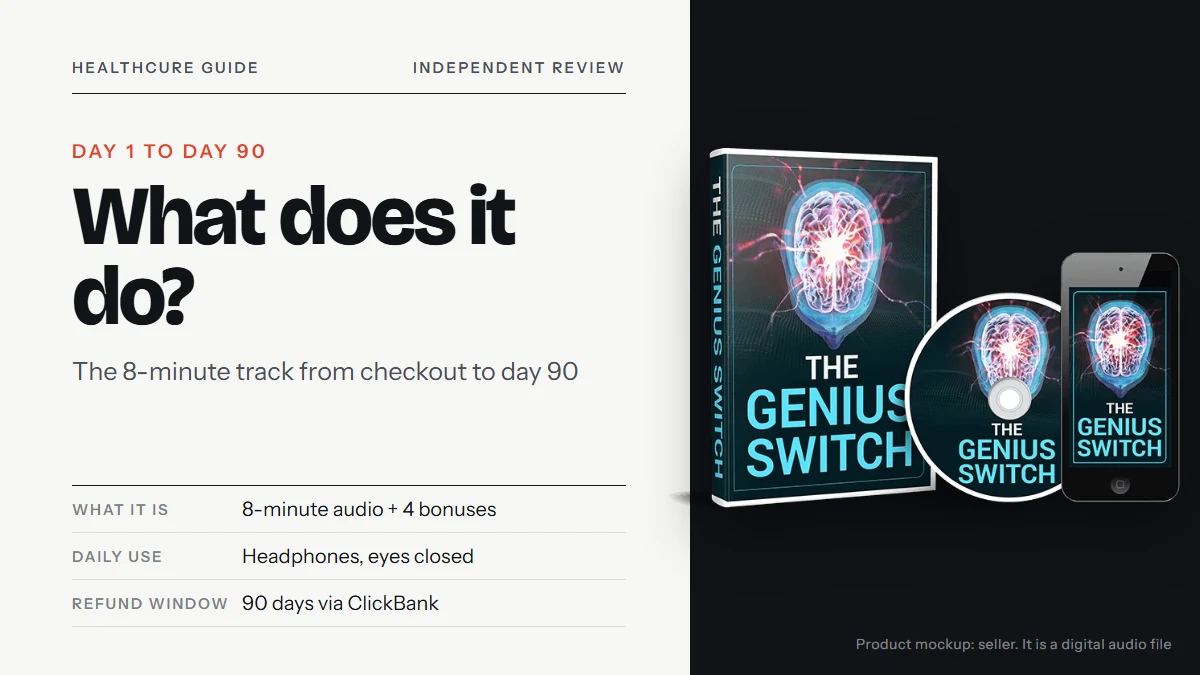
What is Genius Switch and what does it do once it is actually on your phone? Most explanations stop at the sales pitch. This one follows The Genius Switch through time, from the moment you reach the checkout to the day the refund window closes, and at each stage separates what really happens from what the seller says should happen.
A word about us: we write HealthCure Guide on our own account, we do not sell this product, and an order through our links may pay us a commission. Nobody on our team has bought or played the track. The timeline below draws on four seller documents (the sales page, the video, the Terms and the ClickBank order form), and anything only the seller says is labeled as its claim.
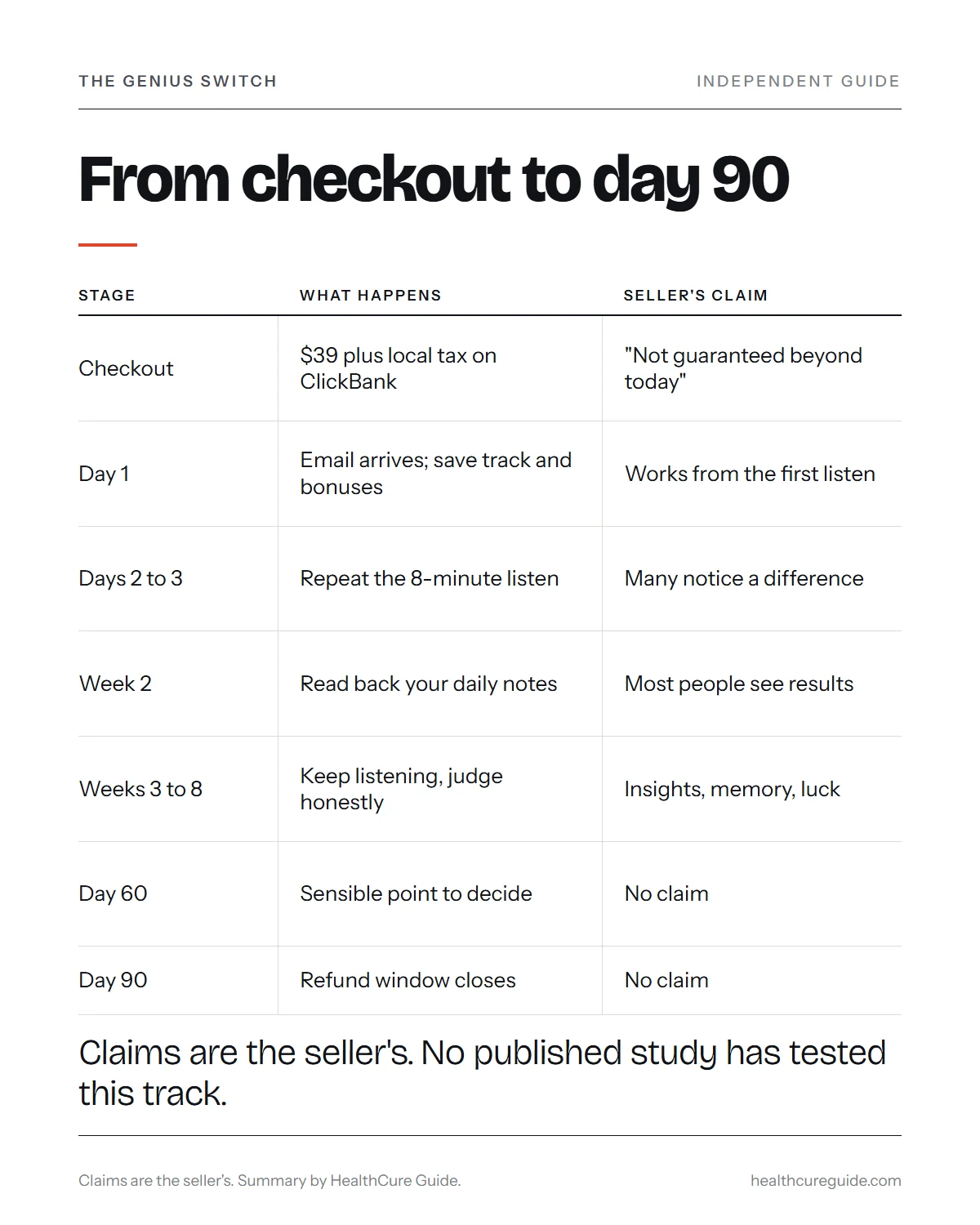
What is Genius Switch and what does it do, stage by stage
The product itself never changes: one recording the seller calls a “targeted auditory sequence”, plus four extras. What changes over 90 days is what you do with it and what the seller says you should be noticing.
| Stage | What actually happens | What the seller claims for this stage |
|---|---|---|
| Checkout | You pay $39 plus any local tax on ClickBank | Price is “not guaranteed beyond today” |
| Day 1 | Email arrives; you save the track and bonuses | It works from the very first listen |
| Days 2 to 3 | You repeat the 8-minute listen | Many buyers notice a difference |
| Week 2 | The routine becomes a habit, or does not | Most people see results |
| Weeks 3 to 8 | You keep listening and judge honestly | Insights, memory, luck and more |
| Around day 60 | Sensible point to decide | No claim |
| Day 90 | The refund window closes | No claim |
The left column is the part anyone can confirm. The right column is the sales story, quoted or summarized from the video, and it has no study behind it.
Before day 1: placing the order
The order starts on the seller’s sales page, geniusswitchoriginal.com, and the payment runs on a ClickBank checkout. Above the $39 offer, the page strikes through three larger figures ($200, $100 and $49), and the video adds a deadline. Those higher numbers are reference prices chosen by the seller, and the deadline is a sales device, so there is no need to rush this step.
Three things are worth doing at checkout:
- Read the total, not the headline. Your country’s currency and any sales tax are applied at the payment step, so the charge can differ from $39.
- Note the descriptor. The charge will show on your statement as CLKBANK*GeniusSwitch, which helps you spot it later.
- Skim the Terms. They describe the order as $39 for a copyrighted file licensed for your personal use, and they contain the 90-day refund rule that actually applies.
One page to ignore: the stand-alone refund page reads like a leftover template for a bottled product called “NeuroActivate”. It sets a 60-day limit, wants unopened bottles back and gives an Ohio return address. It does not fit a download. Rely on the Terms and the ClickBank checkout instead.
Day 1: the email, the file and the first listen
There is nothing to ship, so day 1 begins in your inbox. ClickBank lists the item as a digital product with access as soon as your card clears, and in the video the seller says the order goes out by email at once. Product questions go to [email protected], and later marketing messages come from GeniusSwitchOfficial.com.
Your first jobs are practical:
- Save the recording to your phone or computer, as the seller tells you to.
- Save the four bonuses too. The seller lists a guided visualization (its creator is billed as top-rated on the Calm app), a shopping guide about foods it connects with brain fog, a century-old book about attracting wealth, and a five-habit infographic to print.
- Keep the receipt email in a folder of its own, because it holds your order number.
Then comes the listen itself. Headphones on, eyes closed, 8 minutes. There is no app to open and no account to sign into. Any media player will do, and a saved copy plays without a signal.
What does it do on that first day? The seller says it starts working straight away. What can be said with confidence is smaller: you will have sat quietly for 8 minutes with sound in your ears. Some people find that restful in itself, and that is worth knowing so you do not mistake an ordinary quiet break for something more.
Days 2 to 14: settling into the routine
The second week is where the seller’s timing claims arrive. According to the video, many customers feel a difference within two or three days, and most see results within a couple of weeks. No data comes with those statements.
The routine itself stays the same each day. The video says skipping the odd day is “okay”, and it sets no best time and no fixed course length. That makes the habit easy to start, but it also means you need your own structure if you want to judge it fairly.
A simple way to use these two weeks:
- Pick one or two narrow things to rate. For example, how settled you feel after the session, or how focused your first work hour is, on a 1 to 10 scale.
- Rate them at the same time each day. A note on your phone is enough.
- Change nothing else on purpose. New sleep, coffee or exercise habits would blur the picture.
- Read back at day 14. If the seller’s two-week claim were true for you, your notes should show it.
If you notice a calmer mood after listening, that is a fair personal result. It is not, by itself, evidence of “whole brain activation”, the seller’s term for syncing the two halves of the brain.
Weeks 3 to 12: keeping it up and watching the calendar
From week three onward the product does not change, but your decision gets closer. The seller’s larger promises belong to this period: eureka moments, quicker learning, stronger memory, lucky breaks, promotions, money and better relationships, along with stories about weight loss, quitting smoking, headaches, joint pain and children’s grades.
Keep two dates in mind:
| Date | Why it matters |
|---|---|
| Around day 42 | Six weeks of daily use is a generous test by the seller’s own timeline |
| Around day 60 | A sensible point to decide, leaving a margin for any delay |
| Day 90 | Last day of the 90-day refund period |
If you decide it is not for you, phone ClickBank (1-800-390-6035) and quote your order number, which is printed on the receipt email. The written policies set a time limit, not a test of results, so a simple request before day 90 is what they describe.
If you decide to keep it, nothing else happens on day 90. You keep the file, licensed for your own use, and carry on listening for as long as you like.
Claimed effects against what you can check
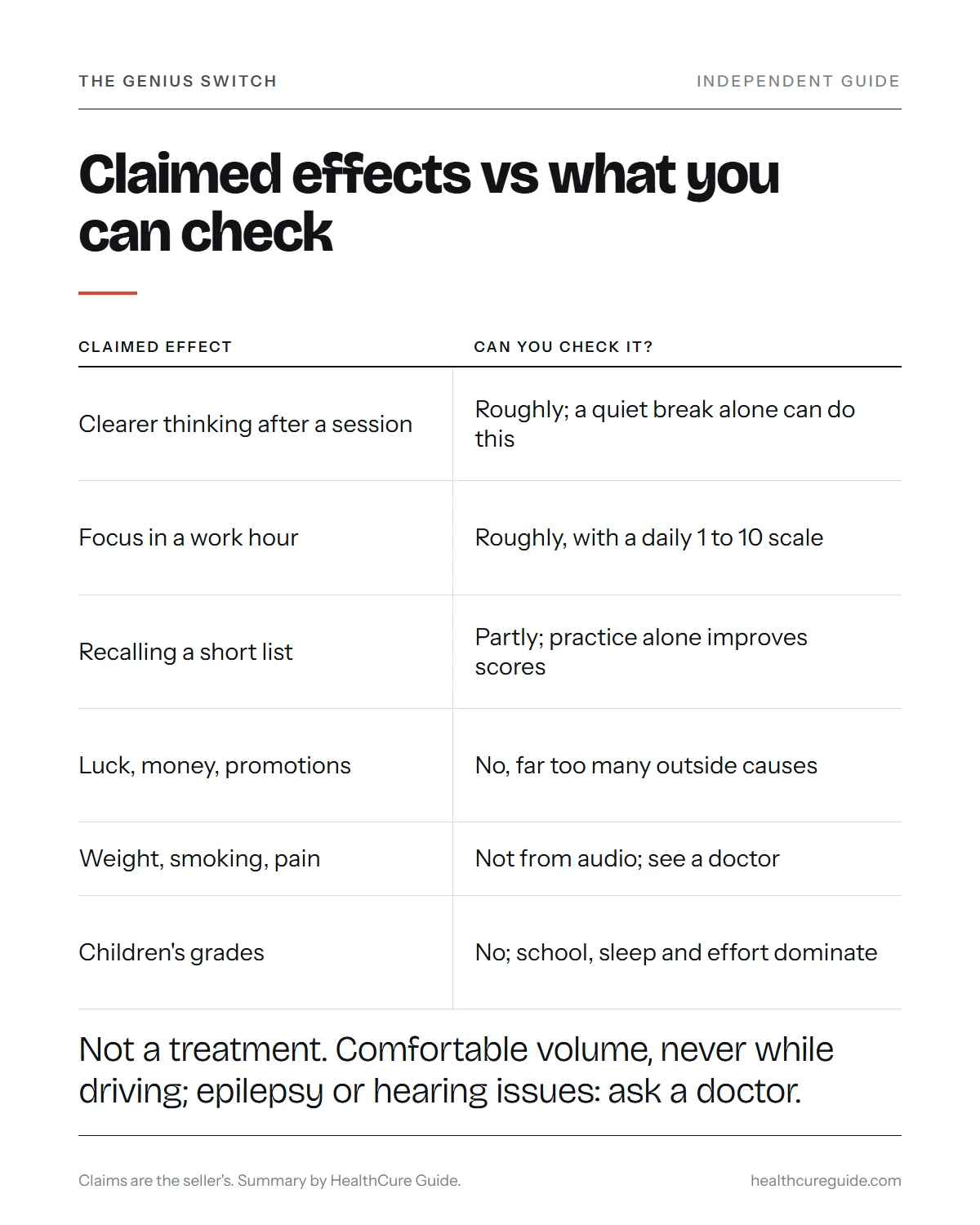
The seller’s list of outcomes is long, and they are not all equal. Some can be noted by a listener in a rough way. Others cannot be linked to a recording by anyone.
| Claimed effect | Can you check it yourself? | Why |
|---|---|---|
| Clearer thinking after a session | Roughly, with daily notes | But a quiet break alone can do this |
| Focus during a work hour | Roughly, with a simple scale | Sleep and stress affect it too |
| Remembering a short list | Partly, with a repeat test | Practice alone improves scores |
| Eureka moments | Hardly | Too occasional to count |
| Luck, money, promotions | No | Far too many outside causes |
| Weight, smoking, pain | Not from audio | These need proper care and a doctor |
| Children’s grades | No | School, sleep and effort dominate |
On the research side, the sales page cites work on 40 Hz binaural beats and on gamma stimulation, including a 2020 attention study by Ross and Lopez. Results in that area are mixed, with a medium effect in one 2019 meta-analysis and mostly negative entrainment findings in a 2023 review, and none of them used this track. The video adds a twist by saying its method has no link to brain waves, which sits oddly beside a reference list built on a brain wave technique.
The seller even supplies one fair caution of its own. After telling a story about a casino win, the presenter admits that nothing proves the track was responsible. The same caution fits every life-event story in the video.
What it does not do
Some things the product simply does not do, whatever the video suggests:
- It does not treat anything. In the seller’s own disclaimer it is “not intended to diagnose, treat, cure, or prevent any disease”.
- It does not come as an app. There is no app, game or software, only an audio file and four digital extras.
- It does not come with proof. No published study has tested the recording.
- It does not promise outcomes in its own Terms. They include a section titled “For Entertainment Purposes Only” and say brain entrainment is not to be treated as an exact science.
- It does not come with checkable testimonials. The Terms allow the customer stories to be performed by actors or avatars and describe them as exceptional rather than typical.
- It does not arrive with a verified expert. We could not confirm the identity or role of the man fronting the sales footage, a presenter who introduces himself as Dr. Daniel Barone; its headline bills him as a top NYC brain doctor.
The video also says the paid track is not sold on Amazon, YouTube or Spotify, so a recording found there is not what this timeline describes.
Using it safely along the way
Ninety days of daily listening is a lot of time with headphones on. Our own advice, which applies to any audio routine of this sort:
- Set a volume that stays comfortable for the full 8 minutes.
- Never play it while driving or using machinery, since the routine has you close your eyes.
- If epilepsy, seizures or hearing difficulties are part of your history, speak with a doctor before the first session.
- Keep any treatment you already have. A recording is no substitute for care.
The short answer
So, what does the product do? In practice it gives you an 8-minute recording and four digital extras by email, and asks you to listen once a day. Over 90 days that adds up to roughly twelve hours of quiet listening, a habit some people may enjoy for its own sake.
What it is said to do is a separate matter. Sharper thinking, luck, money and healing are the seller’s claims. No study backs them, and the seller’s Terms quietly file the whole product under entertainment. The fair way to find out is a careful personal trial, decided by around day 60, with the refund window as your safety net.
This page offers general information only and is not medical advice.
Related reading
Common questions
What happens in the first hour after paying for The Genius Switch?
The checkout describes it as a digital product with immediate access once the payment is approved, and the video says the order is emailed straight away. In practice you should find a receipt and a delivery message in your inbox, save the audio file and the bonuses to your device, and file the receipt where you can find it later.
Is anything supposed to change on the very first listen?
The seller says so: the video claims the track starts working the first time you play it. Nothing has measured that. After one session you are most likely to notice that you sat still with your eyes closed for 8 minutes, which some people find calming. Treat any bigger change on day one as something to watch, not as proof.
What does the seller say a listener should notice by the end of week two?
The video says many customers notice a difference within the first two or three days and that most see results within a couple of weeks. Those are the seller's timing claims, with no data behind them. They are useful mainly as a yardstick: if two weeks of daily listening bring nothing you can describe, the seller's own schedule has not been met.
Which of the claimed effects can a buyer check personally?
Only the narrow ones. How calm you feel after a session, how focused a work hour seems or how well you recall a short list can be noted on a simple daily scale. Luck, promotions, money, weight, smoking, pain and children's grades depend on far too many other things to link to a recording.
What happens at day 90 if no refund has been requested?
The refund window in the Terms and on the ClickBank checkout runs 90 days from purchase. After that the stated policies no longer promise your money back, and you simply keep the file for personal use. If you are unsure about the track, decide well before then, ideally around day 60.
Does the track need an internet connection to play each day?
Not once it is saved. The seller tells buyers to put the track on a phone or computer, and a saved audio file plays in an ordinary media player without a signal. Keep a backup copy as well, so a lost phone does not also mean a lost recording during your refund window.
Is there anything the daily routine should never replace?
Medical care of any kind. The site says the product is not intended to diagnose, treat, cure, or prevent any disease, and its Terms call it entertainment. Keep taking any treatment you have, and take memory, attention, mood, pain or sleep problems to a doctor instead of hoping an audio track will sort them out.