The Genius Song · Benefits
The Genius Song Benefits: Seller Claims vs the Research
The sales video promises sharper thinking, luck, money, better relationships and even weight loss. Here each promise sits beside what can be checked, and the answer is mostly: very little.
- $39 one-time price
- 90-day refund
- Cognitive Support
At a glance
- Refund window
- 90 days
- from purchase
- Price
- $39
- one-time digital purchase
- Written by
- HealthCure Guide Editorial Team
- Published
- Reading time
- 6 min read
HealthCure Guide is an independent review site, not the seller. Order links on this page are affiliate links: if you buy through them we may earn a commission at no extra cost to you. It does not change our verdict. Disclosure.
The promises, sorted by area
The sales video for The Genius Song runs for 39 minutes and covers a wide spread of outcomes. We grouped them so each can be weighed on its own.
| Area | What the video claims | What can be checked |
|---|---|---|
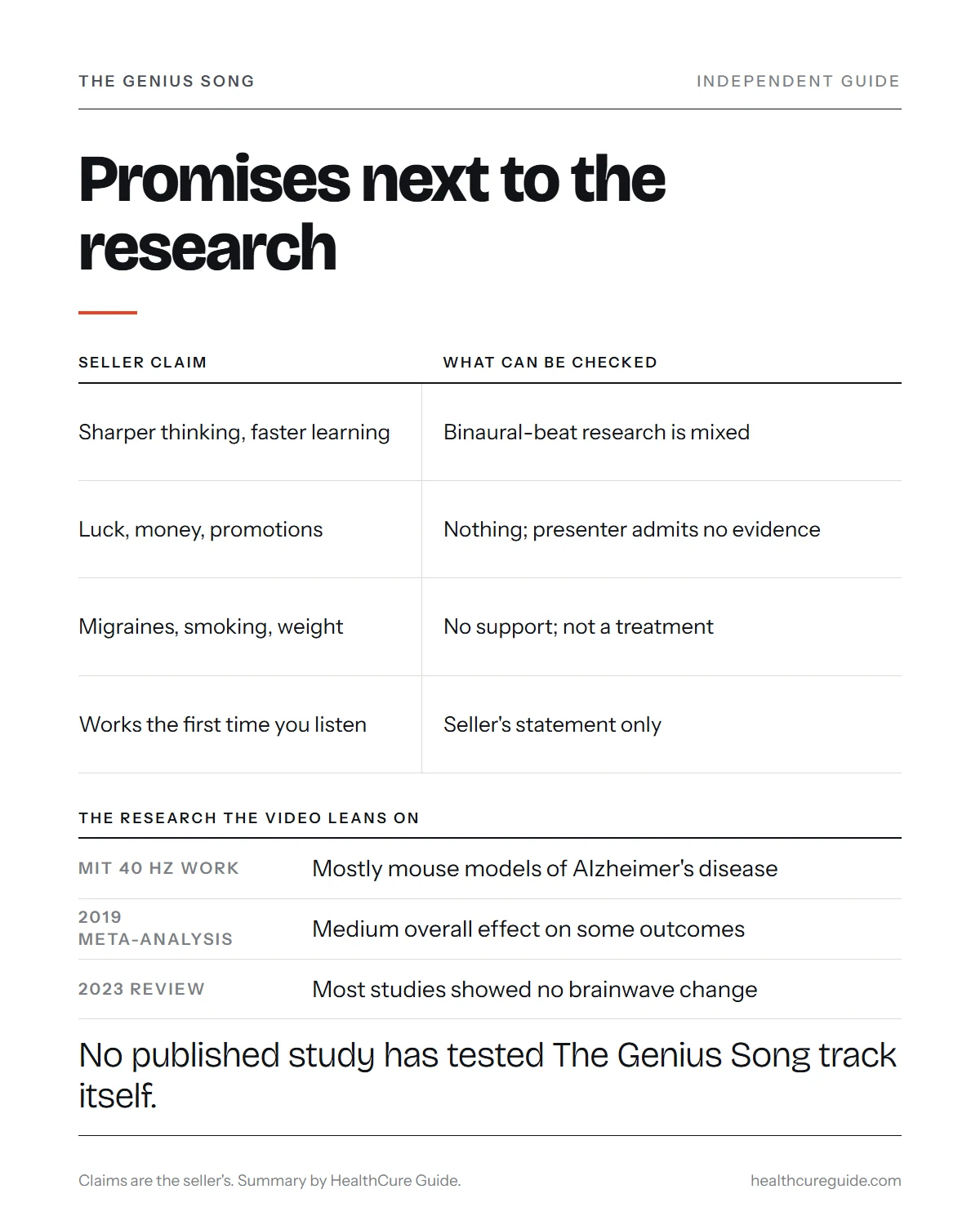
| Thinking | Eureka moments, problems solved “with little to no effort”, faster learning, better memory | No study of the track. Binaural-beat research on attention and memory is mixed and never used this track. |
| Luck and money | Synchronicities, “abundance”, promotions, a signing bonus, a casino win | Nothing. The presenter himself says there is no evidence the track caused the casino win. |
| Family and relationships | Better relationships, an engagement, a child’s grades going from C to A, easier bedtimes | Anecdotes only, told in a video whose Terms say parts of the marketing were dramatized. |
| Health | Migraines gone, quitting smoking, joint pain, a 16-pound weight loss | No support. The site says the product is not meant to treat any disease. |
| Timing | Works “the very first time”, a difference in two to three days, results in a couple of weeks | The seller’s statements, with nothing to measure them against. |
The pattern matters more than any single row. The claims that sound the most impressive are the ones with the least behind them.
What gamma research actually covers
Start with what is true. The brain does produce fast electrical rhythms in the gamma band, somewhere between about 30 and 100 cycles per second, and scientists study them in connection with how we pay attention and lay down memories. The trouble starts when the video turns a research topic into a personal promise.
| The video’s version | The research it most likely points to | What that research is about |
|---|---|---|
| MIT found lucky, wealthy, successful people share one brain wave | 40 Hz light and sound work from an MIT lab | Alzheimer’s disease, studied chiefly in mice, plus a few small first trials in people |
| The video’s story about a monk’s gamma waves | Lutz and colleagues, 2004, PNAS (University of Wisconsin) | Long-term meditators recorded with high-amplitude gamma activity |
| Nearly all young children scoring at “creative genius” level | George Land’s creativity test, popularised in the book Breakpoint and Beyond (1992) | A creativity test, not a brain-wave study; we found no peer-reviewed NASA paper with these figures |
| A sound wave can switch gamma back on | Auditory entrainment and binaural-beat studies | The picture is mixed. A 2019 meta-analysis in Psychological Research pooled studies and reported a medium overall effect on some cognitive, anxiety and pain outcomes. A 2023 systematic review of brainwave entrainment by binaural beats found more studies against the brainwave change than for it (8 of 14 contradicted it, 5 supported it) |
None of these studies used The Genius Song. The video also mentions Princeton, Columbia University, a Berlin research centre, Edison and billionaires who rise at 4 AM; we could not verify those statements, and the text page tells parts of the same story with NASA and Japanese colleagues in place of Princeton and Berlin. For a fuller look at the science, see our article on gamma waves and The Genius Song.
Where the pitch contradicts itself
A trick that takes seven seconds, or seven minutes
The opening minutes pitch a “seven second” trick, later renamed a morning ritual. What is actually for sale lasts 7 minutes, and no separate seven-second step is ever demonstrated. A buyer who expects something instant will be disappointed by the seller’s own product description.
Gamma in the video, theta in the references
The video is built around gamma. The sales page’s 14 references, by contrast, lean on theta and general entrainment studies plus creativity articles from sites like Inc.com and Medium and a TED talk, and the list is identical to the one on the page for The Genius Wave, the seller’s 12-minute theta audio. The browser title of the /video/ page even reads “The Gamma Song”.
Science in one line, entertainment in the next
The Terms state that claims about brainwave entrainment, focus and mental energy are “substantiated by established scientific research”. A few lines away, that same document warns that brain entrainment “is not an exact science” and labels the products entertainment. Both cannot guide your expectations at once, and only the second is consistent with the evidence.
The source of the claims
The man making these promises is presented as Dr. Robert Lake, a name the site’s own disclaimer calls a pen name. His NASA and clinic background therefore adds no weight to the claims above.
Why the stories in the video prove little
Most of the benefits above reach the viewer as stories: colleagues, customers and family members of customers whose lives changed after listening. The seller’s Terms describe how those stories were made. Names were changed, pen names are used, parts of the marketing were dramatized, and some feedback may be performed by actors or digital avatars. Some people featured may know the founders, some were paid, and the outcomes on screen are called exceptional, not what a typical buyer should expect.
The headcount is shaky too. The video and the body of the text page speak of 18,366 people helped, whereas the headline of that same page says 19,389. Neither figure has been verified, and they do not agree. A story can be true and still tell you nothing about what a track will do for the next listener.
What the track cannot do
| It cannot | What to do instead |
|---|---|
| Treat migraines, joint pain, smoking or weight | See a doctor; these have proven treatments |
| Fix attention or memory problems | Ask a doctor, especially if the change is new or getting worse |
| Raise a child’s grades on its own | Talk to the school and, if needed, the child’s doctor |
| Bring luck, money or a promotion | Nothing in the research connects a sound to income |
| Replace sleep, exercise or medication | Keep those in place; at most, this is an add-on |
A fair way to judge it yourself
If you buy it, the 90-day refund gives you room to test it honestly:
- Note the purchase date and set a reminder for about day 75.
- Before the first listen, pick one thing you can observe, such as how settled you feel in the evening, and write a line about it each day for a week.
- Listen as the seller describes, about 7 minutes a day with headphones, at a comfortable volume and never while driving.
- Keep the same notes for two more weeks, the “couple weeks” the video itself mentions.
- Compare the weeks. If nothing changed that a quiet seven-minute break would not explain, ask ClickBank for the refund before day 90.
Small changes in mood or calm are possible from any short rest with headphones on. They would not show that gamma waves were “activated”.
Related pages
- The review page gives our editorial verdict on the whole purchase.
- The safety page covers listening cautions and the seller’s Terms.
- The price page shows the cost per listen and the refund dates.
- The Genius Song buyer guide has the full picture, and the cognitive support category lists related guides.
The Genius Song Official Pricing
As listed on the official order page. A one-time digital purchase delivered by email, with nothing shipped. The crossed-out price is the seller's own reference figure, and checkout may show your local currency plus tax.
The Genius Song audio track
Seller's reference price $200
$39
one-time price, per purchase
Seller lists a $161 saving
- Short daily audio track (seller says about 7 minutes)
- Digital delivery after checkout
- Bonuses listed on the sales page
- 90-day money-back guarantee
Affiliate links. We may earn a commission at no extra cost to you.
Common questions
Why does the Genius Song reference list cite theta studies for a gamma product?
We can only describe it, not explain it. The video is about gamma, but the 14 references on the sales page mostly concern theta and general entrainment, plus creativity articles, and the same list appears on the page for The Genius Wave, the seller's 12-minute theta audio. None of the references tests The Genius Song.
Is the MIT 40 Hz research about The Genius Song track?
No. Researchers at MIT have studied 40 Hz light and sound stimulation, mainly in mouse models of Alzheimer's disease with small early human trials. That work is about brain disease, not intelligence, luck or income, and it did not involve this track. The video borrows the institution's name for a much bigger claim.
How quickly does the seller say Genius Song results appear?
The video gives three timelines: it "starts working the very first time you listen", many customers notice a difference in two to three days, and most daily listeners see results within a couple of weeks. None of these is backed by a study, and the Terms describe the product as entertainment.
What does the presenter concede about the casino story in the video?
After describing a win at a casino, the presenter says there is "of course, no evidence to support that the genius song caused that". It is one of the few plain statements in the video, and it applies just as well to the money, luck and career stories told elsewhere in it.
Other products in Cognitive Support
-
 The Genius Switch
An 8-minute downloadable audio track with four digital bonuses, sold for $39 through ClickBank with claims about focus, memory and luck. It is not an app or a game, and the track itself has never been tested in a study.