FemiCore Ingredients: A Quick Buyer's Checklist
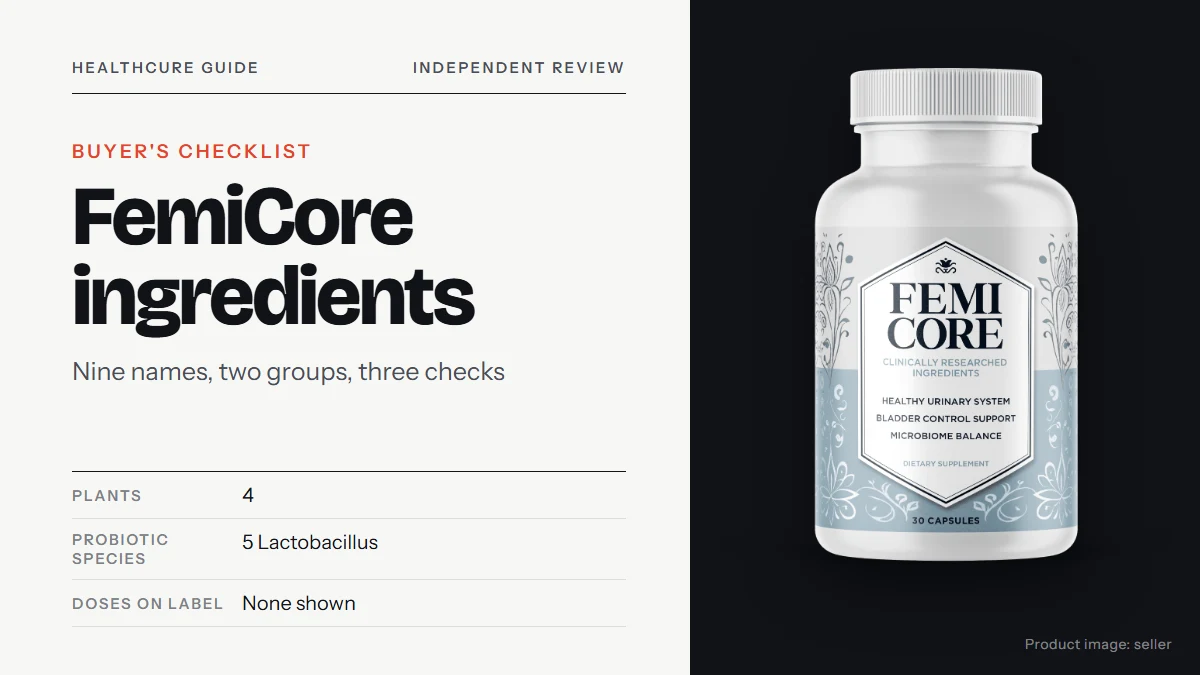
Nine names, two groups, one capsule. This is the scannable version: a short card for each ingredient with its job, how much research backs it and the one caution to remember, followed by the three personal checks to run before you order.
- Written by
- HealthCure Guide Editorial Team
- Reviewed by
- HealthCure Guide Editorial Team
- Updated
- Reading time
- 8 min read
This guide contains affiliate links. If you buy through them we earn a commission at no extra cost to you. It does not change the verdict. Disclosure.
This is a checklist for reading the FemiCore ingredients before you spend money. It is built to be scanned: one short card per ingredient, a single evidence table, then three checks that depend on you rather than on the product.
If you want the long version, with the history and research behind each of the nine, read our FemiCore ingredients guide. If your interest is in how the blend was put together and what the label withholds, that critique is in our formula review.
We are independent of the seller. The order buttons below are affiliate links: when a reader buys through one, we may receive a commission, and the price stays the same.
The FemiCore ingredients in two groups
Every capsule holds the same mix. Directions call for a single capsule each day, taken in the morning with a large glass of water, so a 30-capsule bottle covers a month.
| Group | Ingredient | Short job description (our reading) |
|---|---|---|
| Plant | Cranberry extract | Urinary tract support, the best-studied piece |
| Plant | Bearberry (uva ursi) | Traditional urinary herb, source of arbutin |
| Plant | Mimosa pudica | Proposed calming effect on the bladder |
| Plant | Granular berberine | Unclear for the bladder; metabolic research |
| Probiotic | Lactobacillus crispatus | The species with urinary trial data |
| Probiotic | L. gasseri | Supporting species |
| Probiotic | L. acidophilus | Supporting species |
| Probiotic | L. plantarum | Supporting species |
| Probiotic | L. casei | Supporting species |
Three things are missing from every row: the amount per capsule, and for the probiotics, the strain code and a live count (CFU). Keep that in mind as you read the cards. The research mentioned below was done on these ingredients in general, and we found no trial of the finished formula.
Plant ingredient cards
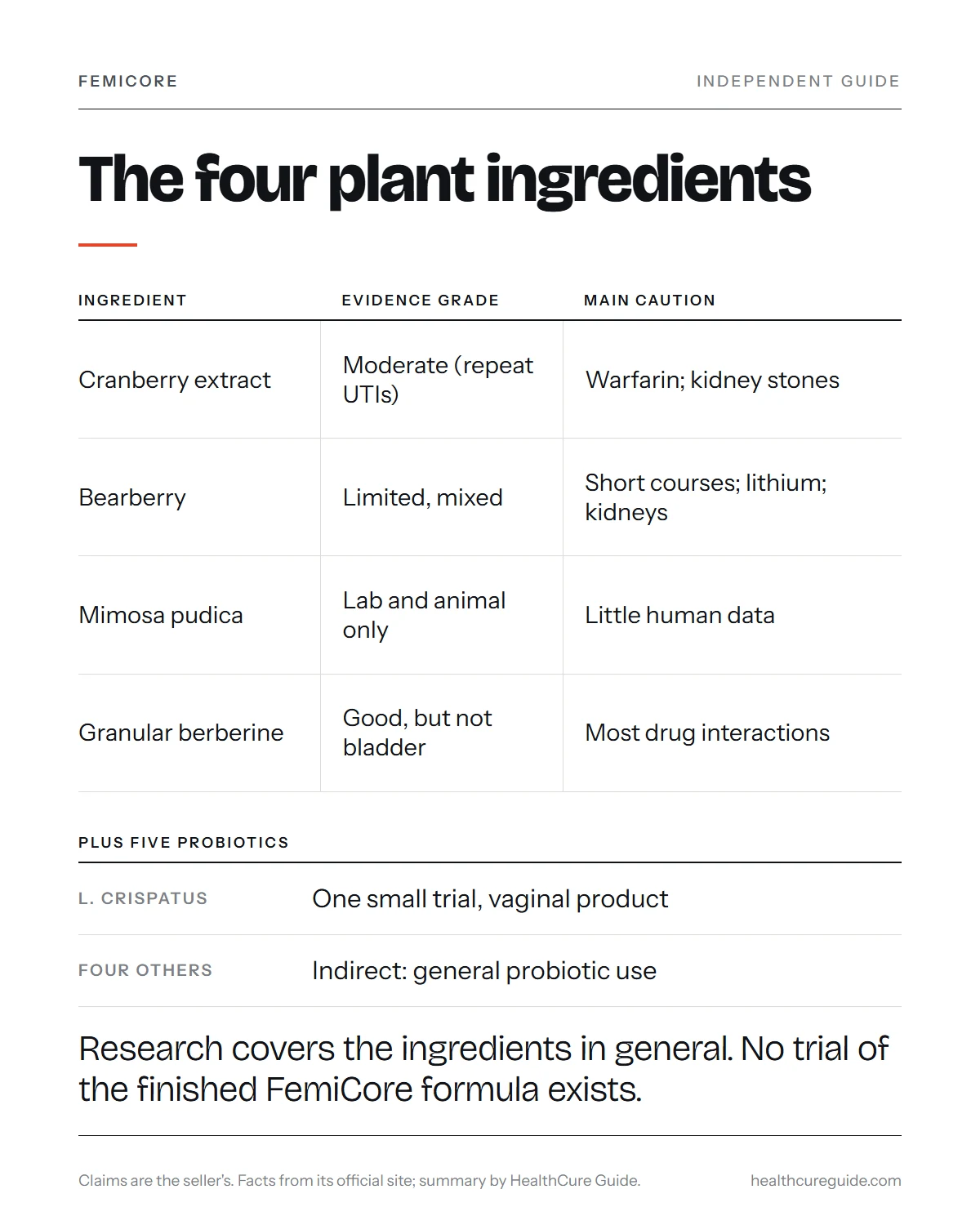
Cranberry extract
- Role: its A-type PACs reduce how well E. coli bacteria can attach to the lining of the urinary tract.
- Evidence grade: moderate, for repeat infections in women prone to them (2023 Cochrane review). Not studied for leaks or urgency.
- Main caution: case reports with warfarin, so INR monitoring matters; oxalate is a concern if you form kidney stones.
- Unknown here: PAC content.
Bearberry (uva ursi)
- Role: its arbutin becomes hydroquinone in urine, which kills bacteria in lab tests.
- Evidence grade: limited and mixed in people. Traditional use in Europe for mild lower urinary complaints, in short courses.
- Main caution: intended for about a week at a time, not months. Can cause nausea and harmless green-brown urine. Not for pregnancy, breastfeeding, kidney disease or children; interacts with lithium.
- Unknown here: arbutin content.
Mimosa pudica
- Role: the most likely candidate for “bladder control support”, based on antispasmodic reports.
- Evidence grade: lab and animal work only. No human trials for bladder symptoms. The thinnest of the nine.
- Main caution: little is known about its effects in people, which is a reason for care rather than reassurance.
- Unknown here: amount.
Granular berberine
- Role: not explained by the seller. Its human research covers blood sugar and cholesterol.
- Evidence grade: good for metabolic outcomes at roughly 1,000 to 1,500 mg a day; none we found for the bladder.
- Main caution: the most interaction-prone ingredient. It can drop blood sugar and possibly blood pressure, and it slows the CYP3A4 and CYP2D6 enzymes, so drugs like cyclosporine may build up. Unsafe in pregnancy and breastfeeding. Stomach upset is possible.
- Unknown here: dose.
Probiotic ingredient cards
Lactobacillus crispatus
- Role: the lead species for the “microbiome balance” claim.
- Evidence grade: one small placebo-controlled trial in which a vaginal L. crispatus product reduced repeat urinary infections. FemiCore is taken by mouth, and its strain is not named, so that trial supports the species choice, not this capsule.
- Main caution: the shared probiotic cautions below.
L. gasseri, L. acidophilus, L. plantarum, L. casei
- Role: round out the blend with familiar probiotic species.
- Evidence grade: indirect. These are well-known probiotics in general, but our sources hold no bladder research for any of the four.
- Main caution: the shared cautions below.
Shared probiotic cautions
- Early on, often in the first week or two, some people notice more gas or a bloated feeling.
- Stomach upset can happen.
- Rare infections have been reported in people with a severely weakened immune system. If that is you, ask your specialist first.
The probiotic half rests on the urinary microbiome idea: since about 2012, sequencing has shown that the female bladder has bacteria, and some studies found women with urgency incontinence had fewer Lactobacillus. It is early science. It does not show that swallowed probiotics change bladder symptoms.
Evidence grades in one view
| Ingredient | Our evidence grade | What the research measured |
|---|---|---|
| Cranberry extract | Moderate | Repeat urinary infections |
| L. crispatus | Early (one small trial) | Repeat infections, vaginal product |
| Bearberry | Limited, mixed | Urinary complaints, short courses |
| Berberine | Good, but off-target | Blood sugar and cholesterol |
| Four other Lactobacillus | Indirect | General probiotic use |
| Mimosa pudica | Lab and animal only | No human bladder data |
Two patterns stand out. The best-supported ingredients were studied for infections, not leaks or urgency. And the only ingredient with strong human data, berberine, was studied for something other than the bladder.
Personal check 1: allergies and diet questions
This is where our sources go quiet. The seller says the product is non-GMO and contains no stimulants. Beyond that, we found no published information about:
- what the capsule shell is made of
- whether any common allergens are present
- gluten or dairy content
- whether it suits vegetarians or vegans
That does not mean there is a problem. It means you cannot rule one out from the sales page. If you have a food allergy, a strict diet or a religious dietary rule, email the seller before ordering and keep the reply. When the bottle arrives, read the full panel on the label before taking the first capsule.
Personal check 2: medicines that clash
Hold your medicine list up against this table. Any match is a reason to speak to a pharmacist or doctor first.
| If you take | Ingredient to flag | Why |
|---|---|---|
| Diabetes medicine | Berberine | Can push blood sugar lower |
| Blood pressure medicine | Berberine | May lower blood pressure further |
| Cyclosporine or other drugs cleared by CYP3A4 or CYP2D6 | Berberine | Can raise drug levels |
| Warfarin | Cranberry | Case reports; INR checks |
| Lithium | Bearberry | Known interaction |
| Drugs that suppress the immune system | Probiotics | Rare infections if severely immunocompromised |
Conditions belong on the same list. Pregnancy and breastfeeding rule out berberine and bearberry. Kidney disease rules out bearberry, and a history of kidney stones is worth raising because of cranberry’s oxalate. The official site’s own caution points the same way: a physician should be consulted during pregnancy or nursing, alongside medication, or with any medical condition. Each caution is explained at length in the side effects write-up.
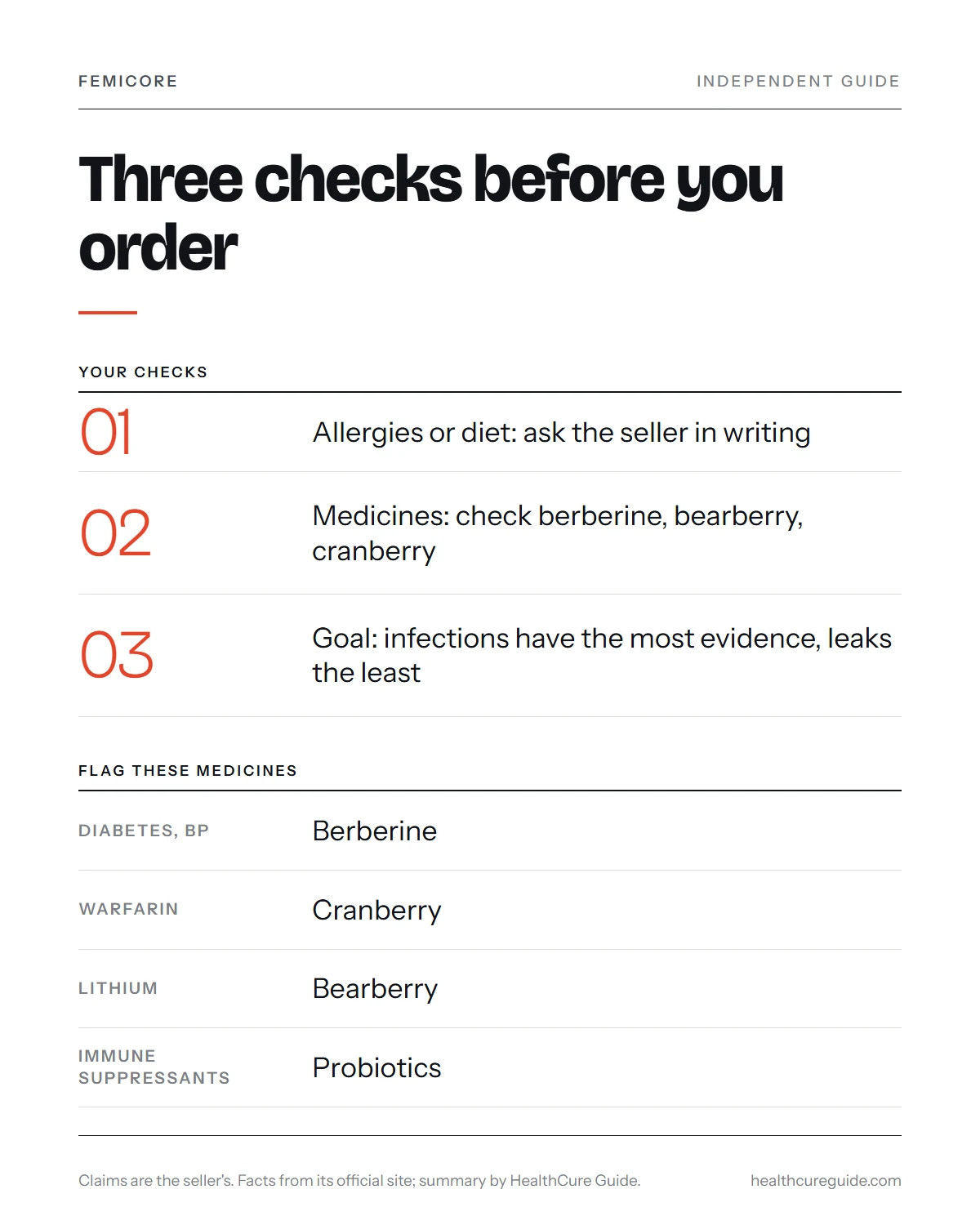
Personal check 3: which ingredient carries your goal
Match your reason for buying to the ingredient that would have to do the work.
- Repeat urinary infections. This is where the evidence is strongest, through cranberry and, more weakly, L. crispatus. The unknown PAC dose is the main gap.
- Urgency or leaks. The case rests on Mimosa pudica (lab and animal only) and the microbiome association. Expect the least from the research here.
- “Microbiome balance” in general. Five species, no strain codes, no count. Plausible, unverified.
If your main problem is new, painful or getting worse, the right first step is a doctor, not a capsule. That applies especially to blood in the urine, fever or chills, pain in the side, burning, or a sudden change in bladder control. In an older relative, confusion together with urinary symptoms also needs prompt medical attention.
Four common misreadings of an ingredient panel
A short list of names invites quick conclusions. These four come up often, and each one is worth correcting before you buy.
“Clinically researched” means the capsule was tested. It does not. The phrase on the FemiCore label refers to research on the ingredients in general. The cranberry, berberine and L. crispatus studies used other products at amounts their researchers chose.
“Natural” means it cannot clash with medicines. Berberine is a plant compound and still slows enzymes that clear many prescription drugs. Bearberry is a leaf and still has a lithium interaction. Where an ingredient comes from tells you little about how it behaves alongside a prescription.
Five probiotic species beat one. More names do not add up to more evidence. Without strain codes and a live count, five species are harder to judge than a single, fully identified strain would be.
An ingredient that works for infections works for leaks. Cranberry’s research is about repeat urinary infections. Urgency and leaks are different problems, and the ingredients aimed at them have the weakest support in this blend.
A five-minute checklist before you order
Tick each line before you buy.
- I know the doses are not on the label, and I am comfortable with that.
- My medicine list has been compared with the berberine, bearberry and cranberry rows.
- I am not pregnant or breastfeeding, and I do not have kidney disease.
- Any allergy or diet questions have a written answer from the seller.
- My goal matches what the evidence actually covers.
- I have no red-flag symptom that needs a doctor first.
- I know the refund rules: 60 days from the delivery date, every bottle returned with the packing slip, return postage paid by me.
If every box is ticked, you are buying with your eyes open. Prices, packages and our editorial score sit together on the FemiCore buyer guide. A plain introduction to the product is in what FemiCore is.
Our take on the nine
As a group, the FemiCore ingredients make sense together, and none is exotic. One carries real human evidence for a related problem, one has a short-course tradition, one is a lab-stage herb, one is borrowed from metabolic research, and five probiotics share one early idea. The missing doses and strain details are the price of entry. Check the three personal points above, and you will know whether that price is acceptable to you.
Common questions
Which two groups do the nine FemiCore components fall into?
Four are plant ingredients: Mimosa pudica, bearberry (uva ursi), cranberry extract and granular berberine. The other five are probiotic species from the Lactobacillus genus: crispatus, acidophilus, plantarum, gasseri and casei. Every capsule holds all nine together in one proprietary blend, and the label does not print the amount of any single ingredient.
Is FemiCore suitable for vegans or people with food allergies?
Our sources do not say. The seller describes the product as non-GMO and free of stimulants, but we found no statement about the capsule shell, allergens, gluten, dairy or vegan status. If any of those matter to you, ask the seller in writing before you buy and read the panel on the bottle when it arrives.
Which single ingredient has the most human research for urinary health?
Cranberry extract. In a 2023 Cochrane review, cranberry products cut repeat urinary infections for women who tend to get them. Two limits apply: the effect depends on the PAC dose, which FemiCore does not disclose, and the research measured infections rather than urgency or leaks.
Which ingredient should I mention first to my pharmacist?
Berberine. It can lower blood sugar, may lower blood pressure and slows the CYP3A4 and CYP2D6 enzymes that many medicines depend on. After that, mention bearberry if you take lithium or have kidney disease, and cranberry if you take warfarin. Take the bottle with you, since the doses are not printed and the pharmacist will want to see the label.
Are the probiotic species in FemiCore named down to the strain?
No. The label lists five species but no strain codes and no colony-forming unit count. Research on probiotics tends to apply to particular strains, so you cannot match FemiCore's bacteria to a specific study. The one urinary trial in our sources used a vaginal L. crispatus product, not a swallowed capsule.
Do any FemiCore ingredients have a limit on how long they should be used?
Bearberry does. European herbal regulators describe it for short courses of about a week for mild lower urinary complaints, not for continuous daily use. FemiCore is taken every morning, and the seller suggests at least 3 months. If you plan a long course, raise this with a doctor or pharmacist before starting.
Sources
- Williams G et al. Cranberries for preventing urinary tract infections. Cochrane Database Syst Rev. 2023.
- Stapleton AE et al. Randomized, placebo-controlled phase 2 trial of a Lactobacillus crispatus probiotic given intravaginally for prevention of recurrent urinary tract infection. Clin Infect Dis. 2011.
- Pearce MM et al. The female urinary microbiome: a comparison of women with and without urgency urinary incontinence. mBio. 2014.
- National Center for Complementary and Integrative Health. Uva Ursi.