Is FemiCore a Health Supplement? What Its Status Means
FemiCore is sold as a dietary supplement, and that single classification shapes almost everything about it: what the label is allowed to say, who checks it, and how much proof sits behind it. Understanding the category makes you a sharper reader of any supplement page.
- Written by
- HealthCure Guide Editorial Team
- Reviewed by
- HealthCure Guide Editorial Team
- Updated
- Reading time
- 8 min read
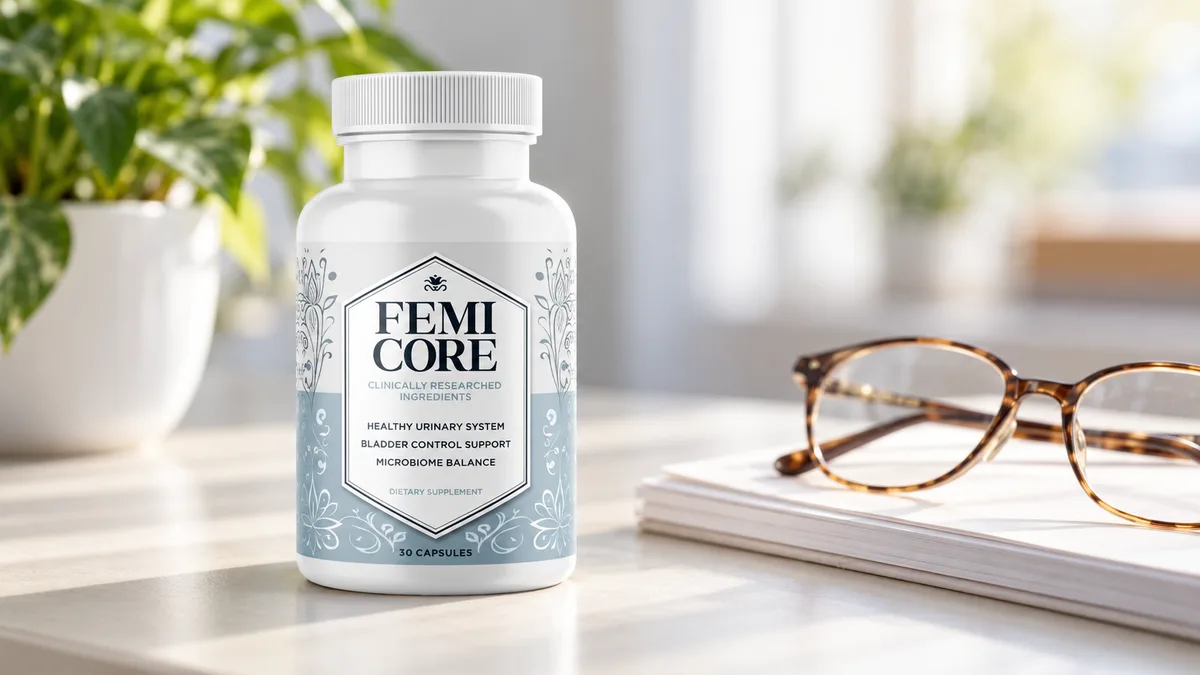
Is FemiCore a health supplement? Yes: it is sold as a dietary supplement, a legal category with its own rules in the United States. The question behind the question is usually “how much should I trust it?”, and the honest answer depends on knowing what that category does and does not guarantee. Most confusion online, including pages that call FemiCore “FDA approved”, comes from misunderstanding exactly this.
This guide explains the classification in plain terms. It is general information about how supplements are regulated, not legal or medical advice.
What “dietary supplement” means in law
In the US, dietary supplements are governed mainly by the Dietary Supplement Health and Education Act of 1994, usually shortened to DSHEA. It defines a supplement as a product taken by mouth that contains a “dietary ingredient” (a vitamin, mineral, herb or other botanical, amino acid, or substances such as probiotics and extracts) and is intended to supplement the diet.
FemiCore fits that definition squarely: it is a capsule containing four botanical ingredients and five Lactobacillus probiotic strains, taken once a day. It is therefore regulated as a food-type product, not as a medicine.
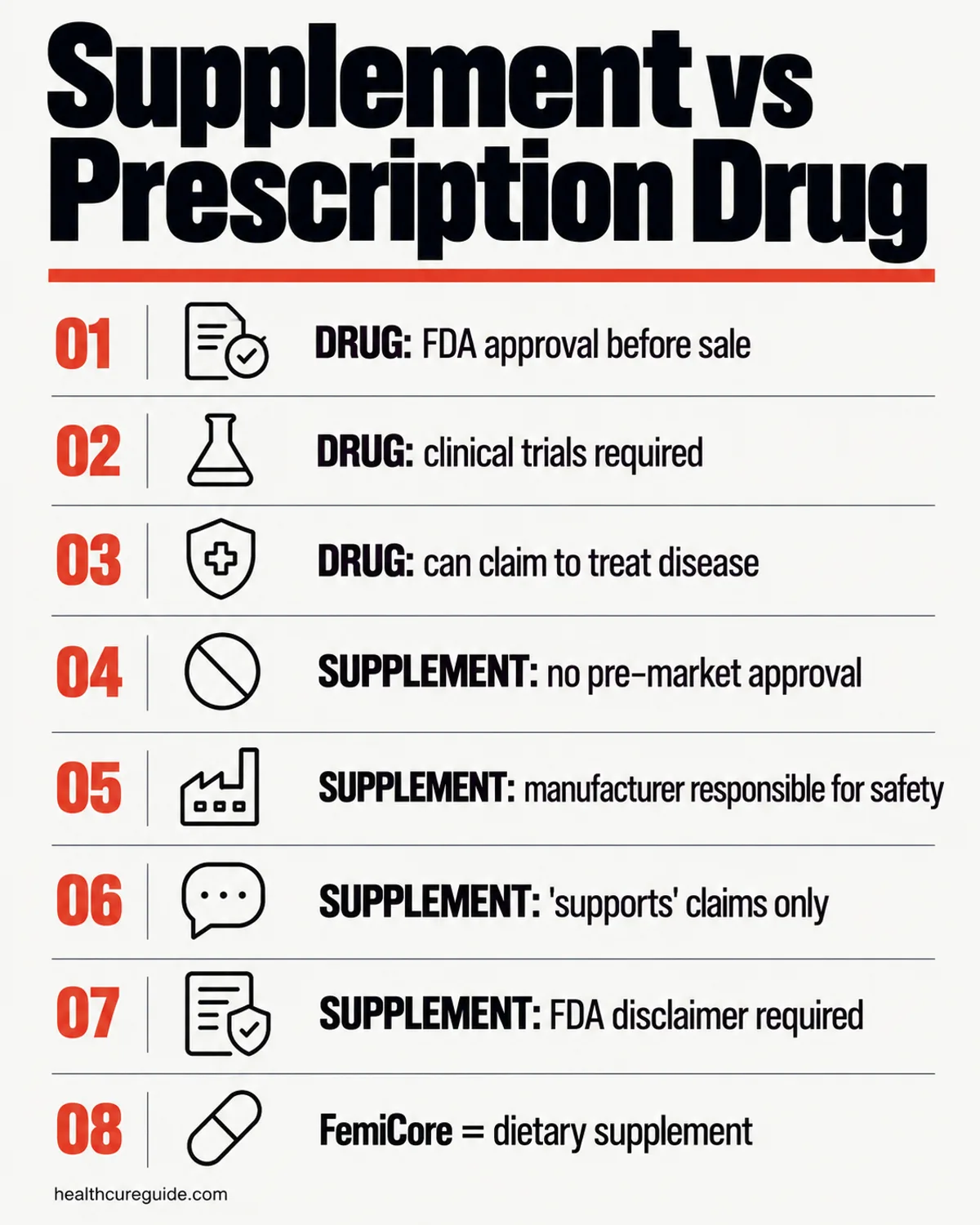
Is FemiCore a health supplement or a drug?
The difference is not about how strong a product feels or how serious the problem is. It comes down to what the product claims to do and how it reached the market.
| Prescription or OTC drug | Dietary supplement (FemiCore) | |
|---|---|---|
| Pre-market FDA review | Yes, safety and effectiveness | No |
| Clinical trials required before sale | Yes | No |
| Can claim to treat or prevent disease | Yes, for approved uses | No |
| Who is responsible for safety | Manufacturer, with FDA approval | Manufacturer |
| Typical label claim | “Treats overactive bladder” | “Supports bladder control” |
| FDA disclaimer on claims | Not required | Required |
So FemiCore can say it is designed to support bladder control and urinary health. It cannot say it cures incontinence, treats overactive bladder or prevents urinary tract infections, and a page that says so is going beyond what the law allows.
What the FDA does and does not do for supplements
This is where most of the misunderstanding lives.
What the FDA does not do
- It does not approve supplements before they are sold.
- It does not test each product for what it contains or whether it works.
- It does not review marketing pages before they go live.
What the FDA does do
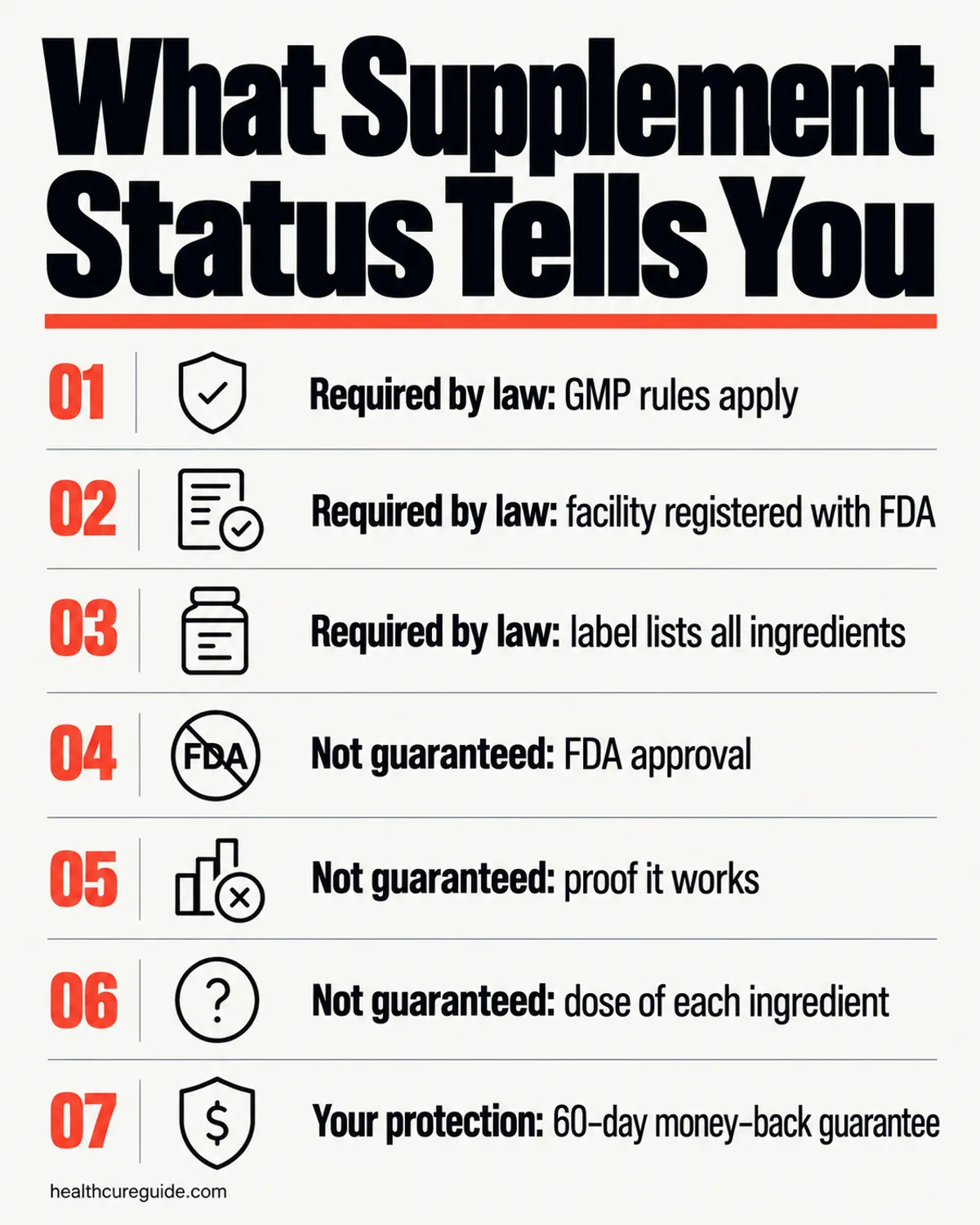
- It sets good manufacturing practice (GMP) rules that supplement makers must follow, covering things like identity testing, cleanliness and record keeping.
- It requires facilities that make food and supplements to register with it.
- It can inspect facilities, issue warning letters, and act against products that are unsafe, contaminated or misbranded, after they reach the market.
- It requires new dietary ingredients, those not sold before 1994, to be notified before use.
The Federal Trade Commission, separately, polices advertising claims, including claims on sales pages and in emails.
What “FDA-registered, GMP-certified” means for FemiCore
The manufacturer says FemiCore is manufactured in the USA with imported ingredients, in an FDA-registered, GMP-certified facility. Both phrases are meaningful, but in a narrower way than they sound.
- FDA-registered means the factory is on the FDA’s register of food and supplement facilities. Registration is a legal requirement, not an inspection result and not an endorsement of any product made there.
- GMP-certified means the facility claims to follow good manufacturing practice, which is required for all supplement makers. Some facilities are audited by independent certifiers; the sales page does not name one for FemiCore.
What neither phrase tells you is whether a finished FemiCore capsule contains the amount of each ingredient you might want, or whether it improves bladder symptoms. The label and the research have to answer those questions.
Structure/function claims and the FDA disclaimer
Supplements are allowed to make what are called structure/function claims: statements that a product supports a normal function of the body. “Supports bladder control”, “promotes urinary tract health” and “supports a balanced microbiome” are examples.
When a supplement makes such a claim, the label must also carry a disclaimer to the effect that the statement has not been evaluated by the FDA, and that the product is not intended to diagnose, treat, cure or prevent any disease. You will see this wording on FemiCore’s materials, as on any supplement. It is not a red flag in itself; it is the required signal that you are reading a supplement claim rather than an approved medical one.
What should worry you is the opposite: a FemiCore page that drops the disclaimer and uses disease language, such as “cures overactive bladder” or “replaces your bladder medication”.
How to read FemiCore’s label as a supplement
Supplement labels follow a fixed format called the Supplement Facts panel. For FemiCore, the key things to look for are:
- Serving size: one capsule.
- Servings per container: 30.
- The proprietary blend: a named blend with a total weight, followed by the nine ingredients. Labelling rules require blend ingredients to be listed in descending order of amount, so the first ingredient listed is present in the largest quantity, but individual weights are not given.
- Other ingredients: the capsule material and any fillers.
- The structure/function claims and the FDA disclaimer.
- Manufacturer or distributor details, which the law requires.
Our FemiCore supplement guide walks through the capsule, dose and label in more practical detail, and our FemiCore ingredients list explains what each of the nine does.
What supplement status means for your expectations
Knowing FemiCore is a supplement should shape how you approach it:
- Evidence is ingredient-level, not product-level. Cranberry and L. crispatus have human trial evidence for urinary tract health. The finished FemiCore capsule has not been tested in a published trial.
- Effects are likely to be gradual and modest. The seller advises using it for at least 3 months before deciding, which is typical for probiotic-based products.
- Safety still matters. “Natural” and “supplement” do not mean risk-free. Berberine interacts with several medicines, bearberry is meant for short courses, and cranberry may interact with warfarin. Our FemiCore side effects guide covers who should check with a doctor first.
- It is not a substitute for diagnosis. New, painful or severe urinary symptoms, blood in the urine or fever need a clinician, whatever supplement you are considering.
- The refund policy is your practical protection. Because no regulator has confirmed that it works, the 60-day money-back guarantee, which requires returning all bottles with the packing slip, is the real risk control for a buyer.
Four myths about FemiCore’s supplement status
“Made in an FDA-registered facility means the FDA checked it.” Registration is a listing. It says nothing about whether this product was reviewed, because supplements are not.
“If it were unsafe, it would not be allowed on sale.” Supplements can be sold without pre-market safety review. The FDA acts after problems are reported, which is why checking interactions yourself, with a pharmacist, matters.
“Supplements are too weak to cause side effects.” Some botanicals are pharmacologically active. Berberine, for example, has measurable effects on blood sugar and on how the liver handles medicines.
“A supplement cannot be legitimate if it makes health claims.” Supplements are allowed to make structure/function claims with the FDA disclaimer. The problem is only when a page crosses into disease claims such as “cures” or “treats”.
Keeping these straight helps you judge any bladder-support product, not just FemiCore, on what it can actually show.
Our view: is FemiCore a health supplement worth considering?
FemiCore is a dietary supplement in the full legal sense: legitimately sold, required to be safely made and honestly labelled, but not required to prove it works. That puts it in the same category as most products in the bladder-support aisle. The right way to treat it is as a reasonable, low-pressure experiment for suitable women, judged on your own symptom diary over two to three months, rather than as a medicine.
For the overall assessment of the formula, see our FemiCore reviews.
Common questions
Is FemiCore a health supplement?
Yes. FemiCore is sold as a dietary supplement, the legal category US law uses for vitamins, minerals, herbs, probiotics and similar products taken by mouth to supplement the diet. It is not a prescription or over-the-counter drug, and it has not been approved by the FDA to diagnose, treat, cure or prevent any condition.
Is FemiCore FDA approved?
No, and no dietary supplement is. The FDA does not approve supplements before they go on sale. The manufacturer says FemiCore is made in an FDA-registered, GMP-certified facility. Registration means the factory is listed with the FDA, which is a legal requirement, not a review or approval of the product.
What is the difference between a supplement and a drug?
A drug must prove it is safe and effective for a specific use in clinical trials before the FDA approves it. A dietary supplement can be sold without that pre-market review, as long as the manufacturer is responsible for its safety and its label does not claim to treat disease. Supplements can only make structure or function claims.
What is a structure/function claim?
A statement that a product supports a normal body structure or function, such as supporting bladder control or urinary tract health, rather than treating a disease. When a supplement makes one, the label must carry a disclaimer saying the statement has not been evaluated by the FDA and the product is not intended to diagnose, treat, cure or prevent any disease.
Who checks that FemiCore is safe?
Under US law the manufacturer is responsible for making sure a supplement is safe and correctly labelled before it is sold, and for following good manufacturing practice rules. The FDA can inspect facilities and act against unsafe or misbranded products after they reach the market, but it does not test each product beforehand.
Why does FemiCore list a proprietary blend?
Supplement labelling rules allow a proprietary blend to show its total weight and list ingredients in descending order of amount, without giving the weight of each one. FemiCore uses this format for its nine ingredients, so you can see what is in it but not how much of each.
Does supplement status mean FemiCore does not work?
No. It means the product has not had to prove it works before being sold. Some supplement ingredients have good evidence, others very little. For FemiCore, cranberry has the strongest human evidence for urinary tract health, while the finished product has not been tested in a published trial.