What Are the Benefits of FemiCore? Claims vs Evidence
FemiCore's sales page lists a handful of benefits for women with bladder urgency and leaks. We traced each one back to the ingredient that is supposed to deliver it, then labelled how much human evidence actually stands behind it.
- Written by
- HealthCure Guide Editorial Team
- Reviewed by
- HealthCure Guide Editorial Team
- Updated
- Reading time
- 8 min read
This guide contains affiliate links. If you buy through them we earn a commission at no extra cost to you. It does not change the verdict. Disclosure.
What are the benefits of FemiCore, once you strip away the sales language? It is a fair question, because the official page describes outcomes (calmer bladder, better nights, more confidence) without saying which of the nine ingredients is supposed to cause which change, or how sure anyone is that it does. This guide does that mapping for you.
For each benefit the manufacturer claims, we name the ingredient behind it, summarise the human research and give it one of four labels:
| Label | What it means here |
|---|---|
| Strong | Consistent results from systematic reviews or several randomised trials in people |
| Some | At least one decent human trial, or strong observational data, but not settled |
| Limited | Plausible mechanism, mostly lab or animal work, very little in people |
| Traditional only | Long history of use, no meaningful human trial evidence |
If you want the background on each ingredient first, our FemiCore ingredients list covers all nine.
What are the benefits of FemiCore? The short list
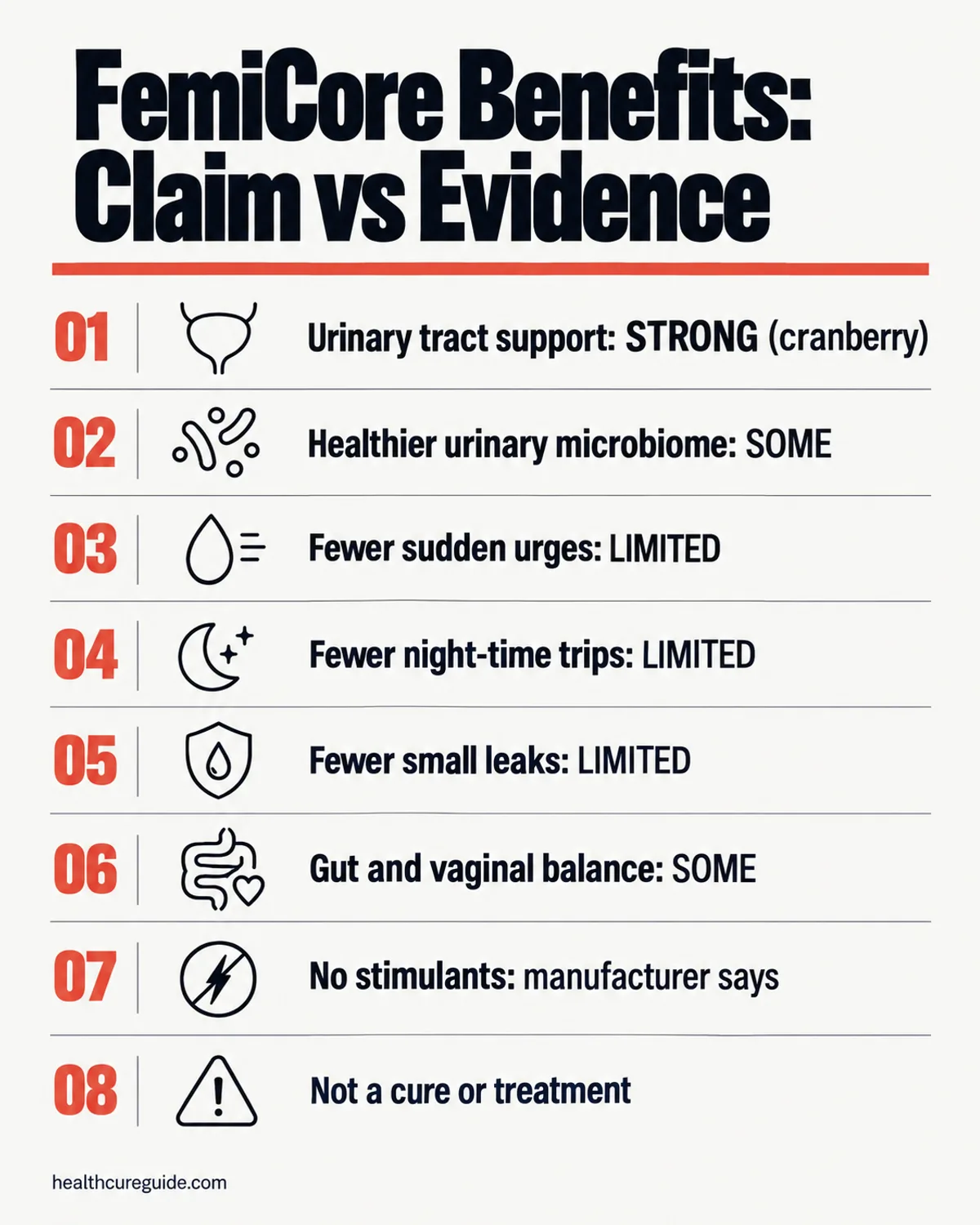
| Claimed benefit | Main ingredient(s) behind it | Evidence label |
|---|---|---|
| Everyday urinary tract support | Cranberry extract, bearberry | Strong (cranberry), traditional only (bearberry) |
| A healthier urinary microbiome | Five Lactobacillus strains | Some |
| Fewer sudden urges | Probiotics, Mimosa Pudica | Limited |
| Fewer night-time bathroom trips | Combination effect | Limited |
| Fewer small leaks with coughs or lifting | No specific ingredient | Limited |
| Gut and vaginal balance | Lactobacillus strains, berberine | Some |
| No drug-style side effects | Formula design | Some, with exceptions |
The pattern is clear. The further a benefit sits from infection prevention and the closer it sits to “bladder control”, the thinner the evidence becomes.
Benefit 1: everyday urinary tract support
Behind it: cranberry extract and bearberry (uva ursi). Evidence label: strong for cranberry, traditional only for bearberry.
This is the best-supported benefit on the list. Cranberry contains proanthocyanidins, compounds that make it harder for E. coli to stick to the lining of the urinary tract, so bacteria are more likely to be flushed out. The 2023 Cochrane review pooled 50 trials and concluded that cranberry products reduce the risk of repeat urinary tract infections in women who get them often.
Two caveats matter. First, that is evidence about infections, not about urgency or leaks. Second, the trials that worked used known doses, and FemiCore does not publish how much cranberry is in a capsule.
Bearberry has a long European history as a urinary remedy, but the human trial evidence is thin and it is usually recommended for short courses only. It adds tradition to the formula more than proof.
Benefit 2: a healthier urinary microbiome
Behind it: Lactobacillus crispatus, L. gasseri, L. acidophilus, L. plantarum, L. casei. Evidence label: some.
This is the idea FemiCore is built around. Research since 2012 has shown the bladder has its own bacterial community, and a 2014 study found women with urgency incontinence tended to have less Lactobacillus in it than women without symptoms.
The closest thing to a test of the “add good bacteria” approach is a 2011 randomised trial of L. crispatus given as a vaginal suppository to women with recurrent urinary tract infections: recurrence was 15 percent with the probiotic against 27 percent with placebo. That is encouraging, but it used one specific strain, by a different route, for infection rather than bladder control. FemiCore’s strains and doses are not specified.
So “supports a healthier urinary microbiome” is a reasonable description of the intent. Whether an oral capsule changes your bladder’s bacteria enough to matter has not been shown.
Benefit 3: fewer sudden urges
Behind it: the probiotics, plus Mimosa Pudica. Evidence label: limited.
Urgency is the benefit most women buying FemiCore care about, and it is where the evidence becomes most indirect. The reasoning goes like this: a bladder with an unbalanced microbiome may be more irritable, an irritable bladder sends earlier and stronger “go now” signals, and restoring balance might calm those signals. Each step is plausible. None has been tested end to end.
Mimosa Pudica is included for its traditional use in calming irritation and smooth muscle. Its support comes from traditional medicine and laboratory work, not human bladder studies.
A realistic reading: if urgency improves, it is more likely to be a gradual softening over several weeks than a sudden change.
Benefit 4: fewer night-time bathroom trips
Behind it: no single ingredient; it is presented as a combined effect. Evidence label: limited.
Fewer night-time trips is often the first change customers mention, which is why the manufacturer gives it prominence. It is also one of the hardest benefits to attribute to a supplement, because night-time urination is affected by so many things: when you drink, caffeine and alcohol, sleep quality, blood sugar, heart and kidney health, and some medicines.
If it improves while you take FemiCore, the capsule may be part of the reason, or a change in evening habits may be. Keeping a simple diary of night trips before and during use is the only way to tell. A new or worsening pattern of night-time urination deserves a medical check rather than a supplement.
Benefit 5: fewer small leaks
Behind it: no specific ingredient. Evidence label: limited.
Leaks fall into two broad types. Urgency leaks happen when the urge arrives too fast to reach a toilet; stress leaks happen with coughs, sneezes, laughs or lifting, because pressure overwhelms the pelvic floor. If FemiCore helps urgency, urgency leaks could follow. Stress leaks are a mechanical problem, and no ingredient in the formula strengthens muscle.
For stress leaks, pelvic floor training has far stronger evidence than any supplement, and it is free. Many women combine both.
Benefit 6: gut and vaginal balance
Behind it: the Lactobacillus strains and berberine. Evidence label: some.
The five probiotic species are common in women’s probiotic products for vaginal and digestive health, and L. crispatus and L. gasseri are among the species most often found in a healthy vaginal microbiome. Berberine has well-documented effects on gut bacteria and inflammation signalling in research reviews. A benefit to gut or vaginal comfort is plausible as a side benefit, though FemiCore is not marketed or tested for it.
Benefit 7: no drug-style side effects
Behind it: formula design. Evidence label: some, with exceptions.
The manufacturer stresses that FemiCore contains no stimulants and does not act on nerve signals the way anticholinergic bladder drugs do, which is why it does not bring their typical dry mouth or constipation. That comparison is fair. It does not mean the formula is free of risk: berberine interacts with several medicines, bearberry is a short-course herb, and cranberry can interact with warfarin. The full picture is in our FemiCore side effects guide.
What the benefits of FemiCore do not include
It is just as useful to be clear about what the formula is not designed to do, so expectations stay realistic:
- It is not a treatment for urinary tract infections. Burning, fever, side pain or blood in the urine need a clinician, not a supplement.
- It does not replace pelvic floor training, bladder training or prescribed treatment.
- It is not tested for overactive bladder as a diagnosis.
- It does not work quickly. The seller itself advises using it for at least 3 months before deciding.
- It does not tell you its doses, so you cannot compare it with the amounts used in research.
How to tell whether you are getting the benefits
Because most of these benefits are subjective and gradual, the only way to judge them fairly is to measure before and during:
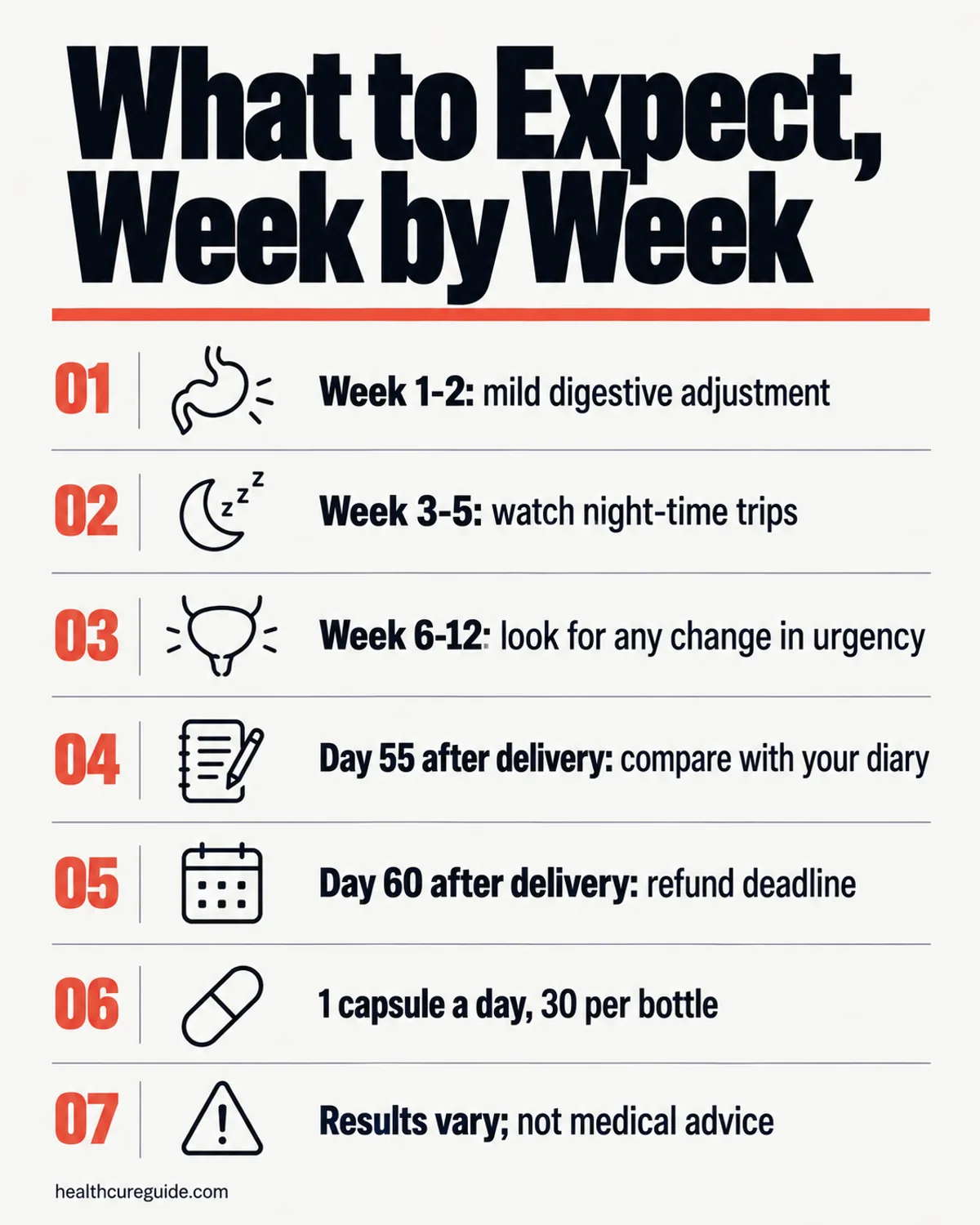
- Keep a three-day baseline diary before your first capsule: daytime trips, night-time trips, urgent moments, leaks.
- Take one capsule every morning with water. Consistency matters more than timing.
- Repeat the diary at week 4 and week 8. Look for a meaningful drop, roughly a third or more, in the symptom that bothers you most.
- Decide by day 55. If the numbers have not moved, the 60-day guarantee lets you return all bottles, opened or not, with the packing slip.
For a more detailed look at whether the overall product delivers, see our evidence check on whether FemiCore really works, and for the full analysis, our FemiCore reviews guide.
Our take on the benefits of FemiCore
The benefits FemiCore claims are coherent and sit on real research, but they are stacked on increasingly indirect evidence the further they get from infection prevention. Urinary tract support is the most credible, microbiome balance is promising, and bladder control itself is untested in this product. That makes FemiCore a reasonable experiment for a woman with mild to moderate urgency who wants a non-drug option and is willing to track her symptoms, and a poor choice for anyone expecting a quick or certain fix.
The information on this page is general and is not medical advice. If your symptoms are new, painful or getting worse, see a clinician first.
Common questions
What are the main benefits of FemiCore?
The manufacturer says FemiCore is designed to support bladder control, fewer sudden urges, fewer night-time bathroom trips, a balanced urinary microbiome and everyday urinary tract comfort. Those are support claims, not treatment claims. The ingredient with the strongest human evidence is cranberry, for lowering the risk of recurrent urinary tract infections. Evidence that the finished product reduces leaks has not been published.
Which FemiCore benefit has the best evidence?
Urinary tract support from cranberry. A 2023 Cochrane review of 50 trials found cranberry products reduce the risk of repeat urinary tract infections in women who get them often. FemiCore does not disclose its cranberry dose, so it is not possible to say whether a capsule matches the amounts used in those trials.
Does FemiCore help with night-time urination?
Fewer night-time trips is one of the benefits the manufacturer highlights, and it is the change customers most often mention. No study has tested FemiCore for this. Night-time urination has many causes, including fluid timing, sleep problems, diabetes and some medicines, so a new or worsening pattern is worth discussing with a clinician.
Can FemiCore cure incontinence or overactive bladder?
No. FemiCore is a dietary supplement, and supplements are not allowed to claim they cure or treat a disease. The manufacturer says it is designed to support bladder control. Pelvic floor training, bladder training and prescription treatments have much stronger evidence for incontinence and overactive bladder.
How long before the benefits of FemiCore show?
The seller advises using it for at least 3 months before deciding. In our view 8 to 12 weeks of daily use is a realistic window, which fits how slowly probiotic and microbiome changes tend to happen. Mild digestive changes can appear in the first week. Judging the product earlier than about two months is likely to give a misleading answer either way.
Are FemiCore benefits backed by clinical trials?
Some of its ingredients are, the finished product is not. Cranberry and Lactobacillus crispatus have randomised trial evidence for urinary tract infections, and research on the bladder microbiome supports the general idea. Mimosa Pudica and bearberry rest mainly on traditional use. No trial of FemiCore itself has been published.
Do the benefits depend on the package I buy?
No. Every package contains the same capsules. The only difference is how long the supply lasts: 60, 90 or 180 days. Because benefits, if any, build over 8 to 12 weeks, a supply shorter than about two months makes a fair judgement difficult.
Sources
- Williams G et al. Cranberries for preventing urinary tract infections. Cochrane Database Syst Rev. 2023.
- Stapleton AE et al. Randomized, placebo-controlled phase 2 trial of a Lactobacillus crispatus probiotic given intravaginally for prevention of recurrent urinary tract infection. Clin Infect Dis. 2011.
- Pearce MM et al. The female urinary microbiome: a comparison of women with and without urgency urinary incontinence. mBio. 2014.
- Habtemariam S. Berberine pharmacology and the gut microbiota: a hidden therapeutic link. Pharmacol Res. 2020.
- National Center for Complementary and Integrative Health. Uva Ursi.